Product Managers shouldn't use AI for these 10 things
When AI speeds up drafting, product managers must still own vision, priorities, safety, customer decisions, and confidential data.

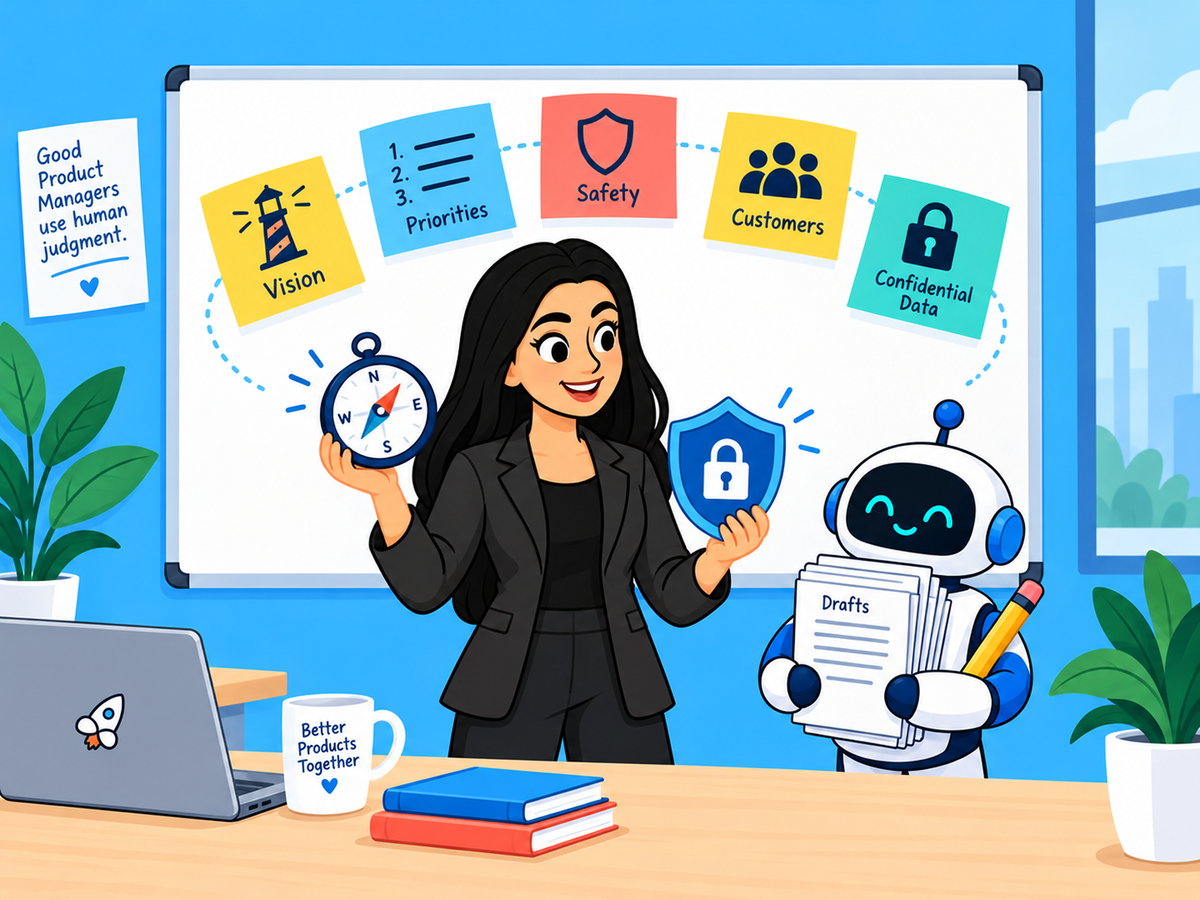
I use AI to prepare work, not to make calls that affect customers, teams, or safety. My rule is to check the original records, name the human decision-maker, and get approval before acting.
These 10 responsibilities stay with people:
- Product vision: I own the direction, not the model.
- Final priorities: I weigh trade-offs before committing the team.
- Customer conversations: I lead the listening and follow-up.
- Demand validation: I check what customers do - not just what AI predicts.
- Ethical trade-offs: I involve the right people to review harms and access.
- Safety-critical releases: I require a qualified human’s sign-off.
- Employee reviews: I check the record and hear the employee’s side.
- Stakeholder commitments: I confirm capacity and approvals before promising dates.
- Sensitive conflicts: I keep listening and conflict resolution human-led.
- Confidential data: I use only tools approved for the data and task.
Before relying on an AI workflow, I also test it against manually reviewed cases. That helps me check its work and does not give it permission to make decisions.
AI can draft the plan. People still own the decision.
AI Risks in Product Development: When Your Tools Start Thinking For You
What AI Changes - and What Humans Still Own
Before AI, PMs sorted research by hand, maintained scoring sheets, and built workshop materials. Now, AI can group feedback, draft specs, model scenarios, and analyze usage data. The work shifts from producing documents to checking evidence and weighing trade-offs. Faster output helps only if it improves the decision. AI can prepare the work, but it doesn’t own the decision.
A RICE score - reach, impact, confidence, and effort - can now be grounded in monthly active users and historical sprint data rather than estimates alone. But the ranking still depends on assumptions a PM must check. AI can prepare workshop options, but people still need to weigh competing goals and resolve disagreements. [2][7]
The first boundary is vision: AI can inform it, but it can’t set it.
The rule is simple: polished output doesn’t mean ownership. Fluency proves neither accuracy nor authority. A polished analysis isn’t verified evidence. A prediction isn’t proven demand. And a recommendation isn’t a decision. The PM stays accountable for the decision and its consequences.
Keep a manually reviewed test set and define acceptance thresholds before relying on AI outputs. Document failure patterns to protect trust and high-stakes decisions. [1][5]
A tool that drafts useful summaries has not automatically earned permission to recommend pricing changes or trigger account deletions. Those uses need separate approval gates. [1][5]
Expand AI use only when controls are explicit. Document approved data, allowed actions, stopping conditions, and the named human owner. Those boundaries can expand, but only after explicit review and human sign-off. [1][2][3][5]
1. Setting product vision
A popular feature isn’t always the right direction. AI can give too much weight to the loudest signals in the data. That can push teams to expand what already works and miss a customer problem that matters more - and better fits the company’s strategy. Outliers expose assumptions that summaries hide. [1] That’s why people must own the vision, even when AI brings the inputs together.
Before asking AI for options, write the problem statement yourself: Who are we serving, what problem matters, and why should this company solve it? Let AI synthesize research and compare scenarios, but keep responsibility for the direction. [2]
The Product Manager should document customer evidence, fit with company strategy, rejected alternatives, and who makes the final call. Model confidence can inform the discussion, but it should never replace the reasoning behind the direction. [1][2]
2. Making final prioritization decisions
Once the vision is set, prioritization determines what the team ships next. A higher feature score doesn’t outweigh a reliability obligation. AI can rank loud requests too highly while giving too little weight to churn risk or contractual obligations. Before accepting its ranking, check renewal risk, incident history, and contract requirements. The PM must weigh reliability, contractual risk, and strategy before committing. [1][2][5]
AI can group requests and flag dependencies, but the PM still owns the trade-off. Check the math, especially when inputs mix monthly and annual revenue. Use AI to spot weak assumptions - not just polish the roadmap. [7][10][11]
Keep a decision record: why reliability work overrides the higher score, what will not ship this cycle, and what evidence would change the decision. [2][3]
Require human review before changing final roadmap commitments. The PM owns the final call and the consequences. A ranking can sort the backlog, but it cannot replace direct customer conversations about why the demand exists.
3. Speaking directly with customers
A permissions screen can hide both usability friction and trust concerns that both get labeled onboarding friction. Read the raw comments, especially the outliers. [5][1]
Direct interviews help you hear that difference. Tone, hesitation, and follow-up questions bring out details that summaries miss. Fixing usability problems doesn’t tell you whether customers have trust concerns.
Ask what customers expected, what confused them, and why they hesitated. Listen for surprise and resistance, then ask follow-up questions rather than accepting a summary as the customer’s meaning. Leave room for concerns your interview guide didn’t cover.
AI can prepare the guide, transcribe interviews in approved tools, and increasingly group and tag themes afterward. [10][7][9] Ask it to flag contradictory feedback separately, then check important findings against the original transcript. [3][1]
AI can help with preparation and organization; humans must lead the listening, probing, and trust-building. The PM owns customer understanding, the interview, and follow-up.
4. Validating demand with customer evidence
Customer interviews show what people say. Experiments show what they do. A convincing business case isn’t proof of demand.
If AI predicts strong demand but prototype tests show customers won’t change workflows, stop the build. Don’t let a forecast outweigh observed behavior. [2][7]
Synthetic personas, simulated interviews, and forecasts can help form hypotheses. They can’t prove that customers will adopt a product or pay for it. Set your evidence threshold before testing, and judge demand by customer behavior - not model output. [2][7][8]
In 2026, B2B SaaS PM Serhii Kibitkin used AI to calculate revenue losses from Atlassian Marketplace customer downgrades in 15 minutes, down from five hours. He accepted the findings only after checking the calculation logic and comparing them with insights from live customer demos. [7]
Before AI, PMs built prototypes and analyzed customer results manually. Now, AI can generate hypotheses, draft experiments, and analyze results faster. Ask it where an idea could fail, not just why you should build it. As AI improves, the human PM still decides whether the evidence supports investing. [3][7][2]
5. Deciding ethical trade-offs
Real demand doesn’t make every rule fair. Higher conversion doesn’t justify excluding customers.
An eligibility rule might block people with disabilities or spotty internet access.
A conversion forecast is not an ethical judgment. A human must make the call.
Use AI to map possible harms and compare policy options - not approve them. Read outlier feedback manually, since summaries can hide signs of exclusion. Use only approved, anonymized data.
Bring in experts from accessibility, engineering, data, legal, and privacy/compliance. Weigh privacy, equal treatment, access, and risk. Document which groups are affected, options that exclude fewer people, a manual fallback, and the human approver.
Before AI, teams relied on manual audits and fixed rules. AI now speeds up analysis, but humans still own decisions about bias and drift. Automate monitoring, not the ethical trade-off.
6. Approving safety-critical releases
Safety sets a higher bar: a release can meet compliance requirements and still be too risky to ship. Passing automated tests does not mean a safety-critical release is ready. Tests cover only the cases they were designed to check, and polished AI output can hide dangerous errors. AI can help with testing and summaries, but it cannot approve risk.
Use AI to generate test cases, flag anomalies, and draft defect summaries. Keep the supporting evidence available for human review. A reference set of known cases, including edge cases, can help catch failures, but it does not replace clinical validation. [5][1]
If a reviewer finds a dangerous edge case, pause the release immediately and escalate it to the named product, engineering, and safety owners. Engineering fixes the issue and adds a regression test. The safety reviewer then confirms that the risk has been addressed. Require documented approval gates and qualified human sign-off. The PM coordinates the process, but the release decision belongs to the designated, qualified human approver - not the PM alone.
Earlier workflows relied on fixed acceptance tests. AI-enabled workflows also need checks for changing outputs and degraded performance. Before release, record each owner’s name, the escalation path, monitoring triggers, and a rollback or safe fallback plan.
7. Evaluating employee performance
After release decisions comes another firm boundary: decisions about people. Ticket counts and online activity leave out work, so AI can turn incomplete records into a misleading review. AI can organize the evidence, but a human must judge the person. [1][5]
Use AI only to organize documented goals and manager notes in approved systems. Keep each summary traceable to its source. Don’t ask AI to assign ratings, rank employees, or recommend promotions or disciplinary action. Those decisions belong to an authorized manager.
Before finalizing a review, the PM acting as manager should hear the employee’s side. What work went unrecorded? Which priorities changed? What blocked delivery? Check AI summaries for unsupported claims, missing contributions, and bias. Then compare the employee’s explanation with the record before drawing conclusions.
Give employees a clear way to correct inaccurate or incomplete evidence before the review is final. Label AI-assisted summaries, record corrections, and require manager approval. Career decisions stay human-owned. [3][9] The same rule applies to stakeholder promises: AI can draft the update, but only the PM can make the commitment.
8. Making commitments to stakeholders
Once the team makes its internal decisions, external commitments still need human approval. A plausible launch date is not an approved promise. Missing engineering time off or a required security review can block a release, overcommit the team, and break stakeholder expectations. [1][3]
Before AI, PMs checked calendars and dependencies before sharing dates. Those checks still matter. AI can draft updates and model schedule scenarios using the release scope, time off, and approval gates. But you still need to check its output against team calendars and the security review checklist. [10][4][1]
Have Engineering validate capacity and the order of work, and have Security confirm its review window. If the forecast doesn't hold up under those constraints, use AI to test alternatives and failure cases. Then adjust the scope or timing - don't skip the review. [1][6][3][4]
Share the target window, unresolved dependencies, and next checkpoint - not a guaranteed date. Label dates and external commitments draft until the relevant owners sign off. [1][8]
9. Resolving sensitive team conflicts
Missed commitments and mismatched expectations can lead to conflict. A process fix cannot repair damaged trust. AI may frame a dispute as an ownership problem and miss what's underneath. Read the original messages before drawing conclusions: direct conversations can reveal what a summary leaves out. [1][5][10]
Keep live listening and facilitation human-led. AI can draft neutral questions using anonymized details, but follow company policy first. Remove names and any details that could identify someone indirectly. [7]
Listen privately before suggesting a joint discussion. Ask what happened, how it affected the person, and what needs to change. Account for power dynamics. AI can't read team dynamics or handle company politics. The PM must judge how to guide the conversation safely rather than simply bring everyone together. [7][10]
Do not let AI mediate or assign blame. Use it to check your assumptions or prepare talking points - not to decide whose account to believe. Protect confidentiality throughout. AI's role stops at preparation; people must handle listening, facilitation, and responses. [10] Apply that same boundary whenever AI touches private information.
10. Keeping confidential data out of unapproved AI tools
Moving fast doesn’t give a PM permission to put data into an AI tool.
A PM who pastes identifiable support tickets into an unapproved tool to summarize onboarding problems can expose customer information, break customer trust, and violate company policy. [1][9]
Confidentiality covers both team conversations and customer data. Customer records, credentials, private contracts, unreleased financial information, and identifiable support tickets must stay out of unapproved AI tools. [1][9]
Removing identifiers is not the same as getting approval. Data-use rules, data-retention rules, and contractual limits still apply. [1]
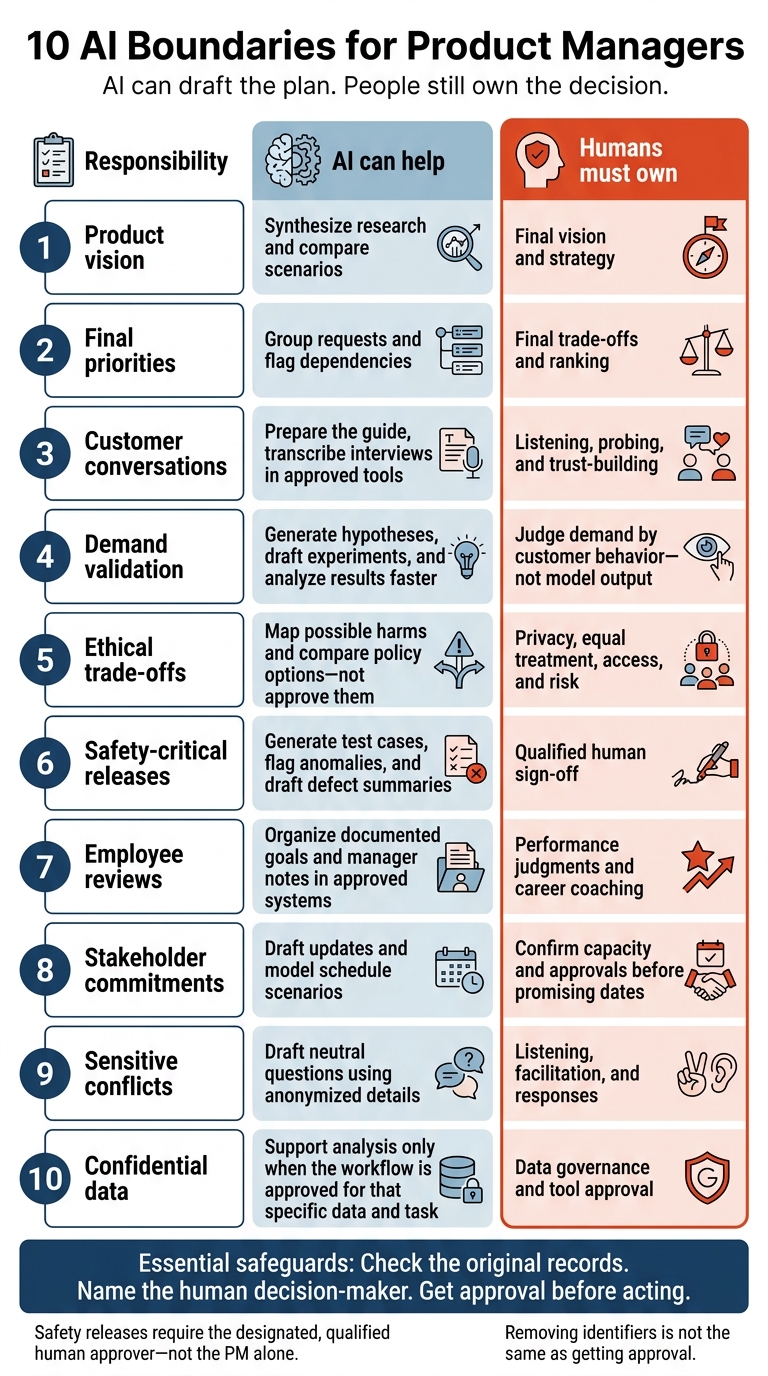
Use AI for support analysis only when the workflow is approved for that specific data and task. It must include the required access controls, data-retention rules, and contractual protections. Share only the minimum data needed, leaving out unnecessary sensitive details. [1][7] The quick reference below separates AI assistance from approval that remains a human responsibility.
The PM owns the decision to use customer data and must get approval from Security, Privacy, or Legal. [9] If approval is unclear, stop until Security, Privacy, or Legal signs off.
Quick Reference: AI Assistance and Human Ownership
AI prepares; humans decide. Use this table to review the ten boundaries and keep ownership with people, even when AI speeds up drafting.
Responsibility | AI can help with | Human owns | Main risk |
|---|---|---|---|
Setting product vision | Modeling scenarios and drafting strategy memos | Final vision and strategy | Evidence failure |
Making final prioritization decisions | Estimating impact and drafting RICE scores | Final trade-offs and ranking | Evidence failure |
Speaking directly with customers | Transcribing interviews and summarizing calls | Live customer interaction | Damaged relationships |
Validating demand with customer evidence | Grouping feedback | Checking raw inputs against actual customer behavior | Evidence failure |
Deciding ethical trade-offs | Generating failure cases and flagging potential bias | Ethical guardrails and moral judgment | Unfair judgments |
Approving safety-critical releases | Drafting acceptance criteria and testing guardrails | Final safety sign-off | Unsafe releases |
Evaluating employee performance | Organizing documented review evidence | Performance judgments and career coaching | Unfair judgments |
Making commitments to stakeholders | Drafting updates and timeline models | Commitment and trust | Broken commitments |
Resolving sensitive team conflicts | Recording action items and summarizing transcripts | Guiding conflict resolution | Lost trust |
Keeping confidential data out of unapproved AI tools | Anonymizing data and identifying PII | Data governance and tool approval | Privacy exposure |
Before AI output becomes a decision, roadmap commitment, or external message, name the human reviewer and add an approval gate.
Conclusion: Check Who Owns the Decision
Use these checks to see whether AI is helping with your work or making the decision for you. Before delegating, ask five questions:
- Does this call for a value judgment or an irreversible trade-off?
- Could it affect rights, safety, employment, privacy, or trust?
- Does it need empathy, negotiation, or a continuing relationship?
- Has the evidence been verified, or is it only AI-generated or summarized?
- Is a named human authorized and accountable for the outcome? [1][3][7]
Base decisions on raw evidence - not polished summaries. Check outliers and calculation logic. Keep 50 to 100 reference cases and use them to manually test whether an AI workflow handles your actual tasks and catches errors before they reach stakeholders. [1][5]
Require approval before pricing changes, legal disclosures, or account deletions. [1][3]
Name the approver and spell out when action must pause. Before proceeding, send exceptions involving privacy, safety, or disputed evidence to the right owner. Use the NIST AI Risk Management Framework to structure governance, and put those rules in writing so the boundary stays clear. [1][3]
Assign decision ownership to a person whenever a choice changes trust, risk, or accountability. AI can draft; the named human remains responsible for the decision.
FAQs
How do I set acceptance thresholds for AI outputs?
Treat AI adoption like a product rollout. Set evaluation criteria and success metrics before handing off tasks. Use a golden set of 50 to 100 test cases to measure performance and catch errors before they reach stakeholders.
Review outliers and edge cases manually. Check outputs against documented quality rubrics and business constraints. Every AI output is a draft that needs human approval. Use challenge prompts to test for flaws, weak logic, and missing context.
How can I prevent human review from becoming a rubber stamp?
Treat AI outputs as proposals, not final answers. Before you publish or act, test the logic, challenge weak assumptions, and verify outlier data yourself [2][1]. Check outputs against a reference set of 50 to 100 cases to catch errors before they reach stakeholders [1].
Do the hard thinking first: frame the problem and review the raw research. Then use AI to sharpen your draft - not to replace your judgment in the decision [2][1].
When should I retest an approved AI workflow?
Retest an approved AI workflow when outside factors or market conditions change, poor recommendations call for retraining, or results create friction or distrust [1][3].
After each model release, review your backlog for features that are now faster or cheaper to build [2]. Set aside 20% to 30% of roadmap capacity for monitoring model drift and retraining [1]. When issues arise, retest promptly: value comes from repeated feedback, not a static file [3].
If you’re finding this blog valuable, consider sharing it with friends, or subscribing if you aren’t already. Also, consider coming to one of our Meetups and following us on LinkedIn ✨ And check out our official website.
Connect with the founder on LinkedIn. 🚀
About the Product Management Society
The Product Management Society is an international community for product managers, founders, designers, and career-switchers, with 2,400+ members across active chapters in Lisbon, Berlin, Frankfurt, and Mexico City. The community runs more than 50 in-person meetups per year, a Slack network, an invite-only WhatsApp group, a blog, and a growing suite of free tools for product leaders. More information is available at www.productmanagementsociety.com.
About Gabriela Naumnik
Gabriela Naumnik is an AI product leader and the founder of the Product Management Society. A Staff Product Manager working at the intersection of AI and enterprise product, she focuses on AI-powered platforms serving Fortune 500 companies. She is a regular speaker at product conferences, publishes on product management at the Product Management Society's blog, and has built the PM Society into one of the most influential product communities in Europe and Latin America. She holds a B.S. from NYU/NYU Shanghai and an M.S. from Columbia University. More information is available at gabriela-naumnik.com and https://www.linkedin.com/in/gabrielanaumnik.