How AI changed the product manager and product designer dynamic in 2026
AI accelerates PM-designer collaboration but not decision rights; share discovery, test drafts, and name owners.

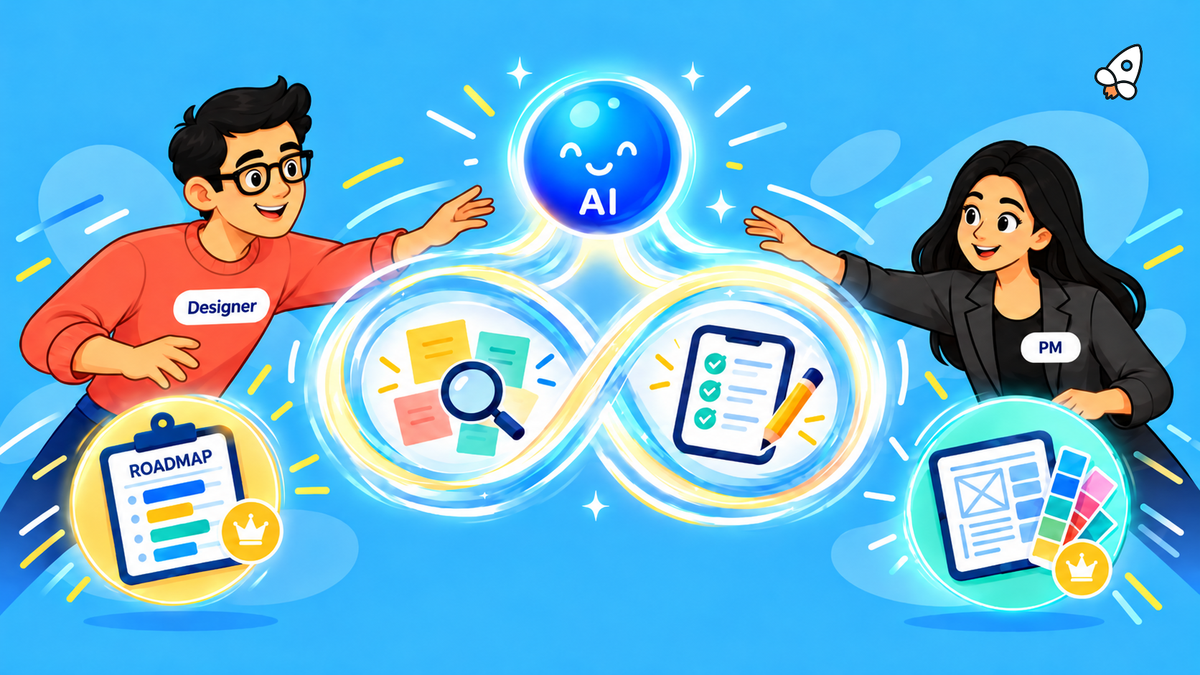
AI brings PMs and designers together earlier. It doesn’t give them the same job. Here's what I recommend: review research together, test an AI-drafted prototype, and name who approves scope and usability before engineering starts.
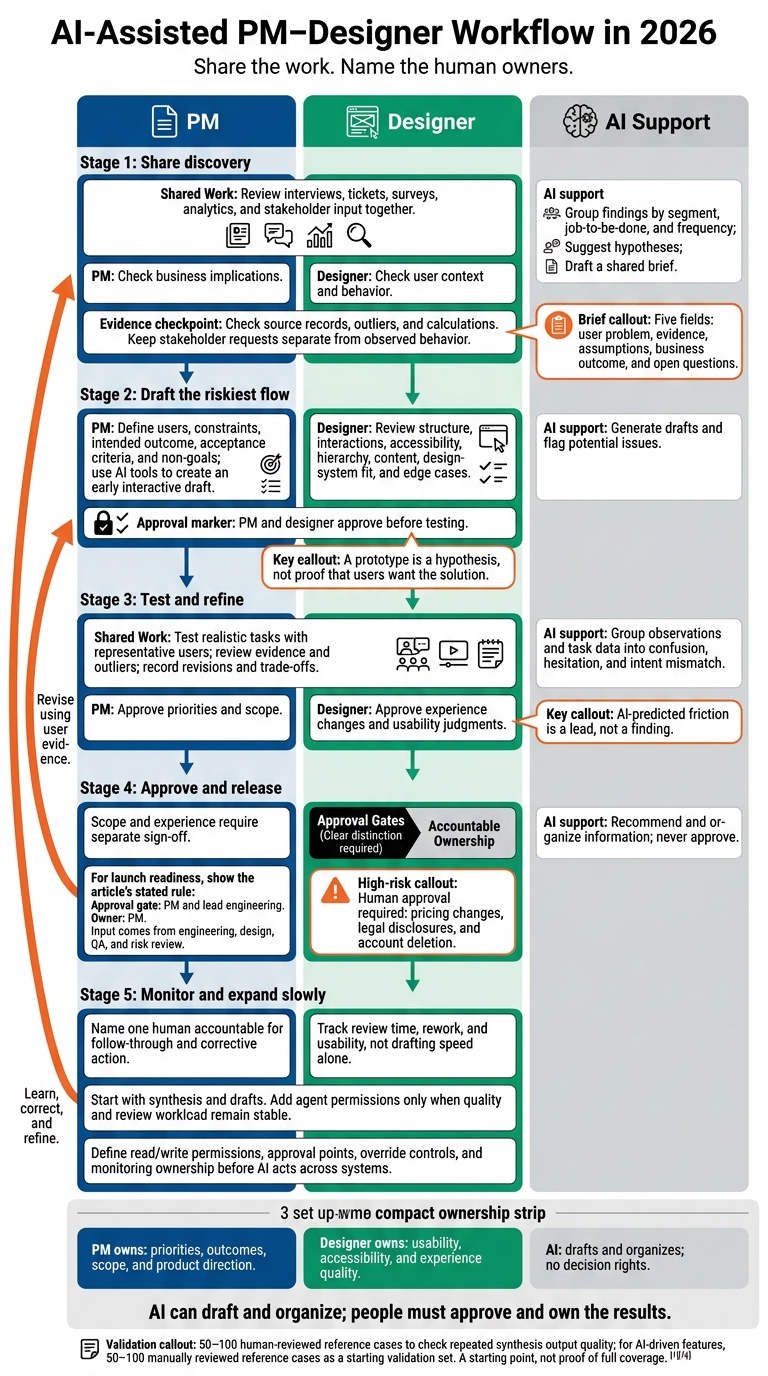
As of October, 2026, I’d separate the work this way:
- Share discovery: Use AI to group feedback and draft a brief. Check source records, outliers, and calculations before treating a theme as a finding.
- Split ownership: PMs own priorities, outcomes, and scope. Designers own usability, accessibility, and experience quality.
- Test before committing: A prototype is a hypothesis, not proof that users want the solution.
- Keep people in charge: Require human approval for release, pricing, legal disclosures, and account deletion. Record decisions and name who monitors results.
- Expand slowly: Start with synthesis and drafts. Add agent permissions only when quality and review workload stay stable.
A rule of thumb: AI can draft and organize; people must approve and own the results. Judge the workflow by what your team learns and changes - not how many documents or prototypes it produces.
Will Gen AI Consolidate the UX and PM Roles?
Use AI for shared discovery and problem framing
Shared discovery replaces a one-way brief with a joint review of evidence, hypotheses, and trade-offs. Instead of passing research from PM to designer, both roles work through it together.
Workflow area | Sequential PM-to-designer handoff | Shared AI-assisted discovery |
|---|---|---|
Source material | Research packaged into a requirements document | Interviews, tickets, surveys, analytics, and stakeholder input reviewed together |
Timing | PM frames the problem before design begins | Both roles revisit the problem as evidence arrives |
AI support | Drafting and note-taking | Grouping evidence, suggesting hypotheses, and drafting a shared brief |
Primary risk | Context gets lost between roles | A convincing AI summary can make an assumption look like a fact |
Start by bringing the evidence together. Then test the themes AI finds.
Combine research inputs and check AI-generated themes
Remove unnecessary fields and anonymize private data before feeding interviews, tickets, surveys, analytics, and notes into AI. Ask it to group findings by segment, job-to-be-done, and frequency. Include source references and feedback that contradicts each theme. Keep stakeholder requests separate from observed behavior. The PM checks what the findings mean for the business; the designer checks user context and behavior.
Treat each theme as a hypothesis, not a fact. Trace key conclusions back to transcripts, tickets, or analytics records, and manually review interpretations that aren't clear. If you repeat this synthesis process, maintain human-reviewed reference cases to check output quality. Check the analytical logic, too.
For example, check whether monthly and annual payments were put on the same basis before estimating revenue loss.
A fluent summary doesn't mean the math is right.
Write one shared discovery brief
Once the themes are clear, write one brief for the team to review together. Use five fields: user problem, evidence, assumptions, business outcome, and open questions.
Name the target users under user problem and add source links under evidence. Put untested explanations under assumptions. Agree on success measures under business outcome. For each open question, assign a human owner and a next validation step.
Treat AI output as a draft. Send privacy decisions and other high-risk decisions for human review.
Build, test, and refine AI-assisted prototypes
In 2026, AI makes prototyping a joint review rather than a handoff. Once the shared brief is set, the team can start with the riskiest flow.
The PM drafts; the designer checks usability
The PM uses natural-language tools to create an early interactive draft. AI-assisted prototyping can cut the time to feedback from weeks to hours. To start, the PM turns the shared brief into a build-ready prompt that defines users, constraints, the intended outcome, acceptance criteria, and non-goals.
The draft’s job is to expose usability problems before engineering commits. The PM checks scope, while the designer checks usability, accessibility, and interaction quality.
Before testing, the designer reviews structure, interactions, accessibility, hierarchy, content, and design-system fit. Can users find the next action, recover from errors, navigate with a keyboard, and understand labels? Check edge cases, too - not just the polished flow. AI can flag issues against team standards, but the designer must verify them and owns the usability judgment.
Test with users and revise the experience and scope
Test realistic tasks with representative users. Internal walkthroughs help the team prepare, but they don’t replace user evidence. AI-predicted friction is a lead, not a finding.
Ask AI to group observations and task data into confusion, hesitation, and intent mismatch. Then review the underlying evidence and outliers. Distinguish an unclear interaction from a wrong requirement. Record each revision, the evidence behind it, and whether it changes the experience or the scope.
Separate shared work from ownership
Creating a draft doesn’t give someone final authority. PMs own problem selection, outcomes, priorities, constraints, scope, and product direction. Designers own experience quality, interactions, accessibility, and design-system consistency. Share framing, flow exploration, experiment design, and evidence interpretation. AI gets no decision rights.
The next question isn’t who uses AI. It’s who can approve each change. This matrix spells out ownership and required approvals.
Activity | PM decision right | Designer decision right | Shared decision | AI contribution | Required human approval |
|---|---|---|---|---|---|
Framing | Select problem, outcomes, constraints | Advise on user needs | Frame opportunity | Suggest themes | PM |
Draft | Set scope and acceptance criteria | Set interaction standards | Explore flows | Generate drafts | PM and designer before testing |
Usability | Check outcome alignment | Approve experience quality | Select issues to investigate | Flag friction | Designer |
Accessibility | Address effects on scope | Own review | Agree on remediation | Flag contrast and labeling issues | Designer |
Testing | Assess effects on outcomes and scope | Assess usability evidence | Design tests and assess findings | Organize observations | PM and designer |
Refinement | Approve priorities and scope | Approve experience changes | Record trade-offs | Revise drafts | PM for scope; designer for experience |
Set decision rights and human accountability
After shared discovery and prototyping, joint AI-assisted work needs named owners for sign-off and follow-through.
Recommend, review, approve, validate, and monitor
Approval is a gate; accountability means owning outcomes after release. Several people may approve a decision, but one human owns follow-through and corrective action. AI recommends, reviewers check evidence and risk, and the owner approves and monitors results.
Use this table as a decision rule to separate approval gates from ownership. Replace role labels with names in the decision record. Specialist approvals add gates; they don’t replace PM or designer ownership.
Decision area | Input | Approval gate | Owner |
|---|---|---|---|
Launch readiness | Engineering, design, QA, and risk review | PM and lead engineering | PM |
Keep a linked decision log that records evidence sources, model version, recommendation, risks, approvers, accountable owner, and resulting changes. For overrides, record the reason and who authorized them. Keep earlier prioritization scores rather than overwriting them.
Before locking direction, check the logic, not just the numbers. For AI-driven features, start with manually reviewed reference cases as a validation set. That’s a starting point, not proof of full coverage.
Resolve disagreements and set release safeguards
Resolve scope-versus-usability disputes using the agreed outcome and user evidence. Record the trade-off: what changes, which users may be affected, and what evidence would prompt reconsideration. Scope and experience need separate sign-off. Escalate unresolved accessibility, safety, privacy, security, or legal concerns to the relevant specialist or leadership. These aren’t routine prioritization issues.
For AI-assisted prototypes and AI-generated recommendations, require human review before customer exposure or committed direction. Engineering and design validate feasibility and usability. Leadership checks strategy fit when needed, and an authorized human approves publication.
Keep pricing changes, legal disclosures, and account deletion behind strict human approval gates - even in experiments. For AI-driven features, document performance thresholds, failure paths, low-confidence fallbacks, monitoring ownership, and who can pause or override the system. Give reviewers a clear way to block release until safeguards are met.
What teams can use now - and what is still emerging
Once ownership is clear, teams can decide which product tasks AI can handle today - and where people still need to make the call.
Available today: synthesis, drafts, prototypes, and analysis
AI can help teams synthesize feedback, write drafts, build prototypes, and analyze data. PMs still own problem framing and trade-offs. Designers still own usability and experience quality.
Capability | Adoption status | Limitations | Required human oversight |
|---|---|---|---|
Feedback synthesis | High: 70% of startup PMs use AI for feedback synthesis | Can gloss over outliers and weak signals. | PM reviews raw outlier quotes; designer checks user context. |
PRD and user story drafting | Moderate: 21.5% adoption for PRD drafting | Can produce polished but wrong output when constraints are vague. | Review technical feasibility and alignment with non-goals. |
Interactive prototyping | Moderate: 19.8% adoption for mockups | Generates code quickly but cannot judge whether users want the solution. | Designer validates usability and brand/UX standards. |
Quantitative analysis | Teams already use AI ad hoc | Can miss logical context or rely on incorrect assumptions. | Check the math and the assumptions behind any metric shift. |
Roadmap generation and autonomous coordination | Low to emerging: 1.1% adoption for roadmap ideation; multi-step agents are still emerging | Struggles with complex prioritization and stakeholder nuance. | Humans make final trade-offs and approve actions with material effects. |
Faster analysis and more prototypes don't prove that product outcomes are better. These tools support the work; they don't make AI an independent decision-maker.
Still emerging: autonomous coordination and product judgment
Before allowing AI to act across systems, define read/write permissions, approval points, override controls, and who owns the outcomes. Tool access is not decision authority.
Start with low-risk tasks before expanding AI authority
Start with repetitive synthesis or draft generation before adding agents. Keep the source evidence, ask AI to challenge proposed options, and treat prototypes as hypotheses - not approved solutions.
Track review time, rework, and usability, rather than drafting speed alone. Expand permissions only after review workload and quality remain stable. For every decision with material effects, name a human owner.
Conclusion: Share the work, name the human owners
In 2026, PMs and designers shifted from handing off requirements to reviewing evidence and testing solutions together. A PM can draft a prototype, a designer can check usability, and the PM can set priorities. But approval rights must be clear: a named human must approve the draft before it becomes the source of truth.
Measure collaboration by what teams learn before committing to engineering - not how many artifacts they produce. Look at concepts tested, decisions changed, and time shifted toward customer research and sharper trade-offs.
Apply the same standard to today’s tools and emerging autonomy. AI-assisted synthesis and prototyping are already usable; autonomous coordination and product judgment are still emerging. AI can coordinate tasks, but humans own final product calls.
FAQs
How can we prevent AI prototypes from biasing user tests?
Treat AI as a partner for testing hypotheses, not the final judge. Define who the product is for and how it should behave. Explain concepts in plain language, generate failure cases before success cases, and test one variable at a time.
Use AI to check responses for hesitation, confusion, and gaps between user intent and product behavior. Keep people accountable: review prototypes with design and engineering teams before drawing conclusions. Maintain a library of failure patterns to help spot and reduce future biases.
Who breaks a deadlock between scope and usability?
The PM breaks the deadlock and owns the decision when a trade-off feels wrong, creates risk, or calls for judgment AI can’t take responsibility for. AI can draft options and help move the process along, but a human must review them. People still make the final call on what scope to ship and which aspects of usability to protect.
How do we know our team is ready for AI agents?
Your team is ready for AI agents when people remain accountable. That means setting clear policies for acceptable uses, data privacy boundaries, and mandatory human review of every AI-generated artifact.
You also need a documented monitoring plan with quality thresholds and fallback paths when agents fail or drift. Beyond managing backlogs, your team must govern learning systems through judgment, cross-functional evaluation, and evidence-based iteration.
If you’re finding this blog valuable, consider sharing it with friends, or subscribing if you aren’t already. Also, consider coming to one of our Meetups and following us on LinkedIn ✨ And check out our official website.
Connect with the founder on LinkedIn. 🚀
About the Product Management Society
The Product Management Society is an international community for product managers, founders, designers, and career-switchers, with 2,400+ members across active chapters in Lisbon, Berlin, Frankfurt, and Mexico City. The community runs more than 50 in-person meetups per year, a Slack network, an invite-only WhatsApp group, a blog, and a growing suite of free tools for product leaders. More information is available at www.productmanagementsociety.com.
About Gabriela Naumnik
Gabriela Naumnik is an AI product leader and the founder of the Product Management Society. A Staff Product Manager working at the intersection of AI and enterprise product, she focuses on AI-powered platforms serving Fortune 500 companies. She is a regular speaker at product conferences, publishes on product management at the Product Management Society's blog, and has built the PM Society into one of the most influential product communities in Europe and Latin America. She holds a B.S. from NYU/NYU Shanghai and an M.S. from Columbia University. More information is available at gabriela-naumnik.com.