What Can Product Managers Expect in 2027? How to Stay Ahead
AI will make production cheap. PMs who sharpen judgment, prototype fast, and set guardrails will lead in 2027.

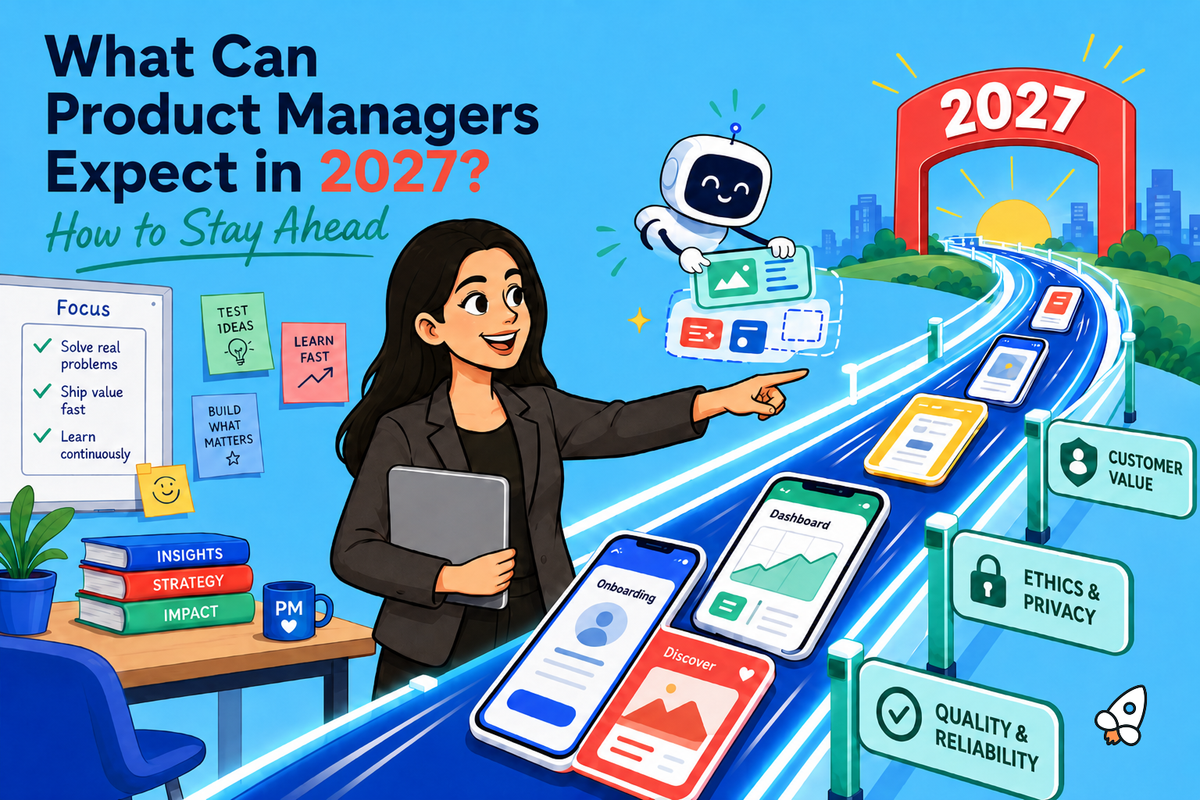
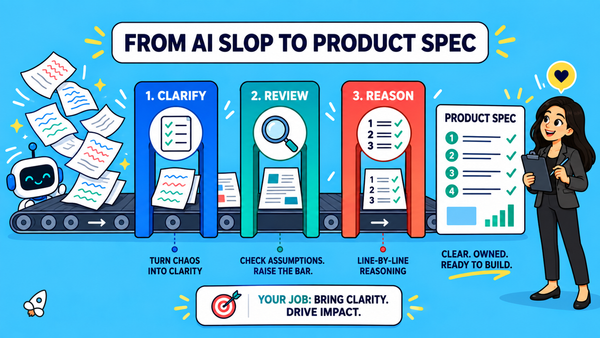
By 2027, I expect PMs to be judged less on writing docs and more on making sound calls. AI fluency in PM job posts grew 7x from 2024 to 2026, AI can cut 15% to 30% of spec and research work, and AI analysis still shows about a 20% false positive rate.
So if I wanted to stay ahead, I’d focus on four things right now:
- Use AI for draft work, not final calls
- Keep my own judgment sharp by checking raw inputs and doing some thinking without AI
- Prototype before I document so I can test ideas in hours, not weeks
- Build review systems like a 50- to 100-case golden set to catch bad outputs
Here’s the short version: PM work is moving from manual output to AI-assisted workflows across discovery, testing, analytics, and team updates. That shift rewards people who can frame problems well, spot weak logic, set guardrails, and decide when a human needs to step in.
I also see a split happening in the role, raising questions about whether product managers will be replaced by AI. PMs who lean into AI move toward product direction, system rules, and higher-stakes decisions. PMs stuck in admin-heavy work face more pressure as teams get leaner and AI handles more drafting and analysis.
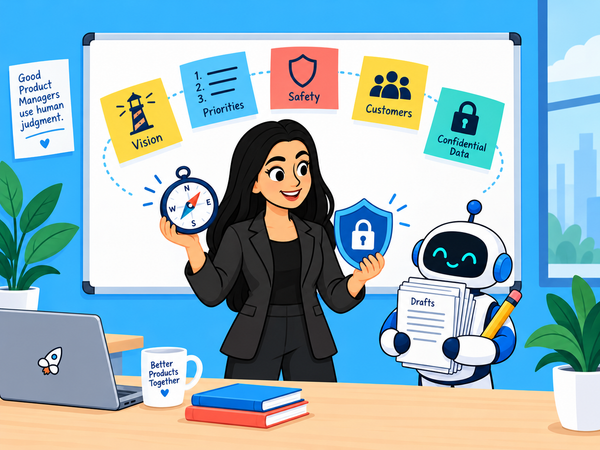
If I were preparing for 2027, I wouldn’t chase every new tool. I’d get good at using AI where it saves time, and I’d get even better at reviewing, deciding, and owning the final story.
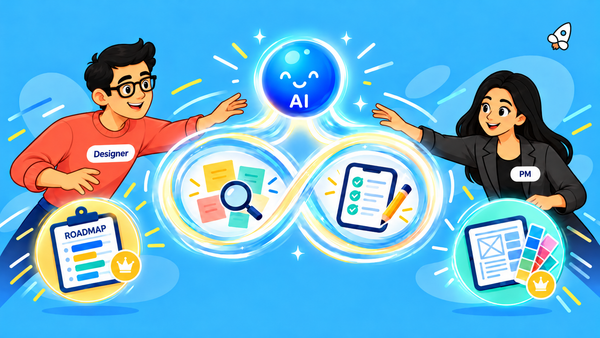
The Future of Agile & PM Roles in the AI World (Agentic Flow Leadership)
How AI Is Changing Core PM Work Right Now
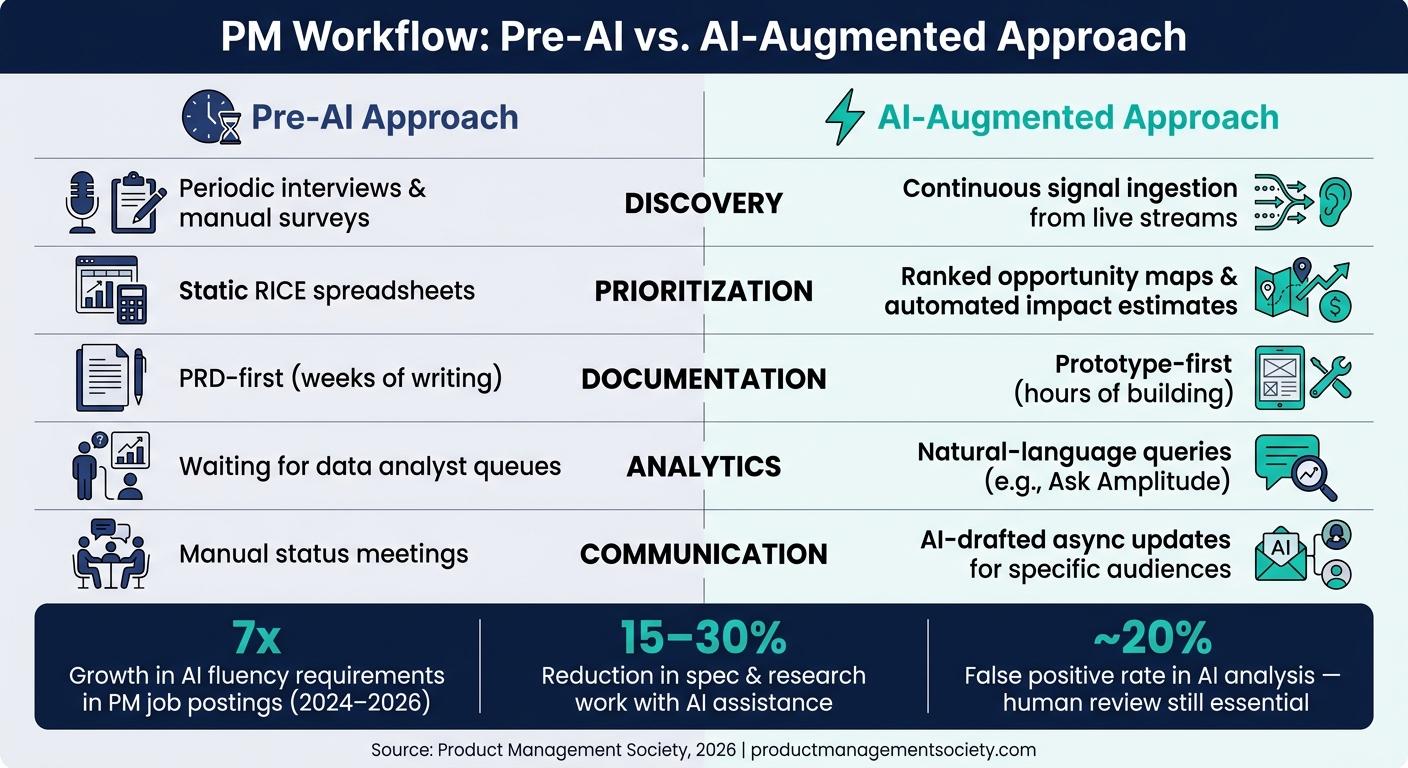
Across the PM workflow, AI is shrinking the time spent on collecting, summarizing, and drafting. As the production side gets faster, judgment matters more. You can see that shift in discovery, testing, and communication.
Discovery and Prioritization: Faster Synthesis, Clearer Trade-Offs
Discovery used to mean days of sorting feedback in spreadsheets by hand, often after the data was already old.
Now, tools like Notion AI, Jira Product Discovery, and Productboard AI help PMs pull in steady feedback from support tickets, sales calls, and user behavior, then group it into live themes. Instead of waiting for a quarterly research cycle, a PM can turn a big batch of feedback into a ranked summary of pain points much faster.
In 2024, Julie Apidopoulos, Director of Product Management at AroFlo, used Productboard AI to auto-link customer feedback and generate problem summaries. The team shipped seven high-impact features within a year, backed by strong NPS feedback and customer portal votes.
RICE sheets aren’t disappearing overnight, but many teams are moving toward ranked opportunity lists with estimated impact. There’s a catch, though: AI models often smooth over outliers. And those outliers can hold the most important signal. PMs still need to read the raw input, not just the summary .
Experimentation and Analytics: More Tests, Less Waiting
Before AI, running an experiment could drag on for weeks. A team had to draft a hypothesis, define metrics, wait for a BI team to build a dashboard, and then sort through the results by hand. That slowed learning and capped how many bets a team could make at the same time.
Now, tools like Amplitude and Mixpanel support natural-language queries. So PMs spend less time pulling numbers and more time deciding what those numbers mean. Testing is moving from manual, multi-week cycles to more frequent multivariate tests with predefined guardrails. In plain English, teams decide ahead of time when to ship, roll back, or take a closer look.
"The cost-to-learning ratio has flipped. Building a prototype now takes a few hours, while writing a detailed PRD can take just as long." - Cat Wu, Head of Product for Claude Code, Anthropic
Stakeholder Communication: AI Drafts, PMs Own the Story
AI now does a lot of the drafting and formatting work in PM communication. That includes documenting product requirements, acceptance criteria, meeting summaries, release notes, and updates shaped for different audiences.
But the PM still owns the story. Framing the right problem, explaining trade-offs, spotting weak logic, and building trust with leadership still sit squarely with the human in the loop. AI analysis currently carries a roughly 20% false positive rate, so hitting publish without editing is a bad bet.
"AI handles more of the production layer, while I own the final call. That means better problem framing, better trade-off calls, better oversight, and better judgment under uncertainty." - Gabriela Naumnik, Founder, Product Management Society
As AI takes on more production work, the bar moves toward fluency, judgment, and speed of change. That shift in day-to-day execution is why AI fluency will be table stakes by 2027.
What Will Be Expected of Product Managers by 2027
AI Fluency Will Move From Optional to Expected
The workflows changing discovery, testing, and communication today will likely be standard practice by 2027. As AI becomes part of day-to-day PM work, the job shifts. It’s no longer enough to just use the tools. PMs will be expected to judge whether the output is any good.
By 2027, AI fluency will mean more than writing prompts. PMs will need to review outputs, set guardrails, and know when human review is needed. There’s a bigger change underneath that too: PMs will spend less time defining product features and more time defining decision rules, constraints, and guardrails for AI-driven features. As Marty Cagan put it: "Most product managers will be expected to understand how the enabling AI technology works, what the range of risks involved are, and the work required to mitigate them."
That shift changes more than daily workflow. It changes what companies expect PMs to own.
PM Roles Will Split Between Strategic and Administrative Work
The PM role isn’t going away. But it is splitting.
Some PMs are using AI to prototype earlier, synthesize faster, and make better system-level trade-offs. Others are still spending most of their time on status updates, backlog grooming, and manual documentation.
That second group is in a tougher spot. As teams get leaner and shipping cycles move faster, companies want more scope and more business impact from each PM. Linear ran its entire product organization with just 2 PMs in 2026, using AI-heavy workflows to keep up speed. LinkedIn also turned its Associate Product Manager program into a "Product Builder" program that trains new hires across product, design, and engineering at the same time. These aren’t edge cases. They point to where team structures are heading, with less patience for PM work that is mostly administrative.
The Career Cost of Not Keeping Up
Ignoring this shift creates two clear risks: slower career growth and weaker judgment. There’s a catch here that people don’t always talk about. If a PM leans on AI too much without thinking, pattern recognition can start to fade.
PMs who don’t build AI fluency are more likely to get stuck doing work AI can already handle. Meanwhile, peers who use it well move toward strategy, systems thinking, and higher-trust decisions. Over time, that can mean less influence, a narrower scope, and fewer chances to shape roadmap direction.
"The threat isn't that AI will replace you. The threat is that a PM who uses AI well will replace those who don't." - Rina Alexin, CEO, Productside
That’s why the next section looks at the skills and workflows PMs need to build now.
How to Stay Ahead: A 2027 PM Readiness Plan
The Skills That Will Matter Most by 2027
By 2027, judgment will matter more than tool use. The PMs who stay ahead won't just know how to use AI. They'll know how to check its output, catch weak logic, and think at the system level instead of getting stuck at the feature level.
That shift is already showing up in hiring. AI fluency requirements in PM job postings grew roughly 7x between 2024 and 2026. So the day-to-day skill set is changing fast.
One smart move: build a 50- to 100-case golden set to catch AI errors before they reach stakeholders. It sounds simple, but that's the point. If AI can help you move faster, you also need a clean way to spot when it's wrong.
The edge is moving from faster output to better judgment.
Here’s how those skills evolve over time:
Category | Short-Term (0–6 Months) | Mid-Term (6–18 Months) | 2027-Ready Capability |
|---|---|---|---|
Data & Analytics | Basic prompt-based analysis | Data pipeline oversight and anomaly detection | Probability-based decisions and model evaluation |
AI Literacy | Using chat for drafting | Context engineering and applied AI | Managing autonomous agentic workflows |
Experimentation | AI-assisted hypothesis generation | Automated guardrail and decision-rule setup | Ongoing multivariate test oversight |
Leadership | AI-augmented status updates | Ethics and regulatory oversight | Strategic judgment and systems thinking |
One guardrail matters a lot here: protect first-principles thinking by doing some analysis without AI. If every step runs through a model, your own reasoning can get rusty. And when the stakes are high, that gap shows.
These skills shouldn't live only on a resume. They should show up in how you run discovery, testing, and communication.
How to Update Daily PM Workflows With AI
The workflow shift is simple: prototype before you document.
Instead of spending weeks writing before anyone sees the idea in action, PMs can use AI to get to something testable in hours. That changes the rhythm of the work.
Julie Apidopoulos, Director of Product Management at AroFlo, put this into practice after implementing Productboard AI in 2024 to auto-link support tickets and generate problem summaries. Her team saved 30 minutes per feature on manual data work and shipped seven high-impact features in a single year, resulting in improved NPS feedback and high portal votes.
That example makes the shift feel concrete. AI isn't just helping with writing. It's changing how product work moves from signal to decision to execution.
Workflow Area | Pre-AI Approach | AI-Augmented Approach |
|---|---|---|
Discovery | Periodic interviews and manual surveys | Continuous signal ingestion from live streams |
Prioritization | Static RICE spreadsheets | Ranked opportunity maps and automated impact estimates |
Documentation | PRD-first (weeks of writing) | Prototype-first (hours of building) |
Analytics | Waiting for data analyst queues | Natural-language queries (e.g., "Ask Amplitude") |
Communication | Manual status meetings | AI-drafted async updates for specific audiences |
That said, not every step should start with AI.
Keep AI out of the first draft of problem statements. Form your own point of view first, then use AI to pressure-test it. Otherwise, it's too easy to inherit bland framing or shaky assumptions without noticing.
And some calls still need hard approval gates no matter how good the tooling gets. That includes:
- pricing changes
- legal disclosures
- account deletions
Those are not "let the model decide" moments.
The next issue is whether the market is rewarding this shift.
Signals to Watch That Show Where PM Jobs Are Heading
The signals are already there if you know where to look. A few U.S. market signals already point to 2027.
One of the clearest examples is LinkedIn's shift of its Associate Product Manager program into a "Product Builder" program - training new hires across product, design, and engineering simultaneously. That's a big clue. The job is moving away from pure coordination and closer to hands-on execution with stronger cross-functional judgment.
PMs now need to know how AI works, where it fails, and when to override it.
Signal Category | Where to Monitor | What Change to Look For | Why It Matters by 2027 |
|---|---|---|---|
Job Market | LinkedIn / Indeed | Rise in "Product Builder" or "AI Fluency" requirements | Signals the shift from coordination to execution |
Team Structure | Industry reports / company blogs | Shrinking PM-to-engineer ratios | Indicates AI is absorbing tactical work |
Tooling | Product updates | Shift from chat-based tools to autonomous agent actions | Moves PM work from drafting to supervising |
Governance | U.S. regulatory news / EU AI Act updates | New bias, privacy, and safety audit requirements | PMs will become the primary owners of AI risk |
As AI features become standard, PMs must understand bias mitigation, privacy, and safety audits. That's no longer side knowledge. It's becoming part of the core job.
Conclusion: The PMs Who Win in 2027 Will Learn Faster Than the Role Changes
Put it all together, and the picture for 2027 is pretty clear: AI fluency will be table stakes, and PMs will be judged less by how much they ship and more by the quality of their decisions.
The PMs who stay ahead won’t get there just by stacking more tools. They’ll do it by combining AI leverage with the things models still can’t copy: sharp judgment, customer empathy, and calm leadership when the path isn’t obvious.
"AI makes production cheap and judgment more valuable, so the edge shifts from PMs who were fast at output to PMs who decide what is worth producing." - Arnould Joseph, Product Marketing Manager
That’s the heart of it. Form your own point of view before asking AI to summarize. Stay close to customers. Make the hard calls. AI can handle production; PMs still own judgment.
The Product Management Society is built to help PMs keep up with that shift - follow the community’s work and resources as the role changes.
To stay ahead right now, start with a few moves this week:
- Review your backlog against recent model releases
- Spot features that are now cheaper or faster to build
- Build a small golden set to catch AI errors before they reach stakeholders
- Test one new AI workflow in your sprint
Small moves, done again and again, add up fast. In a role that changes every few months, that steady habit is the edge.
FAQs
How can I build AI fluency as a PM?
Build AI fluency by using AI as a practical thinking partner, not by trying to become an expert in the tools themselves.
The big shift is simple: give AI the context it needs to help you think better. That means sharing product background, limits, goals, and data. When you do that, the output is far more useful and much more in line with what you’re actually trying to do.
Just as important, don’t take the first draft at face value. Check it. Coach it. Push it. Use AI to pressure-test ideas, run pre-mortems, and review work against your own quality bar.
Treat every output like a proposal, not a final answer. Validate the work, then keep human judgment centered on the things that matter most:
- experiments
- customer conversations
- product vision
That’s where people still do the heavy lifting. AI can help you think, but it shouldn’t do the deciding for you.
Which PM tasks still need human judgment?
By 2027, AI can take on drafting, summaries, and research themes. But PMs still need to steer the work, add context, and own the final call.
That means PMs should keep control of final decisions and validation of AI output. They also need to set decision rules and quality filters, apply real-world and cultural context, and frame ambiguous problems.
Put simply, AI can do a lot of the legwork. PMs still have to decide what matters, what holds up, and what should happen next.
What should I learn now to be ready for 2027?
To stay competitive through 2027, move away from output-heavy work and spend more time on judgment-heavy decisions.
That means building strength in a few key areas:
- AI and data literacy
- System-level thinking
- Experimentation and analytical judgment
- Technical collaboration
- AI tool fluency
At the same time, protect the human skills AI still can't take over: customer insight, ethical oversight, and final trade-off decisions.
If you’re finding this blog valuable, consider sharing it with friends, or subscribing if you aren’t already. Also, consider coming to one of our Meetups and following us on LinkedIn ✨ And check out our official website.
Connect with the founder on LinkedIn. 🚀
About the Product Management Society
The Product Management Society is an international community for product managers, founders, designers, and career-switchers, with 2,400+ members across active chapters in Lisbon, Berlin, Frankfurt, and Mexico City. The community runs more than 50 in-person meetups per year, a Slack network, an invite-only WhatsApp group, a blog, and a growing suite of free tools for product leaders. More information is available at www.productmanagementsociety.com.
About Gabriela Naumnik
Gabriela Naumnik is an AI product leader and the founder of the Product Management Society. A Staff Product Manager working at the intersection of AI and enterprise product, she focuses on AI-powered platforms serving Fortune 500 companies. She is a regular speaker at product conferences, publishes on product management at the Product Management Society's blog, and has built the PM Society into one of the most influential product communities in Europe and Latin America. She holds a B.S. from NYU/NYU Shanghai and an M.S. from Columbia University. More information is available at gabriela-naumnik.com.