AI Product Managers are paid 30-40% more?
AI title alone doesn't guarantee higher pay - negotiate for decision ownership, model evaluation, and inference-cost control.

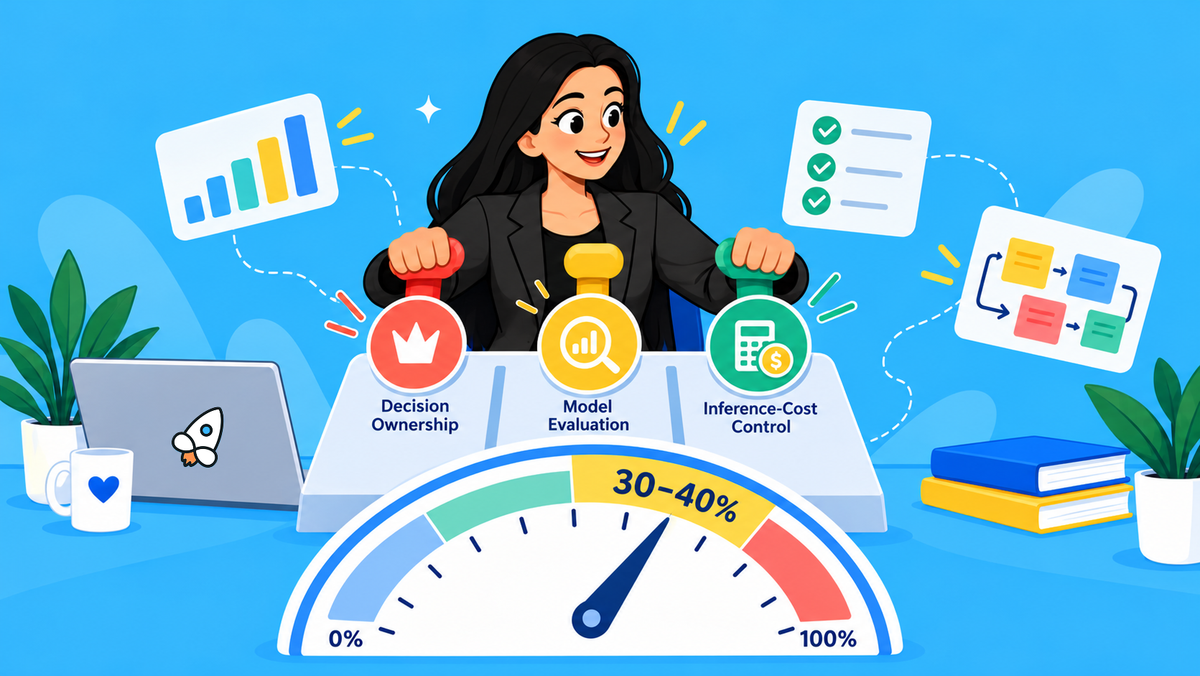
Do AI product managers earn 30%–40% more? Sometimes - but I wouldn’t treat that as the default. Some hiring guides put the premium at 30–40% over traditional PM pay, and broad job-postings data gives the range some footing: postings requiring one AI skill advertise about 28% higher pay, and those listing two or more about 43% more. That covers all roles, not just PMs. Before asking for that premium, compare roles at the same level, location, and employer type, using base salary or total compensation - not a mix.
The decisions you own matter more than the AI title. Work that includes model testing, launch approval, and inference costs can support a higher offer than adding AI features alone.
Here’s what I’d check before a pay discussion:
- Pay benchmarks: Compare career levels, job markets, and employer types.
- The full package: Separate salary and bonus from public stock or private options.
- Role scope: Identify which quality, cost, and risk decisions you can approve.
- Proof of results: Score your AI product management skills, document business outcomes, and choose a small project to close any gaps.
Negotiate for the level of work you own, not a percentage attached to your title.
AI Product Managers are making $300K+ in Healthcare: Salary, Skills & Career Roadmap
How Location and Employer Affect AI PM Pay
After seniority, location and employer type explain most of the remaining pay gap.
PM Pay Across 5 U.S. Job Markets
Location alone can make a standard PM offer look like it includes an AI premium. Pay varies widely by metro: on Levels.fyi, median PM total compensation ranges from about $191,000 in Greater Boston to $315,000 in the San Francisco Bay Area among the metros below. Treat the figures below as PM pay benchmarks across all levels - not as measures of extra pay for AI skills.
U.S. market | Median PM total compensation | Middle 50% (25th–75th percentile) | Salaries reported |
|---|---|---|---|
San Francisco Bay Area | $315,000 | $230,000–$435,000 | 1,302 |
Greater Seattle Area | $300,000 | $230,000–$407,500 | 821 |
New York City Area | $215,000 | $165,000–$287,000 | 980 |
Greater Austin Area | $215,000 | $165,000–$284,000 | 172 |
Greater Boston Area | $191,000 | $147,000–$239,000 | 163 |
Total compensation (base salary, annualized stock, and bonus) across all PM levels. Data: Levels.fyi, October 27, 2026.
Local hiring demand and employer pay bands also shape offers. Ask which geographic band applies to your location and whether a move would change your pay. Cost of living alone doesn't determine your value.
Company Types, Equity, and Pay Risk
Employer type often matters more than the AI label. Similar base salaries can come with very different equity packages.
Value public RSUs using the current share price and vesting schedule. Private options aren't spendable cash and should be discounted heavily for liquidity risk. Carta data shows that, for most of the past decade, employees at startups on Carta exercised less than half of their vested options. Ask about the strike price, dilution, liquidation preferences, and opportunities to sell shares.
Before negotiating, request a separate breakdown of base salary, equity, bonus, and any one-time signing payment.
Employer type | Typical pay mix | Scope and expected technical depth | Compensation risk |
|---|---|---|---|
Frontier AI Labs | Cash plus private-company equity | Very high; model internals, retrieval, and training feedback loops | High; private-company liquidity risk |
Big Tech | Cash plus public RSUs | High; inference costs and latency | Public-market volatility |
AI-First Scaleups | Cash plus private-company equity | High; rapid prototyping | High; valuation and liquidity risk |
Enterprise | Mostly cash, plus an annual bonus | Moderate; AI integration and compliance | Less equity exposure; bonus uncertainty |
Early-Stage Startup | Lower cash, larger equity share | High; full-stack building | High; financing and exit risk |
Qualitative comparison; check current company-level pay on Levels.fyi.
After accounting for location and employer, the next question is whether the role's AI scope justifies any remaining pay premium.
Which AI Responsibilities May Support Higher Pay?
Higher pay comes from owning evaluation, deployment decisions, and inference costs - not just an AI feature. These responsibilities add scope, risk, and business impact, which can help justify a pay premium.
Conventional PM vs. AI PM Responsibilities
AI PMs set standards for acceptable behavior when outputs are uncertain. They also address hallucinations, bias, privacy, and security before launch. NIST's Generative AI Profile lists confabulation, harmful bias, and data privacy among the core risks to test for.
Responsibility | Conventional PM focus | Added AI ownership |
|---|---|---|
Success measures | Conversion, retention, revenue | Track those outcomes alongside precision, recall, and hallucination rates |
Release planning | Feature requirements and delivery milestones | Maintain evaluation datasets, human-review gates, and monitoring for drift and latency |
Failure handling | Bugs, broken workflows, security issues | Also manage misleading outputs, bias, and model drift |
Owning evaluation means deciding whether a system is safe and useful enough to ship. That requires a repeatable evaluation suite, reference cases, and clear approval thresholds.
How Technical Skills Affect AI Product Costs
You don’t need to train models to own their economics. But you do need to understand model API pricing, token usage, usage limits, latency, retries, and human-review costs. A cheaper response doesn’t always mean a lower total cost. Track cost per successful task alongside quality and gross margin.
The more decisions you own - and connect to measurable results - the stronger your case for a higher offer. Next, translate those responsibilities into your own skill score and salary request.
Assess Your Skills and Prepare to Negotiate
Use your score to check whether your current scope matches the pay band you want.
Score Your AI Skills and Results
Rate the skills that most often support higher AI PM pay: 0 = no experience, 1 = contributing, or 2 = ownership with measured results. Your scores should help you spot gaps and collect proof of ownership. The strongest evidence connects your decision to a result and its business value.
Capability | Evidence to collect | Why it helps pay |
|---|---|---|
Roadmap decisions | Investment decisions and documented pivots | Broader scope; less wasted development |
Build/stop decisions | Research and build/stop rationale | Investment judgment |
Test design | Test suites and precision/recall targets | Technical depth; reliable releases |
Risk approval | Risk reviews and release approvals | Governance ownership; lower risk |
Cost/latency gains | Before-and-after cost and response times | Better margins and experience |
AI experiments | Test plans, guardrails, and results | Validated demand and adoption |
Stakeholder alignment | Decisions agreed across engineering, legal, and sales | Senior-level coordination; fewer blockers |
Business impact | Revenue, retention, productivity, or margin changes | Measurable value |
Use your highest scores to support the level you're seeking, not just a pay increase.
Build a Pay Request Around Role Scope
Use the market data above to request the band that fits your scope. Spell out your decision rights - what you can approve without escalation. AI can help with the work, but your case rests on owning strategy and product decisions.
If you're already working at a higher level, ask for that level’s band rather than a pay increase within your current one. A level change can be worth tens of thousands of dollars: at RingCentral, for example, Levels.fyi data shows the step from Senior PM to Group PM adds about $28,000 a year.
Separate guaranteed cash from contingent value. Value public RSUs at their current price and private options at a steep discount for liquidity risk.
If one skill gap weakens your case, pick a project that closes it fast.
Choose Projects That Fill Your Skill Gaps
Choose projects that produce evidence for a higher-level AI PM offer.
Build a manually reviewed case reference set, or document a stop/remove decision that cut waste or lifted activation.
Keep the project’s scope tight, with clear thresholds and measurable outcomes. Record the baseline and measured result before claiming success.
Conclusion: Negotiate the Scope, Not the AI Title
An AI pay premium is possible - not automatic. Levels.fyi data shows ML/AI engineers earning about 1.3 times what non-AI peers at the same level earn, a premium that stopped growing between late 2024 and mid-2026. PM-specific data is thinner. Treat that gap as negotiation context, not a guaranteed pay increase.
Choose AI specialization when it gives you ownership of discovery, model evaluation, inference costs, or risk - not just more features. Bring benchmarks matched to your role and proof of business impact to your next pay discussion. Ask for pay that reflects the decisions you own, not the title on your job description.
FAQs
How can I tell if an AI salary premium is real?
Look beyond job titles to what the role involves. The premium generally applies to dedicated AI PM roles at AI-native companies. These jobs involve managing probabilistic systems, defining precision and recall metrics, evaluating models, and managing inference costs.
Check whether the role requires technical literacy in model behavior, test suites, and data quality. Simply using AI tools to summarize research or manage roadmaps does not qualify for the 28%–56% wage premiums reported by Lightcast and PwC.
What if my AI responsibilities grow but my pay doesn't?
To make the case for a salary adjustment, show how your added AI responsibilities support the business. Gather salary benchmarks for your level, including the pay premium for dedicated AI PM roles.
During negotiations, focus on skills that drive results: building evaluation frameworks, managing inference costs, and setting success metrics for probabilistic systems. Back up your case with successful AI feature launches and document how they contributed to the organization’s bottom line.
If you’re finding this blog valuable, consider sharing it with friends, or subscribing if you aren’t already. Also, consider coming to one of our Meetups and following us on LinkedIn ✨ And check out our official website.
Connect with the founder on LinkedIn. 🚀
About the Product Management Society
The Product Management Society is an international community for product managers, founders, designers, and career-switchers, with 2,400+ members across active chapters in Lisbon, Berlin, Frankfurt, and Mexico City. The community runs more than 50 in-person meetups per year, a Slack network, an invite-only WhatsApp group, a blog, and a growing suite of free tools for product leaders. More information is available at www.productmanagementsociety.com.
About Gabriela Naumnik
Gabriela Naumnik is an AI product leader and the founder of the Product Management Society. A Staff Product Manager working at the intersection of AI and enterprise product, she focuses on AI-powered platforms serving Fortune 500 companies. She is a regular speaker at product conferences, publishes on product management at the Product Management Society's blog, and has built the PM Society into one of the most influential product communities in Europe and Latin America. She holds a B.S. from NYU/NYU Shanghai and an M.S. from Columbia University. More information is available at gabriela-naumnik.com.