Future of Product Management Beyond 2026
AI reduces routine PM work; after 2026 PMs must focus on judgment, risk, and systems thinking while using AI for execution.

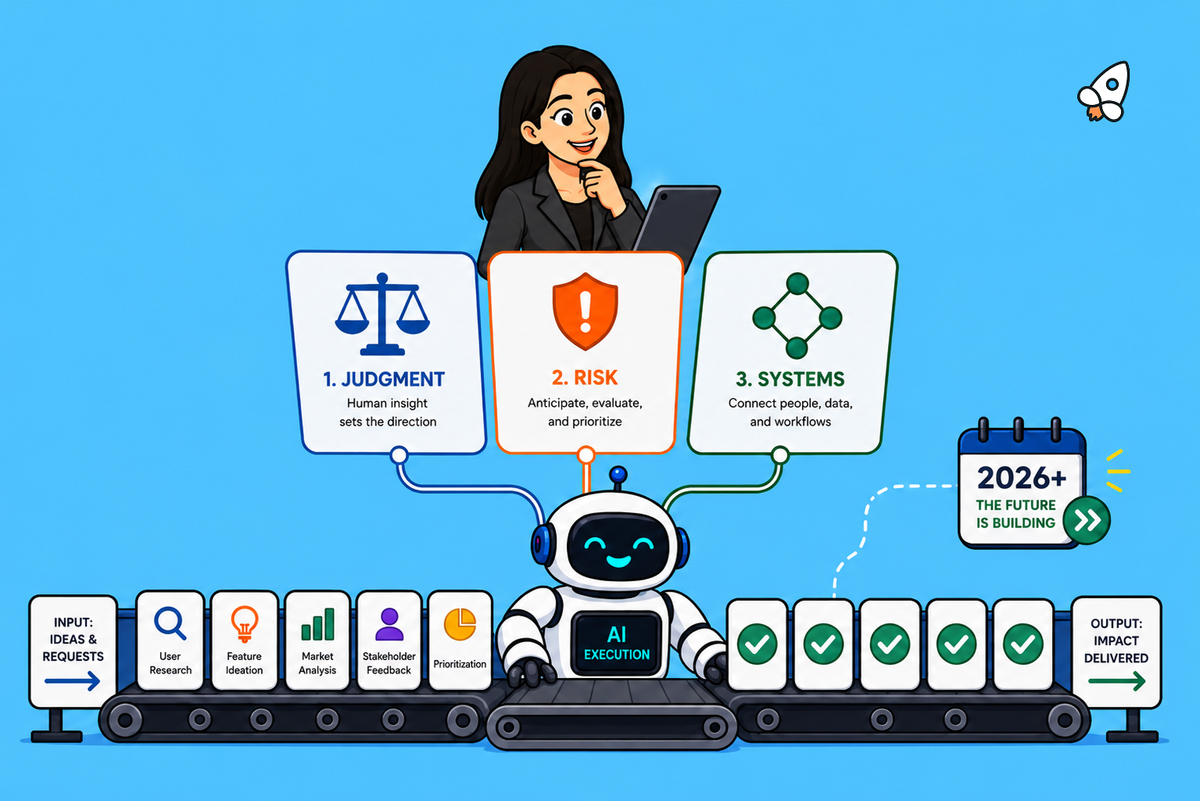
After 2026, I see product management moving in one clear direction: less time on docs and coordination, more time on judgment, risk calls, and system-level thinking. AI is already taking over parts of discovery, prioritization, drafting, testing, and updates. At the same time, hiring signals show AI fluency in product roles grew about 7x from 2024 to 2026.
If I had to boil the whole shift down, it would look like this:
- Execution work gets cheaper
- Decision quality matters more
- PMs are pushed closer to product risk, privacy, bias, and trust
- Roadmaps get less fixed and more fluid
- Prototyping happens before long specs
- Career paths split into AI product, AI-powered PM, upstream PM, and AI-heavy product ops
Here’s the plain-English version: if your role depends on status updates, handoffs, and writing long PRDs, you might wonder will product managers be replaced by AI. If your role depends on making hard calls, reading weak signals, setting guardrails, and aligning people, you’re in a better spot.
A few points stand out fast:
- AI copilots can save about 15% to 30% on spec writing and research synthesis
- Some teams now run with far fewer PMs per engineer
- AI analysis can still be wrong, with roughly a 20% false positive rate
- PMs need their own eval habits, reference cases, and human checks
- High-risk areas like pricing, legal disclosures, and account deletion still need strict human approval
I’d frame the future PM job like this: AI handles more of the production layer, while I own the final call. That means better problem framing, better trade-off calls, better oversight, and better judgment under uncertainty.
Shift | What it means for PMs |
|---|---|
Discovery | I work from live signals, not just periodic research |
Planning | I use shorter learning loops instead of fixed long plans |
Documentation | I prototype first, then document what matters |
Experimentation | I set rules and review outcomes instead of running each test by hand |
Career growth | I build AI fluency, data sense, and risk judgment |
If you want the short takeaway, it’s this: the PM role does not go away after 2026, but the low-leverage parts of it do. The PMs who stay ahead will use AI for drafting and synthesis, while keeping framing, review, and final decisions human.
What Product Management Looks Like After 2026
The Market and Technology Shifts Changing the PM Role
This shift changes more than a PM’s task list. It changes how the whole job works.
A few big forces are reshaping product management: generative AI, agentic workflows, no-code tools, privacy regulation, hybrid work, and product-led growth. The biggest one is agentic AI: systems that can handle multi-step work across tools like Salesforce, Slack, and GitHub. The Model Context Protocol (MCP) has set a common way for these agents to connect with enterprise software.
That puts more accountability on product leaders. PMs now carry more risk tied to data governance, privacy compliance, bias, and trust. If a PM assumes those issues sit only with legal or engineering, that’s a risky bet.
From Delivery Manager to Decision Maker in an AI-First World
AI is taking over a lot of the execution layer of PM work: requirements, status updates, research synthesis, and decks. So the job starts to lean less on output and more on judgment. PMs whose main role is passing context from one team to another are the most exposed. The PMs who keep their edge are the ones who make trade-offs, deal with ambiguity, and own hard ethical calls.
Linear operated with just 2 PMs in 2026, a sign that AI-first teams are shrinking PM-to-engineer ratios.
As AI handles more of the production work, the weekly rhythm of product management changes with it.
How AI-First Product Organizations Operate Differently
AI-first teams are moving away from fixed roadmaps and staged release cycles. Instead, they’re leaning into short exploration sprints and parallel experiments. Support tickets, sales calls, and product analytics now feed into real-time synthesis that points PMs toward opportunity spaces, not static backlogs.
PMs can also build working prototypes in hours with natural-language tools, then bring engineering in only after something shows value. That changes the handoff. It also changes what success looks like. Instead of tracking feature usage alone, teams focus more on business outcomes like support deflection, retention, or revenue impact.
"AI makes production cheap and judgment more valuable, so the edge shifts from PMs who were fast at output to PMs who decide what is worth producing." - Arnould Joseph, Product Marketing Manager
That same shift changes the skills PMs need if they want to stay competitive.
AI Product Manager: Navigating the Future of AI Product Management
How AI Changes the PM Workflow Week to Week
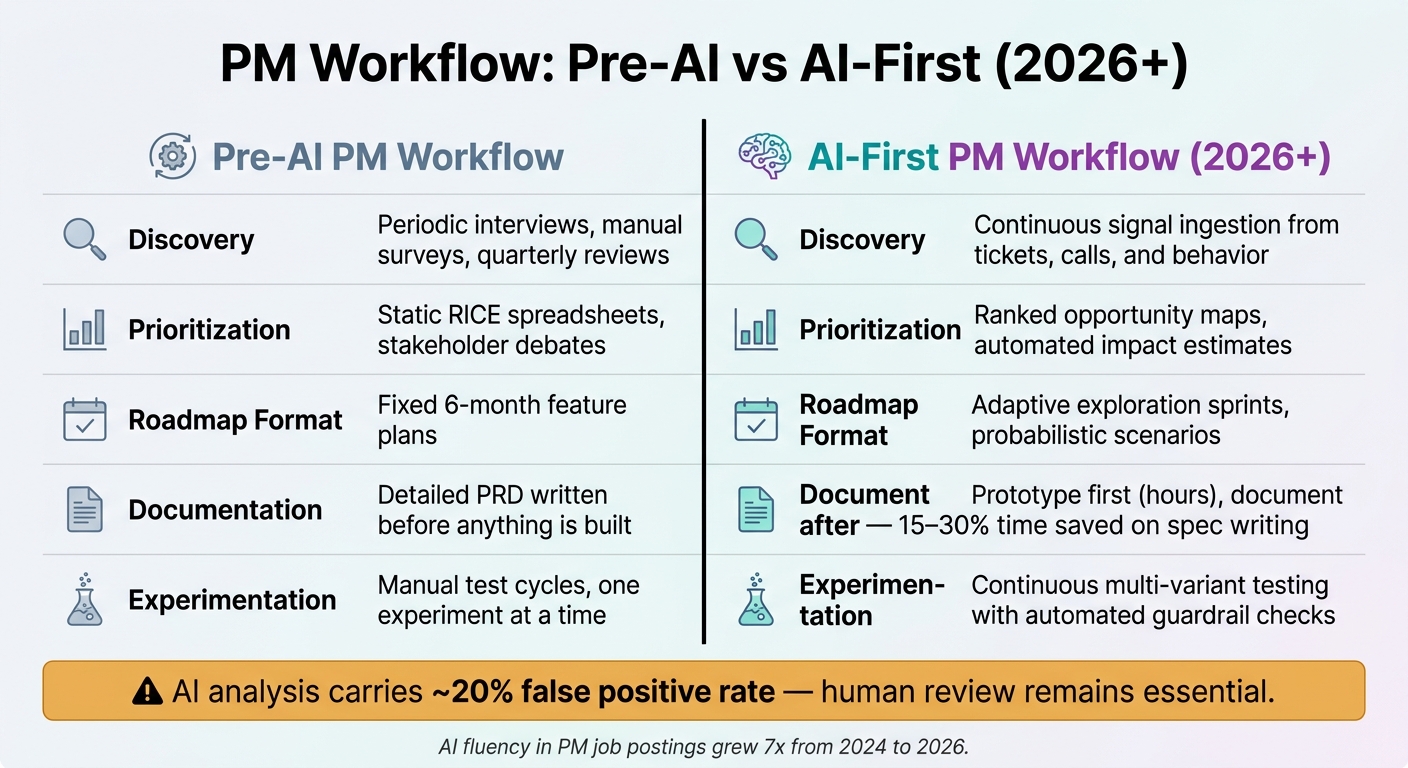
At the week-to-week level, AI changes what PMs gather, decide, and ship.
Discovery, Prioritization, and Roadmapping with AI Input
AI-first teams don’t wait for quarterly research cycles anymore. They work from a steady flow of product signals and re-rank opportunities as new evidence comes in.
PMs now use live signal streams to build adaptive opportunity maps and short exploration sprints instead of fixed roadmaps. Support tickets, sales call recordings, and in-app behavior all feed into a live signal stream that clusters themes in real time.
Workflow Area | Pre-AI | AI-Enabled (2026+) |
|---|---|---|
Discovery inputs | Periodic interviews, manual surveys, quarterly reviews | Continuous signal ingestion from tickets, calls, and behavior |
Prioritization | Static RICE spreadsheets, stakeholder debates | Ranked opportunity maps, automated impact estimates |
Roadmap format | Fixed 6-month feature plans | Adaptive exploration sprints, probabilistic scenarios |
One habit is worth picking up here: if you use AI to synthesize research, read the outlier quotes yourself. Models often smooth over awkward or inconvenient data points, and those are sometimes the ones that expose a bad assumption.
Once discovery becomes continuous, experimentation becomes the next filter for speed and quality.
Experimentation, Measurement, and Faster Learning Loops
AI-assisted experimentation turns testing from a slow manual cycle into a continuous decision loop.
Tools like Statsig and Eppo now support continuous multi-variant testing with automated guardrail checks. That lets teams run more experiments in parallel without piling on the same overhead. Hypothesis generation, variant design, and results analysis now get AI support too. The PM’s role shifts. Instead of manually running each experiment, they define the decision rules for when a variant wins, rolls back, or gets pushed to human review.
"The Product Manager no longer controls a fixed product experience. They navigate a probabilistic environment." - SFEIR Institute
The catch is overconfidence. AI models currently carry roughly a 20% false positive rate, so automated analysis can sound persuasive while sending you in the wrong direction. That’s why PMs now need 50 to 100 reference cases to catch false positives and validate outputs.
When tests move faster, the next bottleneck is how decisions get packaged and shared.
Execution, Documentation, and Stakeholder Updates with AI Copilots
Execution work - writing PRDs, drafting user stories, generating acceptance criteria, and summarizing meetings - is where AI copilots save time the fastest: roughly 15–30% on spec writing and research synthesis. The point isn’t just speed. The point is using that saved time on judgment-heavy work.
The bigger change is sequencing. Instead of writing a detailed PRD before anything gets built, more teams now prototype first and document after.
"The cost-to-learning ratio has flipped. Building a prototype now takes a few hours, while writing a detailed PRD can take just as long." - Cat Wu, Head of Product for Claude Code, Anthropic
For stakeholder communication, AI copilots can draft updates for different audiences, like a technical summary for engineering and an executive update for leadership. That pushes more communication async and cuts down on long status meetings. Still, PMs need to edit AI output instead of taking it at face value. That means catching weak logic and adding the human context that transcripts and tickets often leave out.
This is why PM judgment matters more, not less, as the workflow speeds up.
Skills and Career Moves That Will Matter Most After 2026
As AI changes how PM work gets done, the edge shifts to the skills PMs can own that AI can't.
The Core PM Skill Set After 2026
As AI takes on more production work, PM value moves toward judgment, interpretation, and oversight.
Data literacy is now the starting point. The bigger skill is knowing when to trust AI, when to question it, and when to overrule it.
AI fluency goes past knowing which tools to open. Strong PMs understand how models behave: why they hallucinate, how grounding works, and what latency and token costs mean for product choices. They can also build evaluation sets to test whether an AI feature is doing its job well.
"The ratio of execution to judgment flips. And when it does, there's nowhere to hide." - Allen Yang, Fractional Head of Product
Ethical and regulatory stewardship is also moving into the center of the PM role. PMs should take ownership of data governance, bias checks, and safety guardrails for AI features.
One more thing matters here: keep systems simple. Model capabilities move fast, and complicated workarounds can break easily.
New PM Roles and Specializations Already Taking Shape
That shift in skills is already pushing PM careers into different paths.
The PM role is splitting into a few clear specializations, and knowing where you fit matters more now than it did a few years ago. AI isn't replacing PMs. It's sorting them by the kind of judgment they own. Job postings that asked for AI fluency grew by about 7x between 2024 and 2026.
Role Type | Primary Focus | Key Skills | Common Deliverables |
|---|---|---|---|
AI Product Manager | Building AI-core products (agents, models) | Model selection, evals, API cost trade-offs | Model performance reports, safety guardrails |
AI-Powered PM | Using AI to speed up standard SaaS workflows | Prompt engineering, AI-assisted documentation | AI-drafted PRDs, automated research summaries |
Strategic PM | Upstream strategy and market positioning | Systems thinking, stakeholder influence | Long-term roadmaps, business model design |
AI-Native Product Ops | Maintaining the AI development infrastructure | Information architecture, tool chaining | Context libraries, automated feedback pipelines |
The AI Product Manager role comes with the deepest technical demands: model choice, evals, and API cost trade-offs all sit inside the job. The Strategic PM path leans hardest on systems thinking and stakeholder influence. AI-Native Product Ops is also becoming more important in AI-heavy teams, with ownership of the context libraries and feedback pipelines that keep the system working.
How to Build an AI-Augmented Workflow and Keep Learning
The fastest way to stay relevant is to bring AI into your workflow without handing over judgment.
Use AI for synthesis and drafting. Keep problem framing and decision-making for yourself. In practice, that means checking outlier data on your own instead of just trusting a summary, and editing AI output instead of publishing it as-is.
A few habits are showing up among strong PMs:
- Keep a small golden set to test whether your AI tools still give reliable outputs.
- Re-scan your backlog after major model releases. Features that looked impossible six months ago may now be trivial.
- Block off time, even a half day, to test what new model capabilities now make possible.
Future Scenarios and Key Takeaways for PMs
3 Likely Scenarios for AI-First Product Teams
After 2026, product teams will likely split into a few operating models. Each model asks for a different mix of PM skills.
AI changes both speed and accountability, so product orgs will probably settle into a small set of patterns.
Scenario 1: AI-Augmented Product Triads (the "Product Builder" model). In this setup, role lines get blurrier. PMs, designers, and engineers work more like a tight product trio. PMs use natural-language prototyping before engineering work begins, which shrinks early validation time and cuts handoffs. LinkedIn shifted its Associate Product Manager program into a Product Builder program in 2026, training hires across product, design, and engineering at the same time.
That same speed-up at the start also puts more decision-making pressure on the PM.
Scenario 2: Model-Driven/Agentic Product Teams. Here, the center of gravity moves from shipping features to building and supervising autonomous agents that can plan and carry out multi-step tasks. The PM role starts to look more like a "Responsible AI Owner" - someone who manages model failure modes, acceptable error rates, and ethical guardrails instead of just maintaining a feature list. Of the three paths, this one puts the most weight on accountability.
The more freedom the system has, the more the PM shifts from feature owner to risk owner.
Scenario 3: The AI-Native Product Loop. In this model, roadmaps are continuously re-ranked based on live product signals. As Art Kreimer put it:
"The 12 months roadmap is quietly becoming a liability. It implies a level of certainty... that nothing about the current environment supports."
These are plausible directions, not fixed outcomes. AI models in 2026 can already handle far more complex tasks than they could 16 months earlier.
Governance, Trust, and Why PM Judgment Stays Central
All three scenarios run into the same hard truth: accountability can't be handed off to a machine.
As AI shows up in more customer-facing experiences, that question gets sharper. In many cases, the PM is the person expected to own the trade-off when something goes wrong, feels off, or carries risk.
Marty Cagan put it plainly:
"Most product managers will be expected to understand how the enabling AI technology works, what the range of risks involved are, and the work required to mitigate them."
Algorithmic fairness, data governance, and safety guardrails do not regulate themselves. AI can suggest an answer. It can't judge reputational risk, read a tense stakeholder meeting, or decide when a feature has crossed an ethical line. Judgment stays with people because accountability needs a person, not a system.
Some product areas should stay firmly human-controlled, with strict approval gates in place. That includes pricing, legal disclosures, and account deletion.
Conclusion: What PMs Should Do Now to Stay Ahead
Across every scenario, the PM's long-term edge is still judgment.
The pattern is pretty clear: AI automates the production layer; judgment becomes the scarce resource. Drafting, synthesis, and formatting get cheaper. Framing the right problem, making a call under uncertainty, and earning stakeholder trust become more important.
"The threat isn't that AI will replace you. The threat is that a PM who uses AI well will replace you." - Rina Alexin, CEO, Productside
A few moves stand out right now:
- Re-scan backlogs after major model releases
- Build eval sets
- Keep problem framing and final decisions human
FAQs
Will AI reduce PM jobs after 2026?
No. AI is unlikely to eliminate product management, but it will reshape the role.
As AI takes over routine execution work like documentation, research synthesis, and status reporting, demand will move toward high-judgment, strategy-focused PM work. Roles built mostly around coordination may shrink. But PMs who lead with business sense, customer empathy, and strong decision-making will matter more.
Which PM skills matter most in AI-first teams?
In AI-first teams, the PM role shifts away from routine execution and toward strategic judgment. The old core still matters, of course. User empathy, clear communication, and strategic thinking don’t go away. But now they need to be paired with a stronger grasp of how AI works in practice.
That changes the skill mix in a pretty direct way. PMs need to get comfortable making calls in systems that are less predictable, more data-heavy, and often shaped by model behavior rather than fixed rules.
Key skills include:
- Strategic judgment and systems thinking
- AI literacy and workflow integration
- Probabilistic decision-making
- Data interpretation
- Ethical and regulatory awareness
How can PMs use AI without losing human judgment?
Use AI for speed and analysis, not as a stand-in for thinking.
Start with the hard mental work yourself. Write the problem statement. Sort through raw customer research. Sit with the messy parts long enough to understand what’s going on. Then bring in AI to sharpen the draft, tighten the language, or help spot patterns you may have missed.
That matters because product judgment doesn’t come from skipping the mess. It comes from working through fuzzy, incomplete, and sometimes conflicting input until something starts to click. That’s how you build product sense and pattern recognition.
A good way to think about it: let AI shrink the time spent on execution, but spend the time you get back on work that needs human judgment. That includes customer empathy, stakeholder alignment, and the strategic calls no tool can make for you.
If you’re finding this blog valuable, consider sharing it with friends, or subscribing if you aren’t already. Also, consider coming to one of our Meetups and following us on LinkedIn ✨ And check out our official website.
Connect with the founder on LinkedIn. 🚀
About the Product Management Society
The Product Management Society is an international community for product managers, founders, designers, and career-switchers, with 2,400+ members across active chapters in Lisbon, Berlin, Frankfurt, and Mexico City. The community runs more than 50 in-person meetups per year, a Slack network, an invite-only WhatsApp group, a blog, and a growing suite of free tools for product leaders. More information is available at www.productmanagementsociety.com.
About Gabriela Naumnik
Gabriela Naumnik is an AI product leader and the founder of the Product Management Society. A Staff Product Manager working at the intersection of AI and enterprise product, she focuses on AI-powered platforms serving Fortune 500 companies. She is a regular speaker at product conferences, publishes on product management at the Product Management Society's blog, and has built the PM Society into one of the most influential product communities in Europe and Latin America. She holds a B.S. from NYU/NYU Shanghai and an M.S. from Columbia University. More information is available at gabriela-naumnik.com.