What it takes to reach specific Product Manager career stages
Promotions hinge on scope, autonomy, and measurable impact - what APMs through VPs must own to advance.


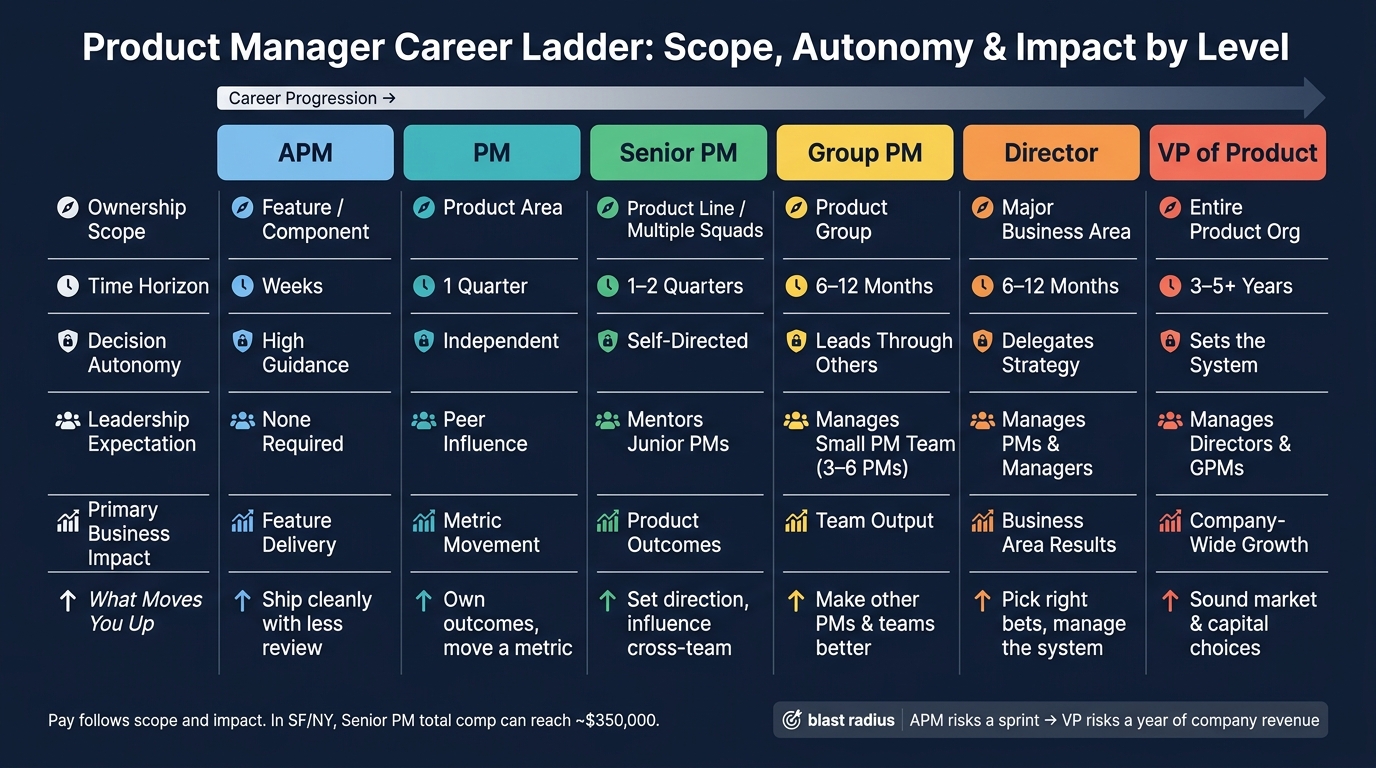
PM promotions come down to 3 things: scope, autonomy, and business impact. If I want to know what level a Product Manager is at, I don’t start with title or years worked. I look at what they own, which calls they make alone, and which metrics change because of their work.
Here’s the short version:
- APM: I learn the craft, ship small pieces, and work with close review.
- PM: I own a product area and must show metric movement, not just launches.
- Senior PM: I set direction for a larger area, handle cross-team trade-offs, and think in 12-month bets.
- Group PM: I lead PMs and am judged by team decisions and results.
- Director: I own a business area, choose where resources go, and tie product work to revenue, margin, and cost.
- VP of Product: I set company-level product direction, lead product leaders, and own long-range business choices.
A fast self-check I’d use:
- Do I own a feature, a product area, or a portfolio?
- Which decisions can I make without approval?
- Can I point to one metric I moved?
- Am I known for shipping, direction-setting, team leadership, or company impact?
One detail stands out: at the top end, pay can get big. In San Francisco and New York, Senior PM total compensation can reach about $350,000. But the article’s main point is simple: pay follows scope and impact.
Product Manager Career Path Explained
Quick Comparison
Level | Main scope | Time horizon | What moves me up |
|---|---|---|---|
APM | Feature or component | Weeks | Need less review and ship cleanly |
PM | Product area | Quarter | Own outcomes and move a metric |
Senior PM | Product line or multiple squads | 12 months | Set direction and influence across teams |
Group PM | Small PM team | 3–12 months | Make other PMs and teams better |
Director | Major business area | 6–12 months | Pick the right bets and manage the system |
VP of Product | Product org / company direction | 3–5+ years | Make sound market and capital choices |
My takeaway: the ladder is less about doing more work and more about handling a bigger blast radius when decisions go wrong. That’s the cleanest way to judge the jump from APM to VP.
Associate PM to Senior PM: building execution, judgment, and product strategy
The first three stages are about moving from guided execution to independent judgment.
Associate Product Manager: learn the craft and ship with guidance
APMs learn how to execute inside clear guardrails. They usually own a small piece of work, often a single feature or component, and think in weeks, not quarters. This is where you build the habits that later roles depend on.
Day to day, that often means writing user stories, grooming the backlog, sitting in on user interviews, and drafting PRDs. In most cases, a senior PM still reviews that work before it moves forward. On the data side, expect supervised SQL work and guided use of tools like Amplitude or Mixpanel. APMs who use ChatGPT or Claude to draft user stories, outline PRDs, or summarize interview notes can move faster.
The promotion signal is simple: ship well with less oversight over time. If your manager still needs to check every ticket and rewrite your acceptance criteria, that’s the gap. The aim is for review to feel like a final check, not a rescue step.
The next move isn’t just about doing the work well. It’s about owning the result.
Product Manager: own a product area and deliver business outcomes
At the PM level, the job changes from completing tasks to owning outcomes. You’re now responsible for a product area from end to end. That means setting a quarterly roadmap, defining success metrics, and becoming the person your cross-functional team turns to when priorities collide.
The work changes in a very specific way: you need to connect user problems to business results. That means running your own user interviews, shaping the problem before jumping to solutions, and knowing whether activation, retention, or revenue is the right metric for a given initiative. A PRD at this level doesn’t just explain what to build. It makes the case for why this work should come before the next item on the roadmap.
PMs are also expected to use SQL and analytics tools like Amplitude or Mixpanel on their own to drive retention, activation, or revenue. That kind of self-sufficiency helps you move fast and earns trust with engineering.
The most common blocker here is shipping without metric ownership. In plain English: launching work without proving it changed the number you were hired to change. If your quarterly review reads like a list of features shipped instead of metrics moved, that’s the gap to close.
From there, the bar moves again. Now it’s less about owning outcomes and more about setting direction and shaping decisions across teams.
Senior Product Manager: lead strategy, not just delivery
A Senior PM moves from running a product area to setting strategy for a major product line or multiple squads. The time horizon stretches to 12 months, and the trade-offs you make start to affect teams beyond your own.
As Jackie Bavaro puts it:
"The transition from PM to Senior PM hinges on three qualities: strategic thinking, autonomy, and nuanced judgment."
You can see that shift in the work itself. A Senior PM’s roadmap is no longer just a prioritized backlog. It’s an investment thesis that explains why certain bets matter for the business over the next year. PRDs at this stage carry a strategic narrative, not just specs. SQL work also changes shape: instead of just tracking feature metrics, you build metric trees that connect product behavior to business results.
Cross-team influence is the other major shift. Senior PMs mentor junior PMs, work through cross-functional dependencies, and build alignment with people who don’t report to them. One of the clearest signs that someone is already operating at this level is that they take on messy, unclear problems before anyone formally assigns them.
The most common gap that holds people back from Senior PM is a weak strategy story. They may be strong at execution but struggle to explain why the roadmap is the right roadmap. The fix is straightforward: write strategy docs, share them with leadership, and get used to defending trade-offs in rooms where the stakes are higher than a sprint review.
Here’s how expectations change across these three levels:
Associate PM | Product Manager | Senior Product Manager | |
|---|---|---|---|
Scope | Single feature or component | Product area or domain | Major product line or multiple squads |
Time Horizon | Sprints (weeks) | Quarterly | Annual |
Decision Autonomy | Proposes and escalates trade-offs | Prioritizes within own area | Negotiates cross-functional dependencies |
Metrics Ownership | Feature delivery | Product outcomes / feature metrics | Business outcomes / P&L impact |
PRDs | Basic, with senior guidance | Detailed specs with outcome framing | Strategic narrative, multi-quarter roadmaps |
SQL / Amplitude | Supervised | Independent | Advanced metric analysis |
Leadership | None expected | Leads cross-functional pod | Mentors junior PMs; influences cross-org |
Once you can set direction and influence beyond your own pod, the next jump is leading other PMs and taking on larger bets.
Group PM to Director: managing PMs, portfolios, and bigger bets
The next step isn't about getting better at personal execution. It's about scaling judgment through other PMs and bigger bets. At this stage, promotion depends on whether you can help other people make sound calls, not just make them yourself.
Group Product Manager: multiply your impact through a small PM team
A GPM usually leads a small team of 3–6 PMs across multiple product areas. This is the first level where your output is judged through other PMs. You’re not just shipping your own work anymore. You’re coaching PMs, pressure-testing roadmaps, and helping teams set better priorities across several product areas.
The clearest promotion signal: your team makes better decisions and gets stronger results because of your leadership.
Portfolio allocation starts to matter in a much more direct way. GPMs have to make real trade-offs. Which product area gets more investment? Which initiative gets paused? Where is the team spread too thin? Those calls shape outcomes more than personal hustle ever could.
Director of Product Management: own a major business area
The move from GPM to Director is less about managing more PMs and more about owning which bets get made in the first place.
Directors own a major product pillar or business line, often manage managers, and plan across 6–12 months. They own a broader portfolio, manage managers, and judge whether the right bets are getting funded. At this level, roadmap choices start to look a lot like business allocation choices.
Directors also have to connect product bets to revenue, margin, and cost. So the bar changes. It’s not enough to explain what the team shipped. You need to explain why those bets matter to the business.
This is also where Directors shape the operating model itself: roadmap reviews, priority-setting, talent development, and kill decisions. A bad call here doesn’t just slow one team down. It can send an entire team in the wrong direction.
What changes between GPM and Director
The jump from GPM to Director is less about scope and more about accountability. GPMs improve how their team works. Directors are accountable for whether the right work is happening at all, across a broader portfolio, with real business consequences attached.
The most common blocker is the execution trap: staying too close to the craft - writing Jira tickets and attending every standup - instead of building the systems and people that make execution possible without you. Directors who do well are the ones who deliberately let go of personal scope so their teams have room to grow.
The contrast is easiest to see side by side.
Aspect | Group PM | Director of Product |
|---|---|---|
People Leadership | Coaches a small team of 3–6 PMs | Manages PMs and often other managers; owns org design |
Strategic Responsibility | Multi-product roadmap alignment | Portfolio strategy and investment allocation |
Planning Horizon | 3–6 months | 6–12 months |
Portfolio Breadth | A few product areas | A major business line or product pillar |
Business Impact | Team delivery and product KPIs | P&L ownership; revenue, margin, and cost outcomes |
VP of Product: own company-level product strategy and product org performance
A Director owns a major business area. A VP of Product owns the company-level product strategy and the product org behind it.
Once a Director is running a business line, the next jump is much bigger: deciding where the company should place its biggest product bets.
What a VP of Product is accountable for
At the VP level, the planning horizon stretches to 3–5 years, and sometimes longer in hardware-heavy industries. The question is no longer “what should we build next quarter?” It becomes “which markets, segments, or platforms deserve capital over the next several years?”
VPs lead Directors and GPMs, not individual PMs. They’re also directly accountable for P&L outcomes like revenue, margin, and competitive position. On top of that, they own the product org itself: hiring, career paths, and the kind of culture that can keep execution strong as the company grows.
At this point, you’re not judged mainly on your own roadmap. You’re judged on the system that produces roadmaps.
External-facing work is also part of the job. VPs regularly work with the board, investors, and executive leadership, explaining product strategy in terms of ROI, growth, and risk.
That kind of scope calls for a different set of muscles: financial judgment, org design, and executive influence.
The skills that separate Directors from VPs
The biggest shift is moving from product execution to business ownership.
The most important change is financial fluency. A VP has to tie product choices to cost structure, margin, and revenue. These decisions are judged through a business lens, not just a product lens.
The other big shift is organizational design. Directors run teams. VPs build the system that runs teams at scale. That means defining roles, setting career ladders, and making sure the org can handle growth without slipping on execution quality.
Aspect | Director of Product | VP of Product |
|---|---|---|
Time Horizon | 6–12 months | 3–5+ years |
Key Stakeholders | PMs, Engineering/Design, and Sales | C-Suite, Board, Investors |
Core Accountability | Product line outcomes and roadmap delivery | Total business performance, including P&L |
Decision Type | Roadmap and resource allocation | Capital allocation and market entry |
Management Scope | Manages PMs and GPMs | Manages Directors and GPMs |
How to reach the next stage: a growth plan and final benchmark
Skills, tools, and AI workflows to build at each stage
Once you understand what each level covers, the next step is simple: figure out what to practice if you want to earn the next title.
Your tools should match your scope. Early on, that usually means execution tools. In the middle, it shifts toward analytics and experiment work. At leadership levels, the focus moves to portfolio views and org-planning artifacts.
AI can help at every step, but the job changes as you move up. At the PM level, use it to draft, summarize, and synthesize faster. At Senior PM, use it to compress research and experiment analysis. At Director and VP, use it to standardize reporting and planning. The point isn't to let AI do the thinking for you. It's to help you move faster while keeping your own judgment at the center.
That same idea shows up in promotion, too. The tool matters less than the judgment behind it.
Common gaps that delay promotion and how to close them
A lot of PMs get stuck because they optimize output instead of outcomes.
If you're stalled at PM, go deep on one metric, like retention, LTV, or NPS, and prove that your work moves it. If you're stalled at Senior PM, the gap is often leadership. You're still solving every problem yourself instead of helping other people solve them. A good next move is to mentor an APM or junior PM, even if it's informal. If Director feels one step too far, the issue is often the shift from personal execution to team output and resource allocation.
Stakeholder communication is another big reason people get passed over. If you can't explain product tradeoffs in business terms to sales, finance, or execs, your work may look weaker than it is. Fair or not, that's how it goes.
Conclusion: use this ladder as your career scorecard
Each PM level comes with a bigger blast radius. Put plainly, it's about the scope of what breaks if you get it wrong. An APM may risk a sprint. A VP may risk a year of company revenue. That's a clean way to judge where you are now and what the next level asks of you.
Use the table below as a benchmark. Find your current stage, then stack it against the level above it.
Aspect | APM | PM | Senior PM | Group PM | Director | VP |
|---|---|---|---|---|---|---|
Ownership Scope | Features | Product area | Product line | Product group | Major business area | Entire product org |
Time Horizon | Sprints / weeks | 1 quarter | 1–2 quarters | 6–12 months | 6–12 months | 3–5+ years |
Autonomy | High guidance | Independent | Self-directed | Leads through others | Delegates strategy | Sets the system |
Leadership Expectation | None required | Peer influence | Mentors junior PMs | Manages a small PM team | Manages PMs | Manages Directors |
Core Tools & Artifacts | PRDs, user stories, backlog, SQL | Quarterly roadmaps, OKRs, A/B tests, Amplitude | 12-month vision, multi-quarter roadmaps, GTM strategy | Portfolio roadmaps, hiring plans | P&L, org design, portfolio roadmaps | Board decks, 3–5-year vision |
Primary Business Impact | Feature delivery | Metric movement | Product outcomes | Team output | Business area results | Company-wide growth |
FAQs
How do I know which PM level I’m really operating at?
Don’t focus on your title. Look at the scope of your decisions and the scale of the results you own.
If a bad call affects only your team, you’re probably still in an earlier stage. If it needs an explanation to executives or hits company financial results, you’re working at a more senior level.
It also helps to ask whether you’re judged by output or outcome. Moving up usually means you’re already performing at that level before the promotion shows up.
What evidence should I show for a PM promotion?
To earn a promotion, show that you've moved from output to outcomes.
That means not just shipping features, but improving business metrics and showing clear value.
Look for proof that you can:
- operate above your level on ambiguous, cross-functional problems
- use strategic judgment tied to business goals
- own measurable results and the trade-offs behind them
- influence others through mentoring, alignment, and leadership visibility
And one more thing: you need to perform at the next level consistently before review.
What usually blocks PMs from reaching the next level?
PMs often get stuck because they lean on the same habits that helped them win in their current job. That works for a while. Then it starts to hold them back.
A common problem is staying too close to day-to-day execution. Another is measuring success by output instead of outcomes. Some PMs also struggle to delegate, which keeps them in the weeds when they should be thinking at a higher level.
Advancement can also slow down when senior leaders don’t have much visibility into a PM’s work. On top of that, weak strategic thinking can become a problem - especially when it comes to long-term direction and dependencies across multiple portfolios.
If you’re finding this blog valuable, consider sharing it with friends, or subscribing if you aren’t already. Also, consider coming to one of our Meetups and following us on LinkedIn ✨ And check out our official website.
Connect with the founder on LinkedIn. 🚀
About the Product Management Society
The Product Management Society is an international community for product managers, founders, designers, and career-switchers, with 2,400+ members across active chapters in Lisbon, Berlin, Frankfurt, and Mexico City. The community runs more than 50 in-person meetups per year, a Slack network, an invite-only WhatsApp group, a blog, and a growing suite of free tools for product leaders. More information is available at www.productmanagementsociety.com.
About Gabriela Naumnik
Gabriela Naumnik is an AI product leader and the founder of the Product Management Society. A Staff Product Manager working at the intersection of AI and enterprise product, she focuses on AI-powered platforms serving Fortune 500 companies. She is a regular speaker at product conferences, publishes on product management at the Product Management Society's blog, and has built the PM Society into one of the most influential product communities in Europe and Latin America. She holds a B.S. from NYU/NYU Shanghai and an M.S. from Columbia University. More information is available at gabriela-naumnik.com.