Stanford Online vs eCornell Product Management
Compare flexible versus structured online product management paths - format, workload, cost, credential, and AI coverage to help you decide.


Which product management course is a better fit for PMs and aspiring PMs?
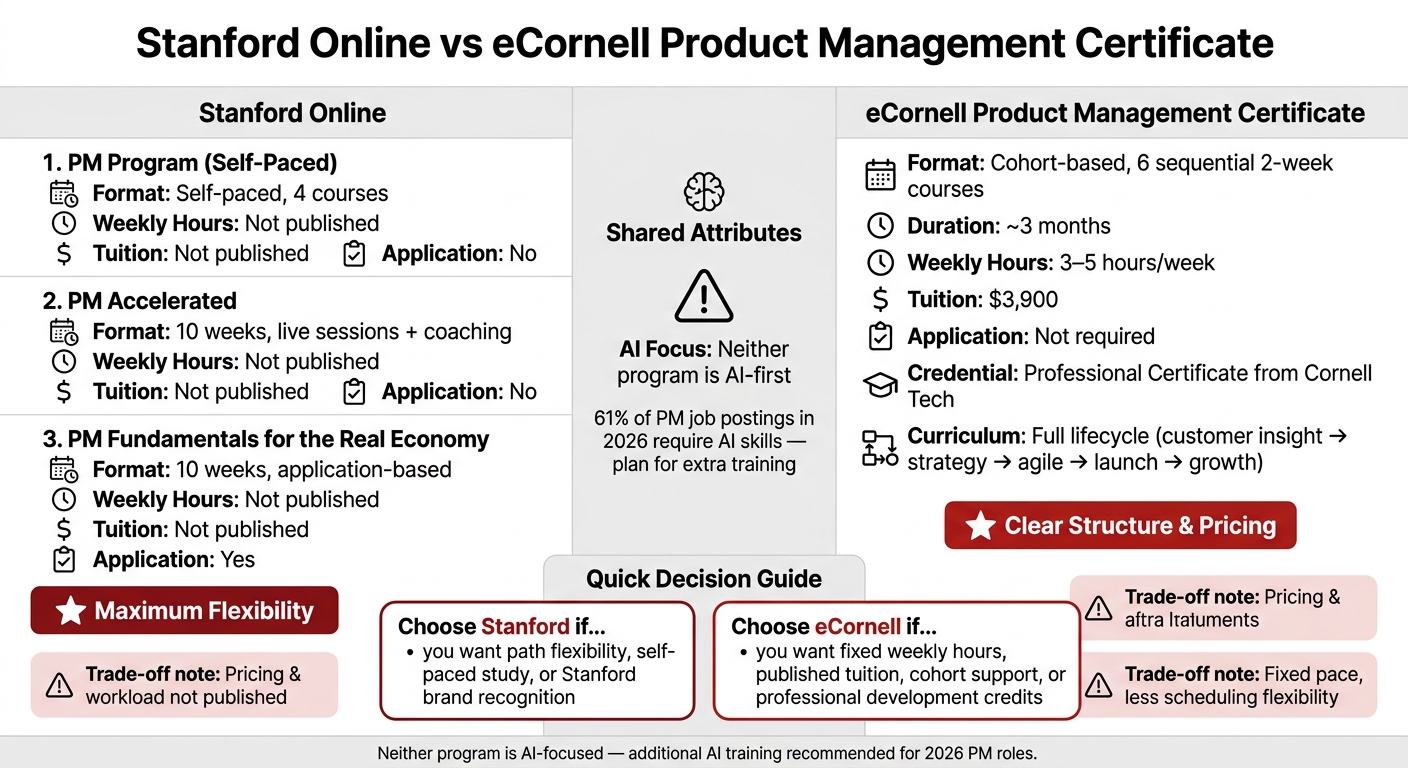
Stanford gives you more paths, while eCornell gives you more clarity. Stanford offers 3 online product management options with different formats. eCornell offers 1 cohort-based certificate with a fixed pace, 3-5 hours per week, and listed tuition of $3,900.
If you’re deciding between them, here’s what matters most:
- Format: Stanford has self-paced and 10-week options; eCornell follows a set sequence.
- Workload: eCornell publishes 3–5 hours weekly; Stanford does not list one standard weekly load across all paths.
- Price: eCornell lists $3,900; Stanford does not list one public tuition figure here.
- Credential: eCornell awards a Professional Certificate from Cornell Tech.
- AI topics: Neither program puts AI at the center, so you may need extra study to master essential PM skills in the age of AI.
- Best fit: Stanford suits people who want path choice. eCornell suits people who want a fixed schedule and clear expectations.
Bottom line: if you want flexibility, Stanford stands out. If you want clear structure, published weekly hours, and listed cost, eCornell is easier to judge up front.
Quick Comparison
Program | Format | Length | Weekly Time | Tuition | Application | AI Focus |
|---|---|---|---|---|---|---|
Stanford PM Program | Self-paced, 4-course path | Self-paced | Not published | Not published | No | Not a core focus |
Stanford PM: Accelerated | Structured with live sessions, coaching, peer work, group project | 10 weeks | Not published | Not published | No | Not a core focus |
Stanford PM Fundamentals for the Real Economy | Application-based path | 10 weeks | Not published | Not published | Yes | Not a core focus |
eCornell Product Management Certificate | Cohort-based, 6 sequential courses | About 3 months | 3–5 hours/week | $3,900 | Not stated here | Not a core focus |
I’ll keep the comparison simple: curriculum scope, pace, cost, credential, AI coverage, entry requirements, and which type of learner each option suits best. For those seeking peer support beyond these programs, joining a product management community can provide ongoing networking and growth.
Stanford Product Management Review : Is It Worth It?
Stanford Online Product Management Options
Stanford offers three online product management paths.
Product Management Program and Accelerated Format
The standard Product Management Program is self-paced and made up of four courses. That gives you the most flexibility if you want to move on your own schedule.
The 10-week Accelerated format is more structured. It includes live sessions, coaching, peer interaction, and a group project. So instead of working through the material solo, you're learning with a set timeline and direct support.
Product Management Fundamentals for the Real Economy
Product Management Fundamentals for the Real Economy is also a 10-week option, but it takes an application-based approach.
Feature | PM Program (Self-Paced) | PM: Accelerated | Product Management Fundamentals for the Real Economy |
|---|---|---|---|
Duration | Self-paced | 10 weeks | 10 weeks |
Structure | Four-course, self-paced pathway | Live sessions, coaching, peer interaction, and a group project | Application-based pathway |
Application Required | No | No | Yes |
With Stanford's options laid out, the next section looks at how they compare with eCornell's certificate.
eCornell Product Management Certificate
eCornell offers a product management certificate program. Here’s the basic setup.
Program Format, Time Load, and Credential
The certificate includes six sequential, two-week courses and takes about three months to finish. Plan for 3–5 hours per week.
This isn’t just a sit-back-and-watch program. The courses include graded assignments, so learners show what they’ve learned instead of only moving through lecture videos. After finishing the program, graduates earn a Professional Certificate from Cornell Tech.
Curriculum Scope and the Product Management 360 Distinction
The curriculum covers the full product lifecycle, not just one slice of product work. That includes customer insight, strategy, agile methodology execution, launch, and growth.
Cornell describes this as Product Management 360. In plain English, that means a full-lifecycle approach that runs from customer insight to growth.
With eCornell’s structure clear, the next section compares it with Stanford on curriculum, pace, price, AI coverage, and brand value.
Side-by-Side Comparison: Curriculum, Time, Price, AI, and Brand Value
The main differences come down to format, time commitment, price, AI coverage, and name recognition. Stanford does not publish one standard weekly workload across all of its pathways. eCornell is much more direct here, listing 3–5 hours per week. So if you want a simple apples-to-apples view, the table below makes that easier.
Comparison Table: Program Structure and Cost
Factor | Stanford Online | eCornell |
|---|---|---|
Program options | Three Stanford pathways | Cohort-based product management certificate |
Time load | Varies by pathway / not published | 3–5 hours per week |
Published tuition | Not published | $3,900 |
Delivery model | Multiple pathways | Cohort-based |
AI focus | AI is not a core focus | AI is not a core focus |
That means the choice isn't just about school name. It's also about how much structure you want and how much ambiguity you're okay with.
Comparison Table: Strengths and Trade-Offs
Factor | Stanford Online | eCornell |
|---|---|---|
Best for | Pathway flexibility and Stanford brand | Clear pricing and cohort structure |
Trade-off | Less consistent across pathways | Less flexible because pacing is fixed |
Brand signal | Large Stanford alumni network | Cornell brand recognition |
Neither curriculum is AI-first. If will product managers be replaced by AI is a question on your mind, that's a gap in both options, and you'll likely need to add separate AI training on top.
On brand value, Stanford has the sharper edge because of its large alumni network. But brand only gets you so far. In the same data, 38 out of 47 successful alumni said public proof of product thinking - like side projects and teardowns - was just as important for inbound interest. Cornell's upside leans more on its brand plus a fixed, structured format.
Which Program Fits Which Learner
Decision Table by Learner Profile
Use the table below to line up each program with your time, support needs, and the kind of credential you want.
Learner Profile | Best Fit | Why |
|---|---|---|
Needs maximum schedule flexibility | Stanford self-paced path | No fixed deadlines, study on your own timeline |
Wants a guided, structured experience | Stanford Accelerated | 10-week path with clear progression |
Has an academic background and wants Stanford's application-based path | Stanford Fundamentals for the Real Economy | Built for applicants moving from academia into product roles |
Wants predictable weekly structure | eCornell Certificate | Cohort-based, 3–5 hours per week, fixed schedule |
Needs a certificate that counts toward professional development credits | eCornell Certificate | Built for learners who need professional development credits |
Final Takeaways and Decision Checklist
After looking at format, workload, and cost, a simple pattern shows up.
Stanford leans toward flexibility; eCornell leans toward structure. If AI skills are part of your goal, plan to add separate training no matter which route you pick, since 61% of PM job postings in 2026 require them.
Before choosing, check these points:
- Schedule: Do you want fixed deadlines and set weekly hours, or self-paced study?
- Learning style: Do you do better with a cohort or on your own?
- Budget: Does the tuition fit your price range?
- Professional development credits: Does your employer or role ask for them?
- AI learning needs: Will you need extra AI training after either program?
FAQs
Which Stanford PM option fits my goals?
The results on hand don't include enough detail about Stanford Online or eCornell product management certificate options. That means I can't yet compare things like:
- topics covered
- workload
- price
- brand value
- AI coverage
So, I can't say which Stanford PM option lines up best with your goals.
If you send the Stanford Online option names, links, or the article's comparison table, I can help match the best path to your goals, experience level, and any time or budget limits.
How should I compare value if Stanford pricing isn’t listed?
If Stanford’s price isn’t listed, compare its value with other signals instead of a direct cost match.
Look at:
- Duration and time load: How long does the program take, and how much work does it ask for each week?
- Certificate included: Does the program come with a certificate, or is that extra?
- Targeted outcomes: Does it help with job-ready skills, portfolio pieces, or capstone work you can actually show employers?
That way, you’re judging value based on what fits your budget and schedule best, not just which option has the lowest price tag.
What extra AI skills should I add after either program?
After either program, add AI literacy so you can understand how models behave and how to make sound decisions with them. Focus on ML basics, data and analytics intuition, NLP concepts, and AI KPIs such as precision, recall, and latency.
You should also build evaluation and oversight skills. That means knowing when to trust AI and when to overrule it, how to design evaluation and “golden” sets, and how to account for bias, privacy, safety, and guardrails.
If you’re finding this blog valuable, consider sharing it with friends, or subscribing if you aren’t already. Also, consider coming to one of our Meetups and following us on LinkedIn ✨ And check out our official website.
Connect with the founder on LinkedIn. 🚀
About the Product Management Society
The Product Management Society is an international community for product managers, founders, designers, and career-switchers, with 2,400+ members across active chapters in Lisbon, Berlin, Frankfurt, and Mexico City. The community runs more than 50 in-person meetups per year, a Slack network, an invite-only WhatsApp group, a blog, and a growing suite of free tools for product leaders. More information is available at www.productmanagementsociety.com.
About Gabriela Naumnik
Gabriela Naumnik is an AI product leader and the founder of the Product Management Society. A Staff Product Manager working at the intersection of AI and enterprise product, she focuses on AI-powered platforms serving Fortune 500 companies. She is a regular speaker at product conferences, publishes on product management at the Product Management Society's blog, and has built the PM Society into one of the most influential product communities in Europe and Latin America. She holds a B.S. from NYU/NYU Shanghai and an M.S. from Columbia University. More information is available at gabriela-naumnik.com.