What Monetizable Side Projects Product Managers Work on in 2026
Guide for PMs to choose narrow, revenue-first side projects: AI copilots, automations, digital products, or advisory.

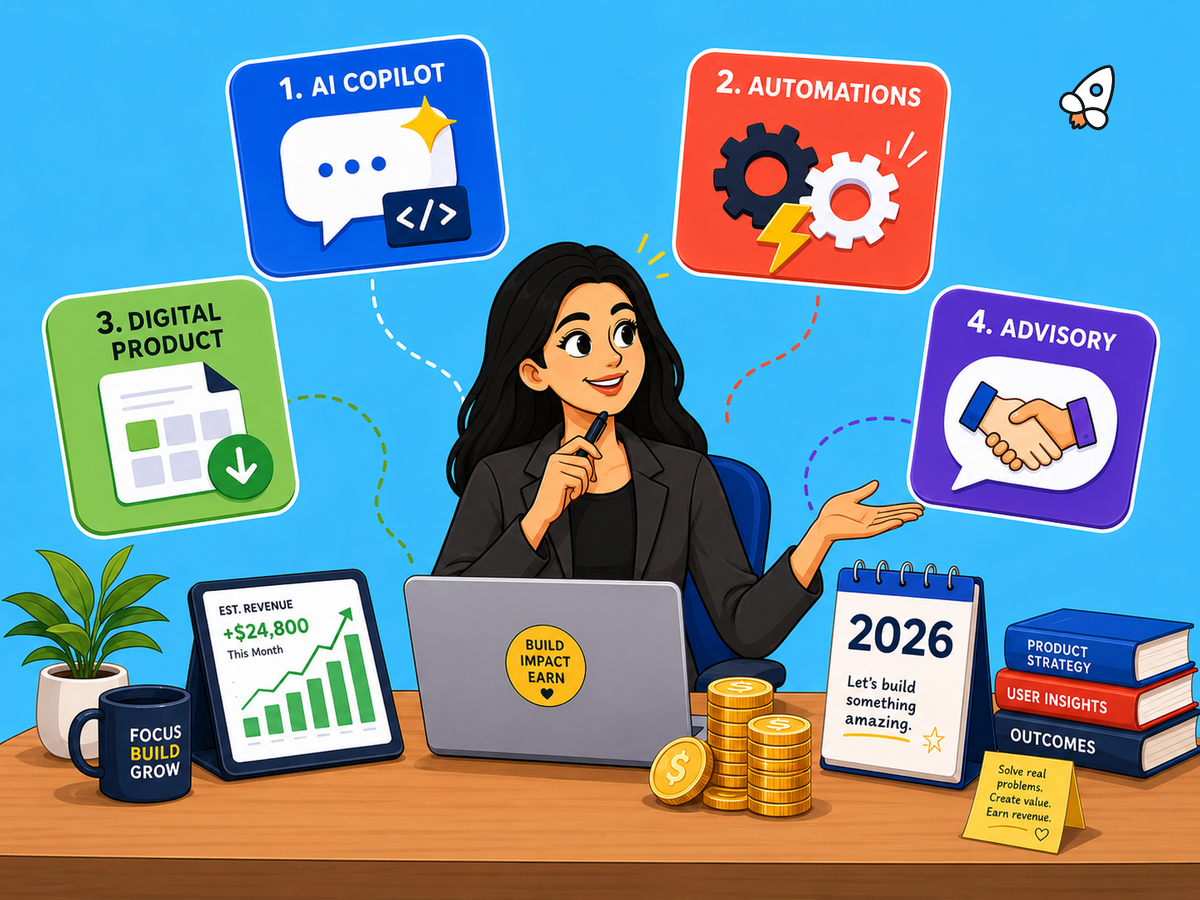
If you're a PM picking a side project in 2026, keep it narrow, tie it to one painful workflow, and charge early. Side projects most likely to make money are not broad apps or generic content plays. They are small offers built around expert judgment and sold in one of four lanes: AI copilots, workflow automations, digital products, or advisory and education.
Here’s the short version:
- AI copilots fit PMs who know one niche problem well and can turn it into a paid output.
- Workflow automations fit repeat tasks with clear triggers, fixed steps, and the same type of result each time.
- Digital products fit PMs with low time and strong domain know-how.
- Advisory and education fit PMs who already have trust, a point of view, or direct access to buyers.
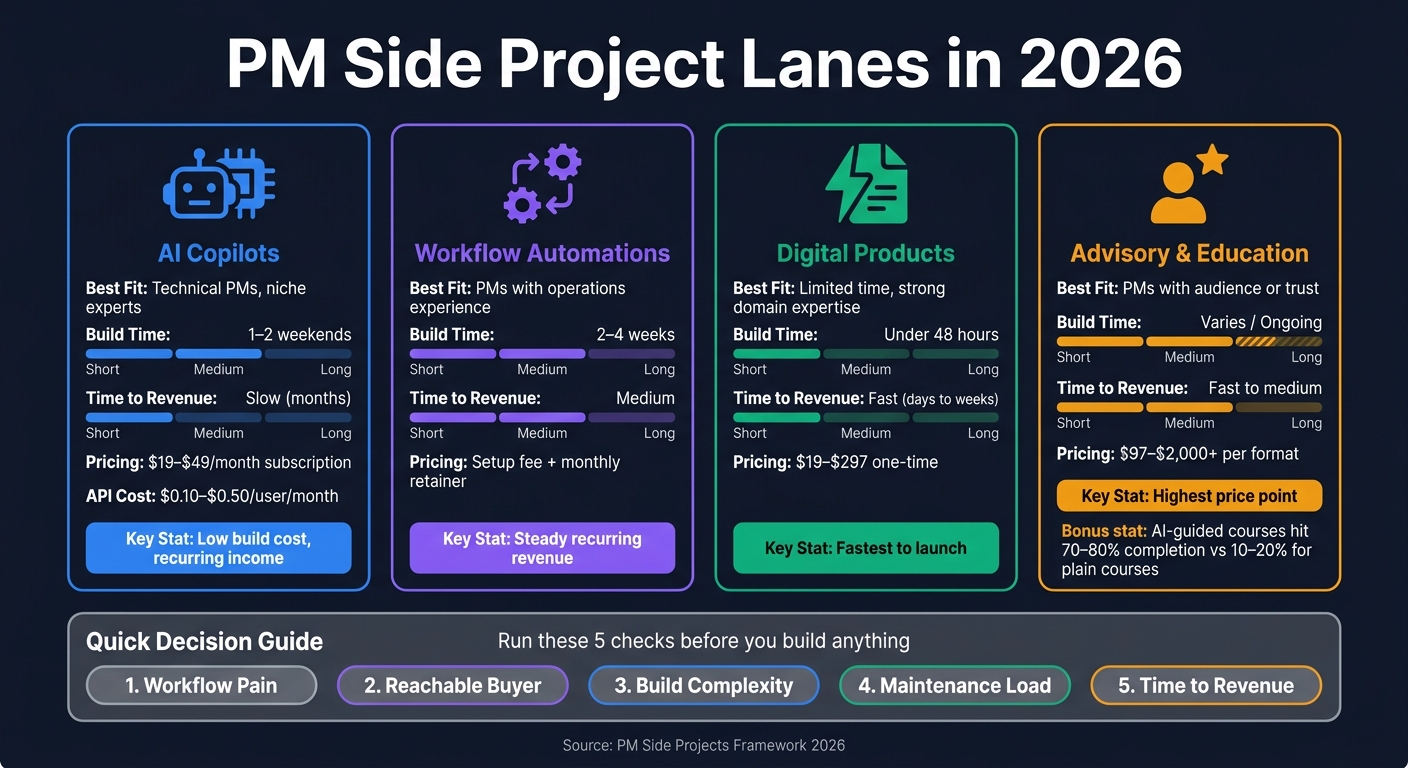
A few numbers make the tradeoffs clear:
- AI copilots may cost about $0.10 to $0.50 per user per month to run and often sell for $19 to $49/month.
- Digital products can be built in under 48 hours and may start earning in days to weeks.
- Workflow automations often take 2 to 4 weeks and are usually sold with a setup fee plus a monthly retainer.
- Advisory offers can start in days and often begin around $2,000+.
- Plain courses often see 10% to 20% completion rates, while AI-guided versions can hit 70% to 80%.
Before building anything, run five checks:
- Workflow pain: Is this one repeat task people want off their plate?
- Reachable buyer: Do I know who pays for this now?
- Build load: Can I ship without getting stuck for months?
- Maintenance load: Will this need constant fixes?
- Time to revenue: How soon can I test if people will pay?
Quick Comparison
Lane | Best fit | Build time | Time to first money | Common pricing |
|---|---|---|---|---|
AI copilots | Technical PMs, niche experts | 1–2 weekends | Slow | $19 to $49/month |
Workflow automations | PMs who know process-heavy teams | 2–4 weeks | Medium | Setup fee + monthly retainer |
Digital products | PMs with little time and strong know-how | Under 48 hours | Fast | $19 to $297 one-time, sometimes more |
Advisory and education | PMs with audience or trust | Varies | Fast to medium | $97 to $2,000+ depending on format |
What I like about this framework is that it does not treat every side project the same. It gives a simple way to match your time, skill, and audience to the type of offer most likely to get paid.
How PMs Should Choose the Right Side Project in 2026
Pick a side project using five filters: workflow pain, reachable buyer, build complexity, maintenance load, and time to revenue. Put simply, these filters turn the earlier test around time, skill, and audience into a clean yes-or-no check.
Workflow pain means one repeat task with steady inputs and outputs. Reachable buyer means you can point to a clear group of real buyers who already pay for some kind of workaround. Build complexity and maintenance load matter for a simple reason: if shipping takes too long or the project needs constant care, it will eat your time. Time to revenue shows how long you can afford to run the project before it starts paying you back.
Build around problems people already search for and already pay to fix. That’s the sweet spot. The four lanes below show what that looks like in practice.
These four lanes line up directly with those filters. AI copilots fit technical PMs or people with deep niche knowledge. You can usually build an MVP in 1–2 weekends, and the best monetization path is often a monthly subscription. Workflow automations work well for PMs who understand process-heavy teams. They tend to take 2–4 weeks to build and usually make money through setup fees plus monthly management. Digital products like templates and prompt packs are the simplest option. You can build them in under 48 hours, and they can start earning within days. Advisory and education are a good match for PMs with a clear point of view and direct access to an audience.
Lane | Best Fit For | Typical Build Time | Time to Revenue |
|---|---|---|---|
AI Copilots | Technical PMs, niche experts | 1–2 weekends | Slow (months) |
Workflow Automations | PMs with operations experience | 2–4 weeks | Medium |
Digital Products | Limited time, domain expertise | Under 48 hours | Fast (days to weeks) |
Advisory & Education | Proven experts with an audience | Ongoing | Fast to medium |
Start with the lane that matches your time and leverage best. First up: AI copilots.
1. AI copilots
AI copilots take one expert workflow and turn it into one paid result for one niche. This is where PMs often do well: they already know the decision path, so they can turn that know-how into a product. This lane works best when buyers already spend money to make this pain go away. API costs can stay around $0.10–$0.50 per user per month while the product sells on a $19–$49 subscription.
The strongest copilots do one thing well: they turn a repeat expert decision into a paid output. Here are four ideas PMs are selling right now:
- Vertical AI agent for niche documentation: Build a narrow tool that drafts repeat industry docs, such as clinical notes, contract summaries, or logistics handoff reports.
- AI diagnostic tool: Create a scored audit that turns user inputs into next steps. Visibility strategist Kelly Sinclair built Valerie the Visibility Auditor, which evaluates a user's weekly activities against a proprietary ROI framework to redirect effort toward high-impact work. One-time pricing in the $27–$97 range is common for this format.
- Three-step bot flow: Bundle three connected bots that take a user from input to final output. In 2026, PR coach Nicole built a three-step workflow where the first bot generates media messaging, the second researches matching podcasts, and the third drafts personalized pitches in the client's voice.
- Niche wrapper with a purpose-built interface: Package an existing model in a simple UI for one job and one buyer. Tools like Lovable let non-technical PMs ship a working web app through plain-language prompts, often within 48 hours.
What makes these products sell is the IPO framework: Input, Process, and Output. The input is what the user gives you. The process is your method built into the product. The output is the thing they can use right away. That setup is the difference between a product people will pay for and a chatbot that feels clever but doesn’t do much.
When a task starts to sprawl across too many steps, PMs usually stop treating it like a copilot and sell it as automation instead.
2. Workflow automations
When a workflow has a few steps, a clear trigger, and the same kind of output each time, PMs should position it as automation, not a copilot.
That’s because workflow automations turn repeat work into a step-by-step system. The best fit is repeatable, low-variance work: tasks with fixed inputs and outputs that don’t change much from one run to the next. This is where PMs can stand out. A generic tool can follow instructions, but it usually misses the business context that makes the workflow useful.
Common workflow automations that people will pay for include:
- Automated client onboarding: Starts when a contract is signed, creates folders, sends a welcome sequence, and tags the new client in the CRM.
- Support ticket triage: Reads incoming emails, drafts replies, and routes bugs to the dev queue.
- Multi-channel content distribution: Pulls key points from one article and turns them into social posts, email summaries, and graphics.
- Lead qualification and routing: Scores inbound leads against set criteria and sends them to the right sales rep or nurture sequence.
For a first version, put a human approval step in place before anything gets sent or published.
If the workflow is too small to automate from start to finish, package the method as a digital product instead.
3. Digital products
When a workflow is too small to automate or changes too much from case to case, turn the method into a digital product. It’s easier to sell, faster to deliver, and simpler to keep up over time.
Here are four product types PMs are making money from in 2026:
- Paid diagnostic reports: Build a scored assessment that takes user inputs and turns them into a custom report. Visibility strategist Kelly Sinclair built Valerie the Visibility Auditor, which reviews a user’s weekly marketing activity against an ROI framework and shifts attention toward higher-impact work. These tools often sell for $27–$97 per use.
- Interactive frameworks: These guided tools walk users through something like a prioritization matrix, GTM strategy builder, or 90-day roadmap generator, then give them a custom output at the end. Most are priced at $97 to $297 as a one-time purchase.
- Packaged bot workflows: Some PMs sell process. Others sell software. A packaged bot workflow is a set of connected agents sold as a template, prompt pack, or guided system, not a constant assistant running in the background. This format usually sells for $47–$197/month or a one-time fee of $297–$997.
- Niche micro-SaaS tools: These are small, focused software products built for one clear group, like usage analytics, price trackers, or feedback-tagging tools. Non-technical PMs are using tools like Lovable and Claude to launch working web apps without a dev team. Subscriptions tend to fall between $29 and $99/month, and the micro-SaaS market is projected to grow from $15.7 billion to nearly $60 billion by 2030.
Digital products make sense when your know-how can be turned into a repeatable system. If your edge comes more from trust, audience reach, or live help, advisory and education may be a better fit.
4. Advisory and education
For PMs who already have trust, an audience, or strong niche credibility, the best offers usually turn expertise into guided execution.
If your edge comes from credibility rather than scale, sell the part people often get stuck on: implementation. That can look like audits, coaching, and guided tools built from hands-on PM work. Plain courses tend to see completion rates around 10% to 20%, while AI-guided versions reach 70% to 80%. That gap matters. It’s why the PM advisory products with the most revenue potential are shifting toward implementation, not just instruction.
Here are four advisory and education formats PMs are already monetizing:
- Expert-backed AI tools: Turn your framework into a guided tool that helps clients get to a clear recommendation fast. Michelle, a messaging strategist, built an AI tool called "Moxie" in 2026 that takes voice-of-customer research as input and produces marketing messaging using her proprietary methodology - replacing a manual process that previously took months. PMs with deep knowledge in areas like FinTech or B2B SaaS can use the same model for roadmap audits, discovery frameworks, or GTM planning.
- Bot squads for client work: A bot squad is a group of connected tools that walks clients through a multi-step service. Nicole, a PR coach, built a three-bot system in 2026: the first runs client intake and produces a media messaging document, the second researches relevant podcasts, and the third drafts personalized pitches in the client's voice. For PMs, that same setup can support roadmap reviews, stakeholder updates, or product discovery, then be sold as a subscription.
- Voice-guided learning experiences: With voice tools like ElevenLabs, PMs can deliver audio-guided coaching that gives clients on-demand access to their framework. These products usually sell for $97 to $497. Pairing them with live office hours or advisory check-ins keeps the offer rooted in advisory work instead of turning it into a plain digital product.
- Cohort-based implementation sprints: Run a small-group workshop over 2 to 4 weeks, then add live feedback, templates, and office hours. This gives buyers a clear way to apply PM frameworks - whether that’s discovery, prioritization, or GTM planning - with direct access to your judgment at each step.
"AI tools reduce the perceived heaviness of implementation. Clients who would otherwise stall on a blank page... can now move through the process with guided support." - Kelly Sinclair, Co-founder, wAIv
These offers tend to work best when they move buyers through a simple path: a free diagnostic, then a paid tool, then premium advisory. They also tend to earn more when they’re packaged into a simple stack and priced based on how much support the buyer gets.
Build Stacks and Monetization Models That Actually Fit PMs
Once PMs choose a lane, the stack and pricing model decide if the offer has a shot. PMs in 2026 win by turning product judgment into AI-powered workflows, not by spending months building big standalone software from scratch. Tools like Lovable, MindStudio, and Make keep launch costs and build time low. The edge isn't the code - it's the framework built into the tool.
Here’s a simple way to match each project type to the right stack, buyer, and pricing model:
Project Type | Target Buyer | Typical Stack | Time to First Revenue | Pricing Model | Support Burden |
|---|---|---|---|---|---|
AI Copilot / Micro-SaaS | Niche SMBs, power users | 4–8 weeks | Subscription ($49–$299/mo) | High (model changes and API updates) | |
Workflow Automation | Ops and HR leads | Make, Zapier, MindStudio, wAIv | 2–4 weeks | Setup fee + monthly retainer | Medium (logic refinement) |
Digital products, prompt libraries, and PM templates | Solo creators, freelancers | 48 hours – 1 week | One-time ($19–$97) + upsell | Low (static assets) | |
Advisory / Consulting | Executives, founders | MindStudio, Claude | Days | Premium project ($2,000+) | Low (high-touch, low volume) |
Cohort-based education | Upskilling professionals | Teachable, ElevenLabs, Loom | 4–6 weeks | One-time + upsell ($197+) | Medium (live sessions) |
The money logic changes by lane. Copilots and micro-SaaS tend to work best with subscriptions or per-seat pricing. That gives you recurring revenue that can grow as more users come in. Templates and prompt packs fit one-time purchases better, often as the first step into a higher-priced offer. Advisory and cohort-based education can charge more because buyers are paying for your direct judgment, not just the system itself.
A simple path is to start with a $0–$27 diagnostic, then move buyers into a $97–$297 tool and a $497+ premium offer.
Conclusion
The side projects that pay in 2026 tend to share three traits: they stay narrow, solve an immediate problem for a specific buyer, and run on AI-based systems. So the main call isn’t whether you should build. It’s which lane lines up with your time, skill set, and audience.
Pick the lane that fits your edge. Then keep the goal simple: build a repeatable system. The best opportunities come from turning AI into a repeatable result, not from writing clever prompts.
Start small, sell early, and use buyer feedback to grow only after the first offer proves itself. Early revenue checks demand and your judgment at the same time. And when you’ve shipped a side project, you also have a stronger product story. It shows you can build with AI and get something into the market.
Build narrow. Ship fast. Charge early.
FAQs
Which side project lane fits my PM background best?
Start with the overlap between your PM skill set and actual market pain. If you know a niche well and can spot the same frustrating workflow popping up again and again, that’s a strong place to begin.
You’ve got a few solid paths:
- Digital products: templates, prompt packs, and action-focused guides
- Services: AI-driven workflows built for one specific industry
- AI apps: micro-SaaS or vertical copilots
Pick the path that fits your timeline and your comfort level with tech. Then use a 90-day plan to test the idea with paying users.
How do I validate demand before I build anything?
Start with a specific problem you know well. Then make sure the pain is real.
A simple rule: at least 10 people or companies should already be dealing with that problem and paying for something to fix it. If no one is spending money yet, that's a warning sign. You may have an idea, but not a business.
Next, turn what you know into a repeatable framework. Think of it like taking something you can do on instinct and laying it out step by step so another person could follow it. That makes it easier to explain, test, and sell.
Before you build too much, put that framework in front of five potential buyers. Ask direct questions:
- What feels confusing?
- What seems missing?
- Would you pay for this?
Those conversations can save you from wasting months on the wrong offer. People will usually show you the gaps fast if you listen.
One more rule matters here: keep your starting costs under $500 until money starts coming in. Early on, the goal isn't to look big. The goal is to learn what people want and get proof that they'll pay for it.
What should I sell first if I have very little time?
If your time is tight, start with digital products or services that lean on what you already know. That gives you a head start and cuts down setup time.
Templates are a good example. Think Notion boards or document frameworks. They're usually the fastest thing to get out the door, and you can start selling them right away.
You can also offer an AI-assisted service you already understand, like workflow automation or content drafting. In many cases, services bring in cash faster than software, because you don't need to build an MVP before you can start.
If you’re finding this blog valuable, consider sharing it with friends, or subscribing if you aren’t already. Also, consider coming to one of our Meetups and following us on LinkedIn ✨ And check out our official website.
Connect with the founder on LinkedIn. 🚀
About the Product Management Society
The Product Management Society is an international community for product managers, founders, designers, and career-switchers, with 2,400+ members across active chapters in Lisbon, Berlin, Frankfurt, and Mexico City. The community runs more than 50 in-person meetups per year, a Slack network, an invite-only WhatsApp group, a blog, and a growing suite of free tools for product leaders. More information is available at www.productmanagementsociety.com.
About Gabriela Naumnik
Gabriela Naumnik is an AI product leader and the founder of the Product Management Society. A Staff Product Manager working at the intersection of AI and enterprise product, she focuses on AI-powered platforms serving Fortune 500 companies. She is a regular speaker at product conferences, publishes on product management at the Product Management Society's blog, and has built the PM Society into one of the most influential product communities in Europe and Latin America. She holds a B.S. from NYU/NYU Shanghai and an M.S. from Columbia University. More information is available at gabriela-naumnik.com.