10 Networking Tips for Product Managers
Combine people-first outreach with AI: attend meetups, join PM groups, build a 5–8 peer circle, track contacts, and follow up fast.

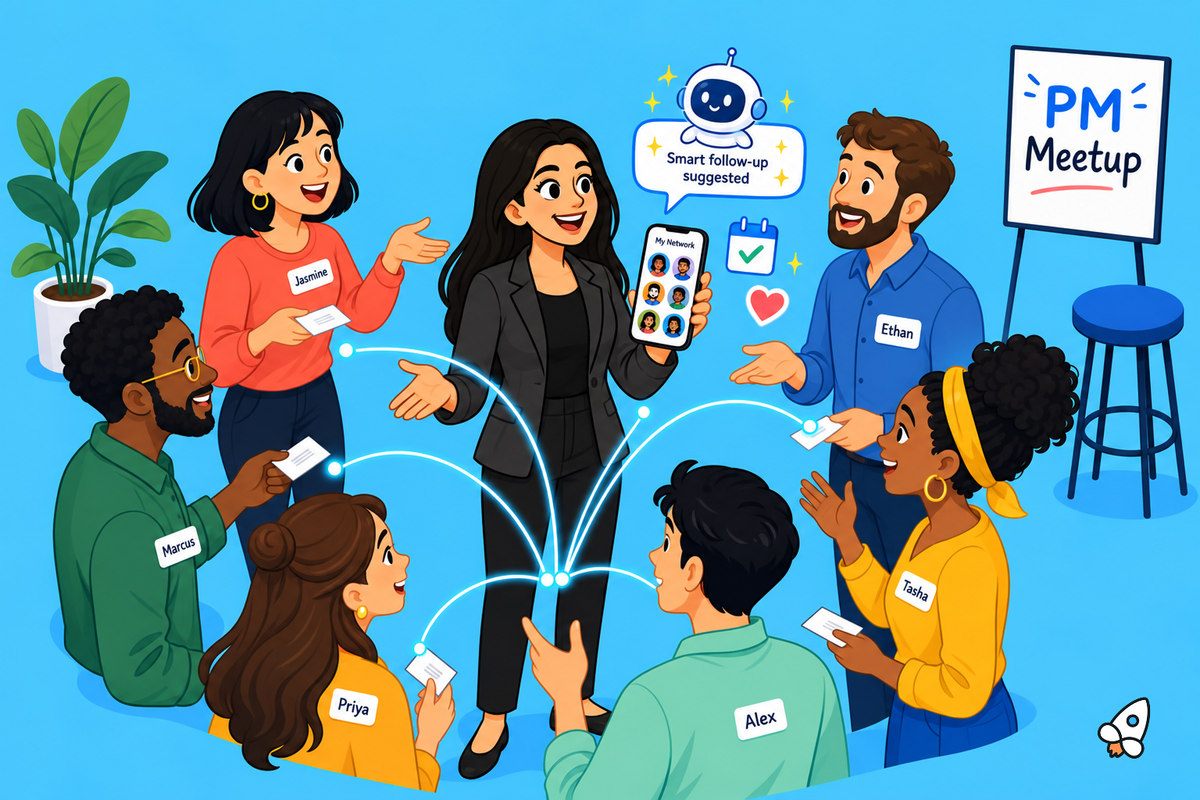
To build a stronger personal PM network, do these 10 things: show up in person, stay active in PM groups, build a small circle, use LinkedIn with care, follow up fast, track contacts, and let AI handle prep work.
This article’s core point is quite simple: PM networking works best when you mix people-first contact with AI support. And we have clear numbers to back it up: PM roles can draw hundreds of applicants, referrals can make you 3–5x more likely to get interviews, and many jobs still come through personal connections.
Here’s the full playbook in one quick scan:
- Start with PM meetups where you can meet people who do product work
- Go to local events and conferences for face-to-face talks
- Join online PM groups to stay in touch between events
- Build a peer circle of 5–8 PMs for steady contact
- Create topic-based chats for deeper talks
- Use LinkedIn with focus instead of random outreach
- Send follow-ups in 24–48 hours
- Track contacts in a simple CRM or spreadsheet
- Use AI to find warm paths and draft outreach
- Treat networking as hybrid work: AI for admin, people for trust and judgment
What I like about this approach is that it doesn’t frame networking as “meet more people.” It frames it as meet the right people, keep in touch, and make each follow-up easier.
How to Network and Follow-up after Applying for Product Manager Roles
Quick Comparison
Area | Best Use | What Matters Most |
|---|---|---|
In-person events | First meetings and trust-building | Shared context and repeat contact |
Online groups | Staying active between meetups | Regular interaction |
Small peer circles | Honest feedback and referrals | Consistency |
Targeted outreach | Specific messages | |
CRM tracking | Keeping relationships warm | Follow-up timing |
AI tools | Research, drafts, reminders | Human editing |
AI can help me move faster, but people still decide who they trust, refer, and remember.
1. Start With Product Management Society Events and Meetups
If you're building your PM network from zero, Product Management Society events are a smart place to begin. The community includes more than 3,000 members across product roles and nearby functions. That matters. You're not walking into a room full of random business contacts. You're meeting people who know product work firsthand.
These meetups tend to center on actual PM challenges, so the talk moves beyond small talk pretty fast. Instead of just swapping LinkedIn profiles, people get into how they handle roadmaps, stakeholder pushback, hiring, and product bets. That's where good connections usually start.
There’s also a simple numbers game here: relationships grow through repeat contact. With more than 50 in-person meetups each year, you get more chances to see the same people again and again. That repeat exposure helps turn a one-time intro into something more familiar. Between events, the Society keeps the conversation going through Slack and WhatsApp follow-ups.
AI can help with the busywork around networking. Before an event, you can use it to sum up speaker bios or pull together quick notes on the companies attending. Afterward, it can help draft follow-up messages while the details are still fresh. That said, the tool only helps with speed. The connection still comes from the actual conversation.
Another plus: recruiters and hiring managers show up at these events, and members say the connections they make there have helped their careers. So don’t think of this as a one-and-done appearance. The better move is to show up often enough that the next chat feels easy, not cold.
2. Attend Local Product Meetups and Industry Conferences
If Tip 1 helps you get into a strong PM circle, local meetups and conferences help you go beyond it. They put you in front of new companies, open roles, and decision-makers you probably wouldn’t meet through your current network.
That matters for one simple reason: in-person conversations are easier to build on. You leave with a shared moment, a specific topic, or a quick exchange you can mention later. That makes follow-up feel natural instead of forced.
Deeper Conversations and Easier Follow-Up
Face-to-face contact tends to build trust faster than most online outreach. You can hear tone, read energy, and get a better sense of how someone thinks. That’s especially useful in product, where conversations often touch on stakeholder influence, trade-offs, and judgment calls.
As one of Product Management Society members put it:
"AI makes PM mentorship easier to scale, but people give it depth."
That line gets to the point. AI can help with reach, but people are what make the interaction stick.
And here’s what often changes everything: seeing the same person again. The second or third meetup can turn a quick intro into an actual relationship. Local events make those repeat touchpoints much easier, so each chat starts a little warmer than the last.
Use AI for Prep and Follow-Up
AI can help before and after the event without taking over the human part.
Before you go, use it to research speakers and companies you’re likely to run into. That way, you’re not walking in cold. You’ll have a rough sense of who’s who, what they work on, and what might be worth asking.
After the event, use AI to draft a personalized follow-up note. Timing matters here. The 24–48 hour window after an event is when follow-ups tend to land best.
A simple way to handle it:
- Use AI once before the event for research
- Use AI once after the event for a draft
- Keep the actual conversation human
That last part matters. AI should support the process, not stand in for it.
Career Relevance
Focus on events where recruiters, hiring managers, and senior PMs are likely to show up. Those rooms tend to be more useful if you’re looking for your next role or trying to get closer to the people who shape hiring decisions.
Showing up once is good. Showing up often is where things start to change. Over time, casual introductions can turn into professional contacts you know by name.
Use local events to make the first connection, then keep it warm in online PM communities.
3. Join Online Product Communities and Slack Groups
Local events get you in the room. Online communities keep you connected in between. They give you a place to ask a fast question on a Tuesday afternoon, get input on work in progress, or find someone dealing with the same mess you are. You don't have to wait for the next meetup. That's why these spaces often become the link between one-off events and longer PM relationships.
Relationship Depth
Not all communities work the same way. Curated, invite-only groups tend to work better because people know each other and the discussion stays on track. Product Management Society's invite-only spaces follow that model.
Repeat Contact
Slack groups are useful because they let you get feedback on actual work, fast. You can post an early draft, test your thinking, or ask how someone else handled a tough product call - all within the same week.
A simple move helps here: engage with someone's posts for a week before messaging them. By the time you reach out, you're not just another cold name in their inbox.
AI Leverage
AI can help with the busywork, but it won't replace the need for human judgment. It can summarize long threads, draft replies, and surface discussions worth your time. Use it to handle the admin side so you can spend more of your energy on conversations that need human judgment.
Career Relevance
If you work in a specialty - like AI-native products or fintech - niche communities will often do more for you than broad ones. For specialized PMs, niche groups usually beat general spaces. They make it easier to meet peers who know your domain and can vouch for your work.
Use these communities to spot the 5–8 PMs you want to stay close to.
4. Build a Small Peer Circle of 5–8 Product Managers
Once you’ve made a few strong connections in online communities, pull them into a small peer group. Keep it small: 5–8 product managers is plenty. That size helps people open up faster. A big network may look good on paper, but a tight circle is where trust starts to build. It’s also where casual online contact turns into a group that can actually help each other.
Relationship Depth
Referred candidates are 3–5x more likely to land interviews than cold applicants. That gap matters. A small peer circle is often where those warm referrals begin.
These aren’t just people who recognize your name. They know how you think. They’ve seen your judgment over time. And when the moment comes, they’re far more likely to back you because they’re not guessing about your work.
"The scoreboard is shifting: Reach → Relationship; Clicks → Commitment; Virality → Credibility." - Michael Leibovich, Adobe Head of Growth
That quote gets at the point pretty well. The win isn’t more reach. It’s more trust.
Repeat-Touch Potential
This isn’t about finding more people. It’s about staying in touch with the right few. The value comes from repetition. One good conversation helps. Ten steady ones change the relationship.
Set up a simple weekly rhythm:
- a 30-minute call
- a shared notes doc
- a rotating discussion prompt
That’s enough. Low effort, steady follow-through.
AI Leverage and Career Relevance
Use AI to handle summaries and notes. Keep judgment, candor, and coaching with people. By 2026, 74% of senior PMs use AI every week, which makes human conversation matter even more in the moments that count.
The toughest PM calls usually don’t live in a neat framework. Internal politics, trade-offs, and career moves all depend on context. They also depend on trust. You need people who can tell you the hard thing plainly, without posturing or sugarcoating it.
That’s another reason to keep the group small. Smaller circles make honest feedback more likely, and useful feedback is the whole game here.
If the circle starts to gain momentum, break it into smaller topic chats when it makes sense. That gives people room to go deeper on things like hiring, roadmap work, stakeholder conflict, or career moves without turning the main group into noise.
5. Create Topic-Based Small Group Chats
Split your peer circle into smaller chats by topic so each thread stays useful and active. That helps the main group stay alive while each side chat goes deeper.
Relationship Depth
Use each chat for the hard PM stuff: trade-offs, stakeholder friction, and what not to build. That’s usually where people stop speaking in polished takes and start showing how they think.
Repeat-Touch Potential
Tie the conversation to something concrete, like a product teardown or PRD review. That shared artifact gives people a reason to come back, because the next discussion connects straight to the work already on their plate.
AI Leverage
Use AI to summarize long threads so people can catch up fast, but keep the discussion itself human. If someone misses 40 messages, a short summary can get them back in the room without killing momentum. Once the thread gets active, move the strongest connections into direct LinkedIn follow-up.
Career Relevance
These chats show how you think, not just what you shipped.
Use topic chats to build trust faster, then carry those relationships into one-to-one outreach.
6. Use LinkedIn for Targeted Product Networking
Use LinkedIn to connect with the PM peers, hiring managers, and leaders who matter most for your next move. Once you know who those people are, LinkedIn gives you a simple way to stay visible between conversations.
Relationship Depth
Start with 2nd-degree connections when possible. A warm intro from a shared contact often gets you through the door faster than cold outreach. Before you send a request, mention one specific post, talk, or project. That small detail makes the outreach feel human and gives the other person an easy way to reply.
Repeat-Touch Potential
Connecting is just the start. The relationship grows when you show up in small, useful ways over time. Congratulate someone on a promotion or new role. Share an article that lines up with something they care about. Leave a comment when they post.
Those steady touchpoints help you stay on their radar without making the interaction feel transactional.
AI Leverage
Use AI to draft the first message, sum up recent activity, and check tone before you hit send. By 2026, 74% of senior product managers use AI every week, and many use it to see whether a message sounds too salesy or too vague.
Career Relevance
Your profile should point to the roles and problems you want next. Keep your headline and summary direct so your fit and direction are clear the second someone lands on your page.
Use LinkedIn to open the door. Then follow up while the conversation is still warm.
7. Send Follow-Up Notes Within 24–48 Hours
After the first conversation, timing matters almost as much as the conversation itself. Send a follow-up within 24–48 hours to reinforce that first impression and improve response rates.
Relationship Depth
Skip the generic thank-you note. Instead, mention one specific detail from the conversation: a problem they brought up, a product call they made, or a resource you both talked about. People tend to remember how an interaction ends, so a thoughtful note can shape how they remember the meeting. It also gives you a natural starting point for the next message.
Repeat-Touch Potential
A specific follow-up makes you easier to remember. It also makes future contact feel more natural, whether you're asking for a referral, an intro, or a quick take on a roadmap call. Referred candidates are 3–5x more likely to land interviews than cold applicants.
AI Leverage
One simple way to do this: record a quick voice note right after the meeting, then use AI to turn it into a clean draft and point out anything missing. Let AI handle the rough draft. Your judgment should shape the final note.
"As execution gets cheaper, the critical skill becomes choosing what to execute." - Jenny Karuna, CPO, Katch
Career Relevance
If the conversation touched on a role or team you want, say so and attach your resume. If you don't hear back, follow up again in 7–10 days and once more at 21–28 days. After that, move on.
8. Track Relationships With a Simple Networking CRM
Most PMs meet people. Far fewer keep good records on those conversations.
That’s where a spreadsheet or simple CRM helps. It doesn’t replace relationship-building. It helps you keep it going. After you send the follow-up note, the next step is to log what you learned. Follow-up is the move. Tracking is what keeps that move going over time.
Relationship Depth
Track just enough detail to make the next message feel personal, not forced.
That usually means:
- Name
- Role
- Company
- Last conversation date
- Key takeaways
- Next follow-up date
You can also add shared interests or a specific question that came up in the conversation. That gives you an easy entry point when you reach out again.
Repeat-Touch Potential
A CRM makes it easier to stay on someone’s radar without sounding pushy.
If you log next steps and follow-up dates, you can time your outreach around things that matter to the other person, like a promotion, an article they published, or another milestone they mentioned. Reminders help here. When a contact shares news, changes roles, or hits a milestone, you have a natural reason to check in.
AI Leverage
Tools like Dex can pull contacts from LinkedIn, email, and your phone into one place, then automate interaction tracking and follow-up reminders.
AI can also take rough notes and turn them into clean contact records with next-step reminders, so things don’t slip through the cracks. That frees you up to focus on the human part: timing, tone, and context. Over time, that record gives you a stronger base for faster, better AI-assisted outreach later.
Career Relevance
About 70% to 80% of jobs are filled through personal connections and internal referrals.
A CRM can help you map warm paths, like second-degree contacts who may be able to introduce you to the right people. It also helps to tag contacts by type, such as mentors, target employers, and peers. Once you do that, it becomes much easier to spot where your network is deep and where it’s thin.
9. Use AI Tools to Find People and Write Outreach Messages
After you log contacts in your CRM, use AI to figure out who to contact next and what angle makes sense. With your contact list in place, AI can point you to the next best people to reach out to and help you draft a stronger opening message.
Find Warm Introductions
AI can map the best path to a warm introduction by looking at skills, goals, and working styles. It can also spot mutual connections just outside your current network who may be able to make an introduction. Once you know who that person is, use AI to turn that context into a first message that feels grounded and specific.
AI Leverage
Give AI a clear hook to work with: a post they wrote, a metric from your work, and a direct ask. You can also record a short voice note, have AI turn it into a draft, and then revise it for tone and detail. Before you send an important message, use AI to flag weak logic or awkward tone.
Career Relevance
Have AI scan their recent posts and pull out one hook that fits your goal before you send the request. AI can draft the message, but you should still choose the tone and timing.
10. Get Ready for Hybrid, AI-Assisted PM Networking
Once you've built a network through events, communities, peer circles, and follow-ups, the next shift is how AI changes the work around networking.
PM networking now breaks into two lanes: AI handles research, drafts, scheduling, and follow-up reminders. People handle trust, judgment, and career decisions.
Relationship Depth
As AI fills feeds with generic content, in-person moments stand out more. That makes small, trusted groups worth more than broad, noisy channels. Curated Slack groups and small chats matter more too, because they keep conversations grounded and focused.
PMs who mix face-to-face events with small online groups tend to build stronger relationships.
Use AI for prep and follow-up. Use live conversations for judgment, trust, and referrals.
Repeat-Touch Potential
AI can flag dormant contacts, new roles, and timely reasons to reconnect. That makes follow-ups easier to tailor without sounding canned.
AI Leverage
Use AI for the first draft, then edit it yourself. It can also help pressure-test your thinking before high-stakes conversations.
Career Relevance
AI skills for product managers demand grew by about 7x between 2024 and 2026. As AI becomes part of day-to-day PM work, being fluent in AI-assisted networking becomes a clear edge.
Treat AI as part of your networking workflow, not as a replacement.
How PM Networking Has Changed: Pre-AI vs. AI-Assisted
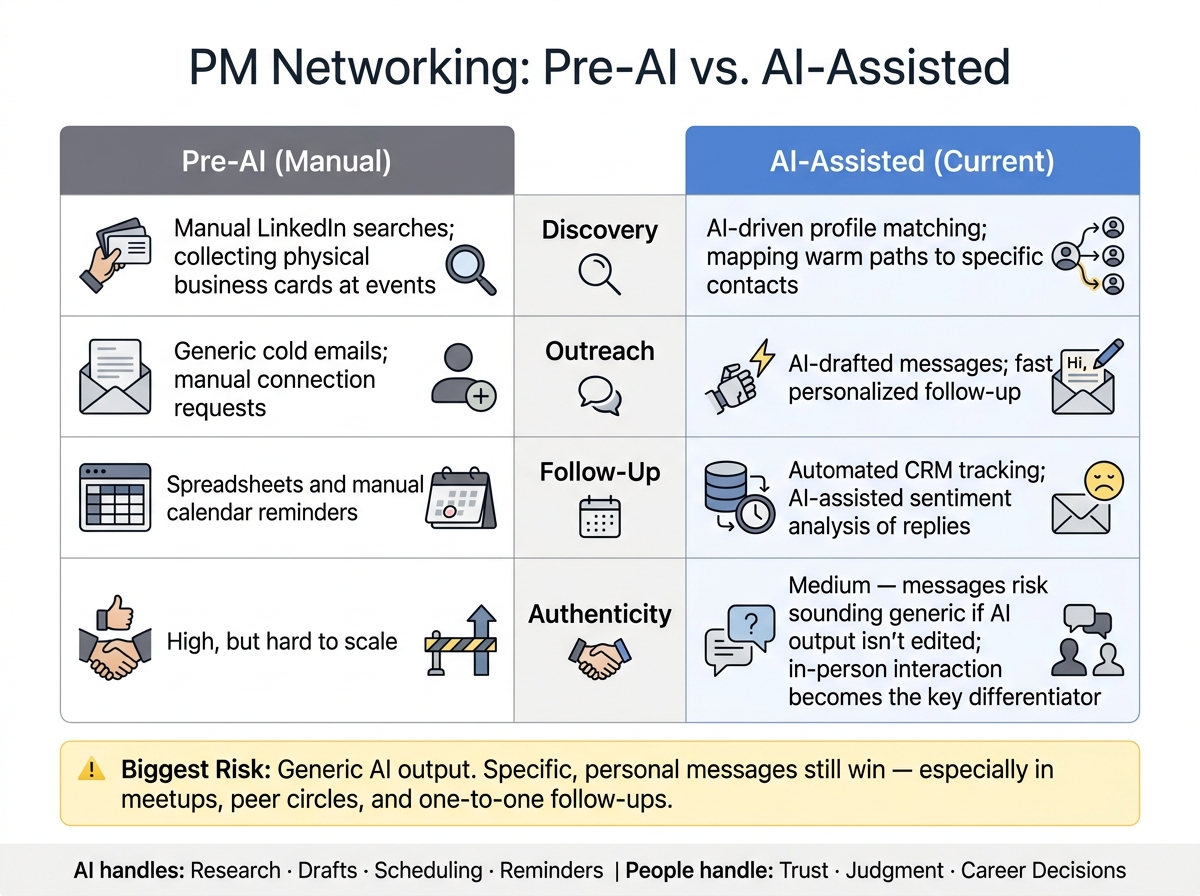
These tips work because they pair live relationships with AI support. PM networking now breaks into two parts: AI handles research and follow-up, while people handle trust and judgment. You can see that split at each step.
Before AI, networking meant manual searches, cold outreach, and spreadsheet reminders. Now AI takes care of much of the admin work. People still make the calls that shape trust, fit, and career moves.
Here’s the simplest way to compare the two models.
Stage | Pre-AI (Manual) | Current AI-Assisted |
|---|---|---|
Discovery | Manual LinkedIn searches; collecting physical business cards at events | AI-driven profile matching; mapping warm paths to specific contacts |
Outreach | Generic cold emails; manual connection requests | AI-drafted messages; fast follow-up |
Follow-up | Spreadsheets and manual calendar reminders | Automated CRM tracking; AI-assisted sentiment analysis of replies |
Authenticity | High, but hard to scale | Medium - messages can sound generic if AI output isn't edited. Human, in-person interaction becomes the differentiator |
The biggest risk is authenticity. Specific, personal messages stand out. That’s why meetups, peer circles, and one-to-one follow-ups still matter most.
Use this split to decide where AI helps and where human contact matters more. The tables below turn that shift into quick networking choices.
Quick Comparison Tables for PM Networking Choices
The earlier tips show how PM networking works. These tables make the next step easier: which channel should you use first? The split is simple. AI helps with speed. People build trust. Use that split for each networking call you make.
When trust matters most, go deeper. When discovery matters most, go for reach. And when you need steady follow-through, lean on smaller circles.
In-Person vs. Virtual Events
Factor | In-Person Events | Virtual Events |
|---|---|---|
Best For | Building deep trust; reaching senior PMs and decision-makers | Broader reach without travel |
Key Advantage | Shared experiences create natural icebreakers | Efficient; broader reach without travel |
Key Drawback | Limited by geography and schedule | Often lower-commitment; lower relationship investment |
If you want stronger connection fast, in-person usually wins. A hallway chat, a shared session, even a quick coffee line moment can do a lot of work. Virtual events, though, are hard to beat when your goal is scale and access without the cost or time of travel.
Online Platforms: Slack vs. LinkedIn vs. Reddit
The platform shapes the relationship. Slack and invite-only groups draw highly engaged members, which usually means less noise and more useful conversation. LinkedIn gives you reach, but the signal can be mixed, so targeted outreach matters. Reddit and forums work best when you're starting from zero in a new area and want to look around before you commit.
Platform | Conversation Quality | Relationship Depth | Best Use Case |
|---|---|---|---|
Slack / Invite-Only | High - curated, human-verified | Deep - peer support and mentorship | Peer circles; real-time feedback |
Variable - high volume, generic outreach | Broad - efficient but often lower-trust | Referral outreach; role targeting | |
Reddit / Forums | Exploratory - serendipitous | Light - good starting point | Discovering new niches from zero |
Think of it this way: Slack is where relationships can grow, LinkedIn is where searches happen, and Reddit is where you can wander a bit and spot new paths.
Large Communities vs. Small Peer Circles
Use large communities to find people. Use small circles to build accountability.
Large groups are good for discovery. You meet more people, hear more ideas, and spot who seems worth following up with. Small peer circles do a different job. They help you stay in touch, trade honest feedback, and keep promises to each other. If a large group is a busy conference hall, a small circle is the table where people actually remember your name.
Outreach Methods: Manual vs. AI-Assisted
Method | Speed | Trust Level | Best Use Case |
|---|---|---|---|
Manual Outreach | Slow | High - personal and specific | High-stakes mentors; senior PM connections |
AI-Assisted Research | Fast | Medium - finds paths, not rapport | Broad strategic networking |
AI-Drafted Outreach | Fastest | Low if unedited - risks sounding generic | First drafts; routine follow-ups |
Here’s the rule of thumb: use AI to do the prep work, not the relationship work. It can help you find people, map links, and speed up a first pass. But if the note still sounds like a template, people will feel it right away.
Use AI for the first draft, then edit for tone and specifics.
Conclusion
From meetups to CRM, the pattern stays the same: strong PM networks don’t happen by accident. People build them on purpose, through consistency and steady follow-through.
One channel won’t do the job on its own. PMs need to use in-person events, online communities, peer circles, and AI-assisted outreach together.
That mix matters even more now. As AI turns more of the execution work into a commodity, PMs who build real relationships - not just contact lists - stand out. That’s the shift happening now. It’s also why warm introductions and solid follow-up still beat cold outreach.
Product Management Society is one example of this hybrid model in practice. It reflects the same approach this article recommends.
The formula is simple: meet people in person, stay active online, keep a small peer circle, follow up fast, and use AI to move faster.
FAQs
How do I start networking if I know no PMs?
Start with a clear goal. Maybe you want mentorship, job leads, or a better read on your industry. That gives your networking some direction instead of turning it into random outreach.
Then spend time where PMs already gather: local or virtual meetups, workshops, online groups, and LinkedIn. That’s usually where the best conversations begin.
Before an event, look up attendees or speakers and prepare a short intro. Nothing fancy. Just enough to say who you are, what you do, and why you wanted to connect.
After the event, send a personal follow-up that mentions what you learned from the conversation. Then stay in touch now and then with a quick check-in, a relevant update, or a note of congratulations when it makes sense.
What should I say in a PM follow-up message?
Make it personal to the conversation. Thank them for their time, and call out one specific takeaway or idea that stood out.
Keep it short. Suggest a simple next step, and include one helpful resource, note, or detail they’d care about.
If you want to keep the connection going, offer an easy cadence like checking in once a month or sharing the occasional update. Add clear contact info so replying feels easy.
How can I use AI without sounding generic?
Use AI as a support tool for scanning, pulling ideas together, drafting, and tracking follow-ups, not for the final human connection. It can help with outreach, sure. But it can't replace emotion, trust, or your own sense of how a moment feels.
If you want to keep your voice, make each message personal. Mention something specific from the conversation or the person's work so it doesn't read like a template. Start with sincere interest, offer something useful first, and make sure the final message sounds like you - your judgment, your experience, your call.
If you’re finding this blog valuable, consider sharing it with friends, or subscribing if you aren’t already. Also, consider coming to one of our Meetups and following us on LinkedIn ✨ And check out our official website.
Connect with the founder on LinkedIn. 🚀
About the Product Management Society
The Product Management Society is an international community for product managers, founders, designers, and career-switchers, with 2,400+ members across active chapters in Lisbon, Berlin, Frankfurt, and Mexico City. The community runs more than 50 in-person meetups per year, a Slack network, an invite-only WhatsApp group, a blog, and a growing suite of free tools for product leaders. More information is available at www.productmanagementsociety.com.
About Gabriela Naumnik
Gabriela Naumnik is an AI product leader and the founder of the Product Management Society. A Staff Product Manager working at the intersection of AI and enterprise product, she focuses on AI-powered platforms serving Fortune 500 companies. She is a regular speaker at product conferences, publishes on product management at the Product Management Society's blog, and has built the PM Society into one of the most influential product communities in Europe and Latin America. She holds a B.S. from NYU/NYU Shanghai and an M.S. from Columbia University. More information is available at gabriela-naumnik.com.