How to get hired as a Product Manager in 2026
Stand out in the 2026 PM market: pick a lane, show shipped work, build a portfolio, master interviews, and run a targeted job search.

Getting a PM job in 2026 is harder because there are more applicants, fewer open seats, and hiring teams want proof, not promise. If I want a shot, I need to pick one lane, show shipped work with numbers, build a small portfolio, prep for interviews with structure, and run a tight job search.
Here’s the short version:
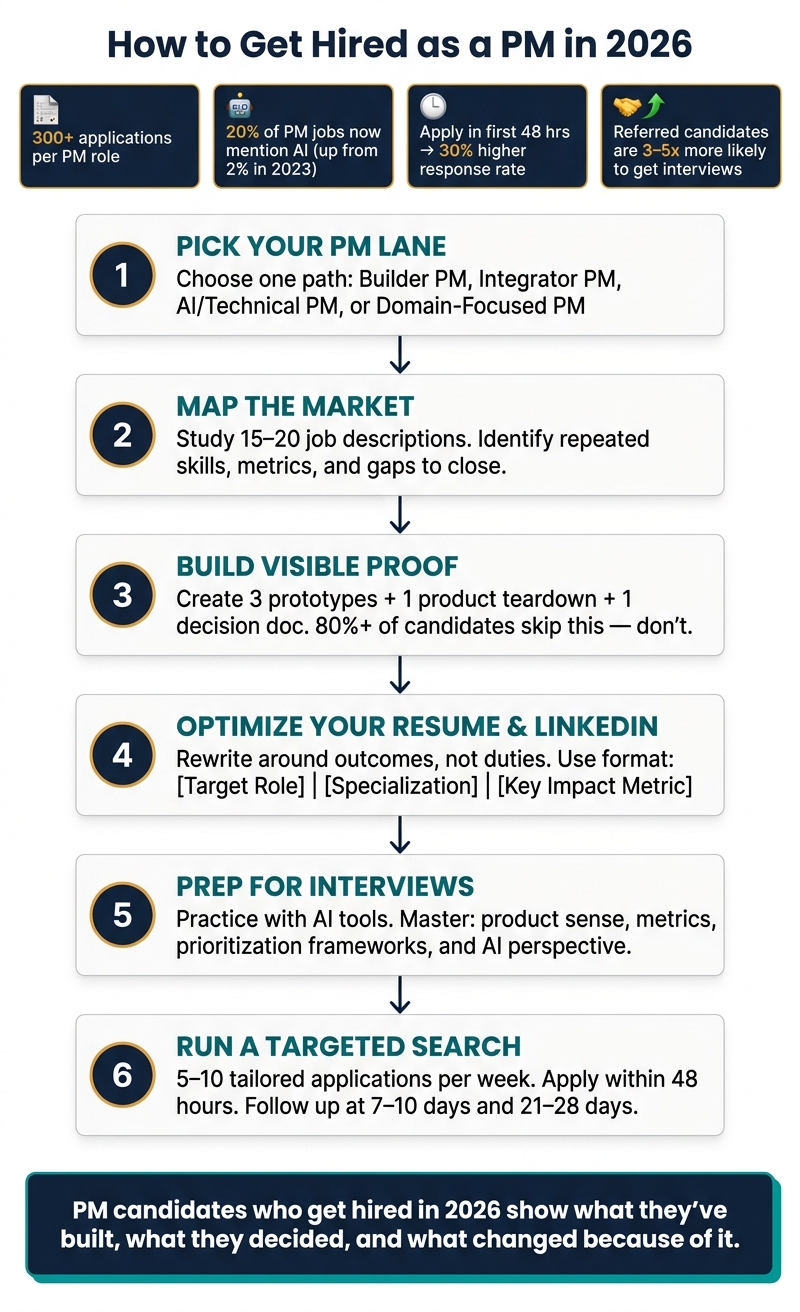
- PM roles are crowded: many roles now get 300+ applications
- AI matters more: 20% of PM job posts mention AI, up from 2% in 2023
- Entry-level is tougher: many “junior” roles now lean toward people with 2–3 years of experience
- Proof wins: shipped work, prototypes, teardowns, and decision docs beat task lists
- Targeted search works better: applying in the first 48 hours can lift response rates by 30%
- Referrals matter: referred candidates are 3–5x more likely to land interviews
What I take from this is simple: I can’t apply like it’s 2023. I need to show results, clear judgment, and work people can review fast.
A good plan looks like this:
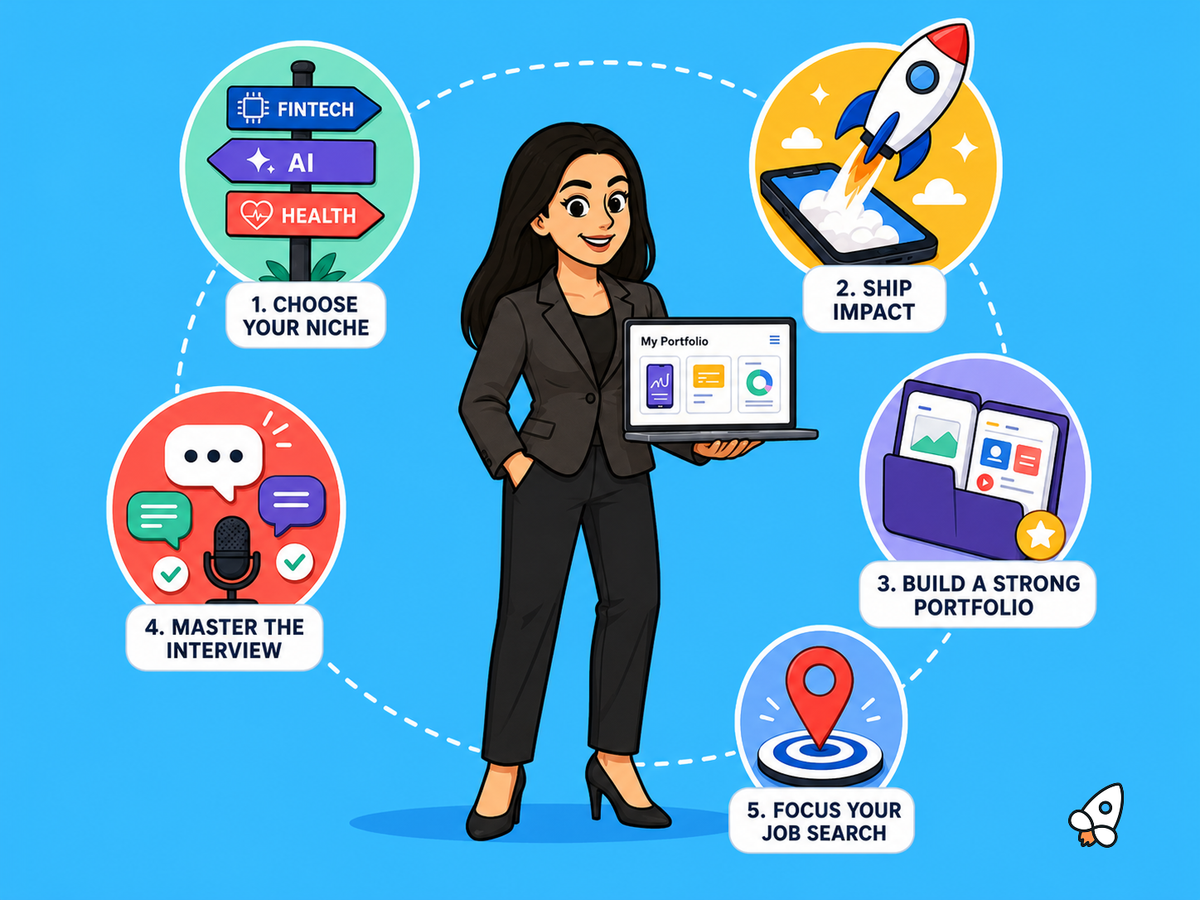
- Pick one PM path - builder, integrator, AI/technical, or domain-focused
- Study 15–20 job descriptions and pull out repeated skills and metrics
- Close gaps with visible work - like 3 prototypes, 1 teardown, and 1 decision doc
- Rewrite my resume and LinkedIn around outcomes instead of duties
- Practice interview stories around user problems, trade-offs, metrics, and team influence
- Apply to a short list of companies with tailored materials and referral outreach
Area | What hiring teams want now |
|---|---|
Resume | Results, ownership, and metric movement |
Clear target role, focus area, and proof | |
Portfolio | Prototypes, teardowns, and product decisions |
Interviews | User-first thinking, metrics, trade-offs, and AI point of view |
Job search | Tailored applications, referrals, and follow-up |
If I had to sum it up in one line, it would be this: PM candidates who get hired in 2026 show what they’ve built, what they decided, and what changed because of it.
How to Become a Product Manager in 2026 (The Complete 10-Step PM Roadmap)
1. Read the 2026 PM market before you apply
Start by reading the market before you touch your resume. That step saves time and keeps you from spraying applications in every direction.
As of January 2026, there are 23,000+ open PM roles globally. At the same time, laid-off PMs are also going after junior roles, which pushes the effective entry bar up to 2–3 years of experience.
Pick one PM lane instead of applying to everything
Right now, the market has split into two clear role types: the Builder PM and the Integrator PM.
The Builder PM is AI-native, builds prototypes fast, and works with less reliance on other teams. The Integrator PM leans on high EQ and keeps marketing, sales, and product moving in the same direction.
That split matters. Companies are being pickier, and generalist backgrounds are harder to place because many teams now want deep domain knowledge in areas like fintech, healthcare, or marketplaces.
Use the snapshot below to line up your background with the kind of PM role companies are hiring for now.
Entry-Level PM | Mid-Level / Senior PM | AI / Technical PM | |
|---|---|---|---|
Experience | 0–2 years; side projects often required | 3–7+ years with a proven track record | Varies; demonstrated involvement in shipping, plus model evaluation depth |
Core expectation | Demonstrated building, product sense | Decision architecture, owning the order of decisions | Building LLM prototypes and evaluating model quality |
Remote availability | Mostly on-site/hybrid for mentorship | More likely to offer hybrid/remote options in generalist roles | 93% on-site or office-based |
Use job descriptions to map what employers actually want
Once you pick a lane, gather 15 to 20 recent PM job posts on LinkedIn that fit it. Then look for repeated skills, phrases, and patterns. From there, build a simple checklist:
- skills you already have
- skills you need to show more clearly
- gaps you still need to close
Also, watch the language in each post. Some roles are task-focused: managing Jira, writing tickets, shipping features. Others are results-focused: driving retention, cutting churn, and measuring what matters like ARR.
That difference tells you a lot. If a job description is packed with task language but says little or nothing about success metrics, that's a signal worth noting before you spend time on the application. Your checklist from this step becomes the base for the skills you build next.
2. Build the skills employers will pay for in 2026
Once you pick a lane, focus on the small set of skills that still drive callbacks. Use the job-post checklist from the last section to spot the gaps that matter most.
Core PM skills that still decide most hiring outcomes
Customer problem framing, roadmap trade-offs, KPI selection, experiment design, clear writing, and cross-functional alignment still matter. PRD writing, sprint hygiene, and Jira management are now baseline - not differentiators.
What sets candidates apart in 2026 is tougher to fake. Hiring managers point to three main separators:
- Decision sequencing - knowing which decisions need to happen first, and which ones can wait
- Cross-functional alignment - lining up competing goals across marketing, sales, and product without losing speed
- Feature-killing judgment - stopping a feature that looks good on the surface but is pushing the product in the wrong direction
"The PMs I see getting passed over right now aren't the ones who can't ship. They're the ones whose entire track record is shipping... the skill stack underneath it is exactly what AI commodified first." - Leah Tharin, Growth Strategy Expert
SQL is also non-negotiable. Technical fluency shows up in 78% of 2026 PM job postings, and showing analytical skills like SQL and A/B testing boosts interview callbacks by 45%.
AI fluency that shows you are current, not just curious
AI fluency now means showing how you use it in product work, not just saying you know it. That can look like:
- Synthesizing research with LLMs
- Building prototypes with AI tools
- Explaining where AI adds value versus noise in a product
AI PM roles now pay 30% to 40% more than standard PM roles, and demand for AI fluency in job postings grew nearly sevenfold between 2024 and 2026.
How to close skill gaps fast with projects and structured learning
When the gap is clear, close it with work people can see. Certifications help less than most people think. What tends to move the needle is visible work - prototypes, teardowns, and decision docs that show how you think.
A simple target works well: build three prototypes, one teardown, and one decision doc. More than 80% of PM job seekers don't have a portfolio, yet candidates who do see a 50% increase in recruiter callback rates.
If you need to close gaps fast, spend 90 days learning the language, building prototypes, and publishing one teardown and one decision doc.
Next, turn these skills into proof on your resume, LinkedIn, and portfolio.
3. Turn your resume, LinkedIn, and portfolio into proof of PM ability
In 2026, recruiters don’t just look for skills on paper. They look for outcomes, work samples, and clear product judgment. Your job is to turn what you know into proof they can scan in seconds.
Write resume bullets that show ownership and outcomes
The biggest resume mistake is simple: people list tasks instead of results.
“Managed the product roadmap” sounds fine at first glance, but it doesn’t tell a hiring manager much. What changed because of your decisions? What moved?
A good baseline is this formula: “Achieved [Y] by [Z].” For example, instead of saying, “Launched an AI chatbot to improve support,” say: “Built an AI support agent that cut ticket volume 22% and reduced time-to-value 40%.”
That version shows impact. It gives the reader something concrete.
One signal that stands out in 2026 is owning the kill. In plain English, that means showing you knew when to stop, cut, or remove something that wasn’t working. That kind of call shows judgment. For example: “Killed a low-usage feature after testing showed it hurt activation, saving 3 engineering weeks per sprint.” Hiring managers pay attention to that because it’s much harder to fake or automate.
If you don’t have revenue numbers, that’s fine. Use other metrics that show movement, like:
- Activation rate
- Churn reduction
- Experiment win rate
- Engineering cycle time
Formatting matters too. A single-column, text-first resume is usually the safer move because ATS parsers can miss keywords in fancy layouts. You don’t want tools dropping terms like “Amplitude” or “JTBD”.
Position your LinkedIn profile for the exact PM role you want
Your LinkedIn headline is one of the first things a recruiter sees. “Product Manager at TechCorp” uses up prime space without saying much.
A stronger format is: [Target Role & Level], [Specialization] | [Top Company/Big Win] | [Key Impact Metric]
For example: “Senior AI PM | Ex-Google | Shipped GenAI to 10M+ users”
That one line does a lot of work. It shows focus, signals credibility, and points to results.
Your About section should be tight and easy to scan: a one-line summary, 3–5 quantified wins, target-role keywords, and a clear contact CTA. For experience entries, don’t stop at what shipped. Show why you made the call. That’s where judgment comes through.
Recommendations help as well. Profiles with at least five LinkedIn recommendations get significantly more views and messages.
Build a portfolio with product teardowns, case studies, and artifacts
If your resume shows results, your portfolio shows how you think. You do not need a PM title. You need proof of product judgment.
Three artifact types cover most of what hiring managers want:
Artifact | What it demonstrates | Time to build |
|---|---|---|
Working prototype | Execution speed: taking an idea from problem to clickable product using AI tools | A weekend |
Product teardown | Analytical judgment: reasoning about real product decisions with evidence and proposing what to test next | An evening or two |
Decision doc | Trade-off thinking: framing a problem, weighing options, and committing to a choice, including what you'd kill | A few hours |
The most common portfolio mistake is stuffing it with feature lists and certifications. That doesn’t show much. A better move is to show a trade-off you had to navigate: a prioritization call with competing stakeholder goals, a KPI you questioned before tracking it, or an AI feature idea with the trade-offs spelled out.
Build in a domain you already know. A healthcare or logistics prototype says more than a generic to-do app because it shows deeper problem understanding. In a crowded field, that kind of specificity is what helps people stand out.
4. Prepare for PM interviews with structured practice and AI tools
Once your resume and portfolio show that you can do the work, the interview loop has to show that you can talk through it under pressure.
Prepare answers for the PM interview formats that matter most
Startups often pack the process into a recruiter screen, a product sense/execution combo, and a founder chat. Large companies usually split things into 4 to 5 separate rounds: product sense, execution, strategy, behavioral, and sometimes a data exercise.
Each round checks for something different. Product sense is about user pain and unmet needs. Execution is about defining success and figuring out why metrics dropped. Behavioral looks at influence without authority. A data exercise may test basic SQL, like finding user cohorts.
When you know the loop in advance, you can prep the right stories for each round instead of studying in a vague, all-purpose way. In 2026, judgment matters more than shipping alone.
Use ChatGPT to sharpen stories, cases, and follow-ups
One of the biggest shifts in PM prep is using AI as a practice partner. A simple prompt can go a long way:
"Act as a senior PM at [company]. Interview me for [role] and challenge each answer."
Add your resume and the job description so the output is more specific to the role.
For story prep, try this: record a rough version of a key work example with a voice-to-text tool, then paste the transcript into ChatGPT and ask it to turn it into a tight SAR (Situation, Action, Result) format. That helps your answer stay rooted in what actually happened, instead of sounding rehearsed.
The main gains are pretty clear:
- Adaptive follow-ups
- Transcript-based feedback
- Company-specific case drills
Know the rejection patterns before they happen
The fastest way to get knocked out is to miss what the interviewer is screening for.
Most rejections come from the same issues: jumping to solutions before defining the user, leaning on vanity metrics instead of retention or activation, and ranking priorities by gut feel instead of using a clear framework. In 2026, two more patterns show up a lot: no AI point of view when the role needs it, and taking solo credit for team work.
Interview area | Strong response | Red flag |
|---|---|---|
Product sense | Starts with user pains and specific segments | Jumps straight to features or solutions |
Metrics | Defines retention, activation, and revenue impact | Names only vanity metrics like DAU or page views |
Prioritization | Uses frameworks like RICE or ICE and explains trade-offs | Ranks by gut feel or internal politics |
AI perspective | Discusses accuracy thresholds, fallbacks, and cost logic | Defaults to "use an LLM" without technical reasoning |
Ownership | Credits the team and shows influence without authority | Claims solo credit with no mention of cross-functional dynamics |
If you avoid the patterns in that right column, you’re already in a better spot than many candidates. Next: how to run a focused job search that turns prep into interviews.
5. Run a focused job search that generates interviews
Once your resume, portfolio, and interview stories are ready, switch from prep mode to search mode. Treat your job search like a pipeline: target, tailor, track, and follow up.
Apply to a short list with tailored materials
Applications per PM role have doubled since 2022, so sending a pile of generic applications usually goes nowhere. A tighter approach works better. Build a list of 10–20 target companies and apply with materials that fit each role. The point isn't volume. It's getting qualified conversations.
For each application, mirror 10–15 keywords from the JD, match the company's wording, and include one portfolio piece that fits the role. Track each step in a simple spreadsheet with:
- company name
- resume version used
- contact identified
- date applied
- follow-up date
Follow up once after 7–10 days, then again after 21–28 days. If there's still no movement, move on.
Aim for 5–10 highly targeted applications per week. Speed matters too. Applications sent within the first 48 hours of a posting have a 30% higher response rate.
Tailored applications can get you in the door. Warm intros can push that door open wider.
Use networking to create referrals instead of cold outreach
Referred candidates are 3–5x more likely to get interviews than cold applicants. That's a big gap, and it's hard to ignore.
For each target company, find three people: the hiring manager, a peer PM, and the recruiter. Spend a week engaging with their posts, then send a personal connection request. After they connect, ask for a 15-minute chat about the team or product. Then follow up with one specific takeaway from the conversation and your resume.
Posting one product teardown each week on LinkedIn can help here too. For example, you might break down a live feature like Spotify's Daylist, tie it to product principles, and suggest one metric-based improvement. That gives hiring managers a window into how you think when they land on your profile. It also helps create warm intros and keeps you close to current hiring patterns.
At this stage, your search should be producing interviews, not just more applications.
The table below shows three common failure modes, where they show up, and what to do next:
Rejection Reason | Where It Appears | Concrete Fix |
|---|---|---|
No proof of work | Portfolio / Interview | Include a product teardown or a working prototype built with AI tools |
Rehearsed delivery | Interview | Use Context–Tradeoff–Decision–Impact to show judgment |
Weak online presence | LinkedIn Profile | Engage with target company posts for one week before reaching out; post one teardown weekly |
Conclusion: PM candidates who get hired in 2026 show proof, not just potential
The PM job market in 2026 rewards one thing above all: visible proof.
Not a resume packed with job duties. Not a polished answer about what you would do. What matters is proof that you can spot a real problem, place a sound bet, and move a metric that matters.
Across the steps above, the pattern stays the same. Strong candidates pick one lane, show outcomes on their resume, and support those claims with work people can actually see. Then they practice their stories out loud until their reasoning feels clear and natural, even under pressure.
"As execution gets cheaper, the critical skill becomes choosing what to execute." - Jenny Karuna, CPO at Katch
The three signals hiring teams want are outcomes, judgment, and visible artifacts. In 2026, judgment beats promise. Hireability comes from proof. That is the bar for PM hiring in 2026.
FAQs
How can I break into PM without direct PM experience?
Focus less on credentials and more on what you’ve shipped. In many cases, the strongest route into PM is an internal move from teams like engineering, design, or customer success. You start by taking on PM-type work before you have the title, like writing specs or running user interviews.
If you’re applying from the outside, you need to show proof that you can build and ship. That proof can come from past impact, a side project with actual users, or even volunteer work. The key is to point to measurable results, spell out the product calls you made, and show product builder skills like AI fluency, workflow design, and shipping prototypes.
What should I include in a PM portfolio in 2026?
In 2026, a strong Product Manager portfolio should focus more on what you've shipped than on credentials.
Start with a short intro. Then include 2–4 case studies and supporting materials like PRDs, roadmaps, or research reports.
If you want to stand out, go a step further. Add working prototypes, product teardowns, written decision docs, and public reasoning.
For each case study, make the story easy to follow. Show:
- The problem
- The context
- The constraints
- Your role
- The trade-offs
- Measurable business outcomes
That way, people don't just see what you worked on. They see how you think, how you make calls under pressure, and what changed because of your work.
How much AI knowledge do I need to get hired as a PM?
In 2026, AI knowledge for PMs means more than just knowing the buzzwords. You should be able to talk through trade-offs with engineers, like latency vs. accuracy, without needing to write code yourself.
That also means showing you can manage products built on probabilistic models. In plain English: these systems don’t give the same kind of certainty as standard software. So you need to understand their limits, design for uncertainty, and work with metrics like precision and recall when judging performance.
It also helps to get hands-on. Tools like Cursor or Bolt can help you build and test prototypes, which makes it much easier to evaluate ideas instead of talking about them in the abstract.
If you’re finding this blog valuable, consider sharing it with friends, or subscribing if you aren’t already. Also, consider coming to one of our Meetups and following us on LinkedIn ✨ And check out our official website.
Connect with the founder on LinkedIn. 🚀
About the Product Management Society
The Product Management Society is an international community for product managers, founders, designers, and career-switchers, with 2,400+ members across active chapters in Lisbon, Berlin, Frankfurt, and Mexico City. The community runs more than 50 in-person meetups per year, a Slack network, an invite-only WhatsApp group, a blog, and a growing suite of free tools for product leaders. More information is available at www.productmanagementsociety.com.
About Gabriela Naumnik
Gabriela Naumnik is an AI product leader and the founder of the Product Management Society. A Staff Product Manager working at the intersection of AI and enterprise product, she focuses on AI-powered platforms serving Fortune 500 companies. She is a regular speaker at product conferences, publishes on product management at the Product Management Society's blog, and has built the PM Society into one of the most influential product communities in Europe and Latin America. She holds a B.S. from NYU/NYU Shanghai and an M.S. from Columbia University. More information is available at gabriela-naumnik.com.