Product Management Hiring Trends in 2026 (Breakdown by Country)
AI skills drive a 2.3x surge in PM jobs—26,900 openings—higher pay, regional growth, and skills-first hiring across US, EU, India, Singapore


The product management job market in 2026 is booming, driven by a sharp rise in demand for AI expertise. Here’s what you need to know:
- Global Surge in Demand: Over 26,900 open PM roles worldwide, a 2.3x increase since 2023.
- AI Skills Are a Must: 61% of PM job postings now require AI experience, with salaries for AI PMs commanding a 15–30% premium.
- Regional Growth: India (+42% YoY), Canada (+67% YoY), and the European Economic Area (+33% YoY) are seeing standout growth.
- Remote Work Trends: Remote roles are growing globally (+43% YoY), but the U.S. lags behind with only 7% of AI-specific PM roles fully remote.
- Hiring Practices: 80–85% of companies now prioritize work samples and simulations over traditional résumés.
AI expertise is reshaping PM roles, with companies seeking professionals who can navigate technical concepts like model behavior, inference costs, and compliance. Salaries reflect this shift, with senior AI PMs earning up to $600,000 at leading companies.
The article provides a detailed breakdown of hiring trends in the U.S., U.K., Germany, India, and Singapore, alongside the specific AI tools and skills PMs need to succeed in 2026.
Global Product Management Hiring in 2026: An Overview
Key Global Hiring Trends for Product Managers
The product management (PM) job market in 2026 is thriving. As of March, there are nearly 26,900 open PM positions worldwide[11], marking a 2.3x increase in demand compared to 2023[8]. Senior-level hiring is leading this growth. In regions like India, senior PM roles have skyrocketed by 87% year-over-year, while junior roles have seen a more modest 16% growth[5].
Remote work continues to reshape the PM landscape. Remote PM roles have grown by 43% year-over-year globally, with notable increases of 86% in Canada and strong growth in Latin America. However, in the U.S., only 7% of AI-specific PM roles are fully remote, with many jobs concentrated in tech hubs like the Bay Area and New York[7]. Across the European Economic Area, remote opportunities now account for 25% to 33% of all PM roles[7].
Additionally, hiring practices are evolving. Around 80–85% of companies now prioritize work samples and simulations over traditional resumes and degrees when evaluating candidates[5].
These trends highlight the shifting demands and expectations for PMs, particularly as AI continues to influence the field.
How AI Is Shaping What Companies Look for in PMs
AI is changing not just what PMs create but also the skills companies expect from them. Tasks like synthesizing data, drafting PRDs, and summarizing user interviews are increasingly automated. As a result, companies are focusing on candidates with strong judgment - the ability to make complex, strategic decisions that AI cannot easily replicate.
Currently, 61% of PM job postings explicitly require AI experience[8]. Employers are seeking PMs who understand technical concepts like model behavior, evaluation methods, and inference economics, enabling them to navigate intricate trade-offs effectively[10].
The role of PMs is also shifting. Companies are moving away from "Output PMs" - those focused on managing backlogs and features - towards "Outcome PMs", who set strategic goals and drive measurable results[3]. As one industry expert from IdeaPlan put it:
"The gap between AI-fluent PMs and those who haven't adopted is becoming a career differentiator." - IdeaPlan[8]
This shift is reflected in salaries. AI-focused PM roles now offer a 15–30% pay premium over traditional PM roles[10]. For example, senior AI PMs at companies like OpenAI and Anthropic earn total compensation ranging from $400,000 to $600,000, compared to $320,000–$420,000 at Big Tech firms[10].
These global trends set the stage for exploring how regional hiring practices differ in the evolving PM landscape.
The Future of Product Management in 2026 (My Predictions)
Product Management Hiring by Country in 2026
United States
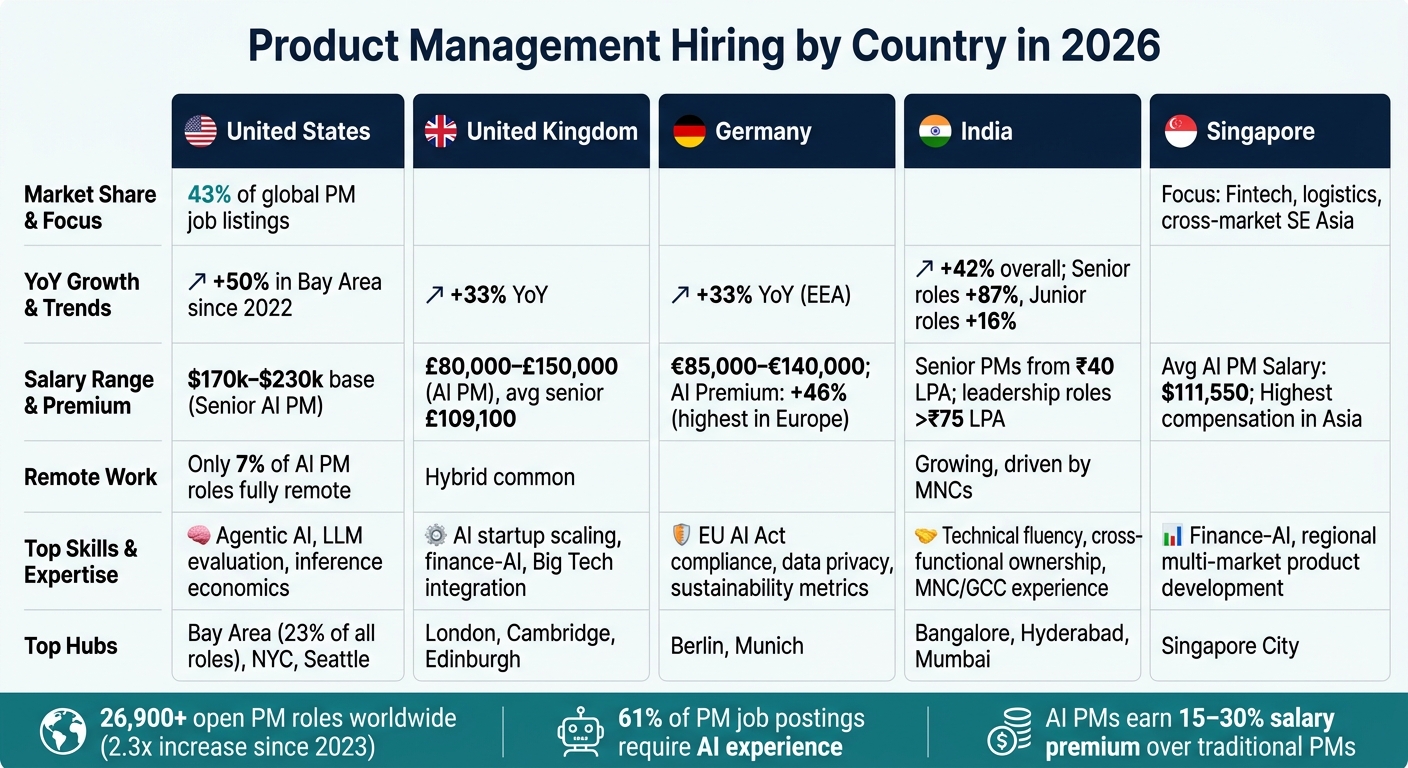
The U.S. continues to dominate the global product management (PM) landscape, making up 43% of worldwide PM job listings[6]. Within the country, the Bay Area leads, accounting for 23% of all open PM roles, a growth of 50% since 2022[4]. New York City holds its spot as the #2 global tech hub for PM hiring, with Seattle not far behind.
Compensation reflects the high demand for skilled PMs. Senior AI PMs earn between $170,000 and $230,000 in base salary, while Directors of AI Product can command between $250,000 and $380,000+[2]. Across all levels, the median base salary for PMs is $135,000, with total compensation averaging $165,000[8]. Remote work opportunities are dwindling, with just 7% of AI-specific PM roles offering fully remote options[7].
Level | SF Bay Area | NYC | Seattle |
|---|---|---|---|
Associate (0–2 yrs) | $110k–$150k | $100k–$140k | $100k–$135k |
Senior (5–8 yrs) | $175k–$230k | $160k–$210k | $155k–$200k |
Director | $230k–$320k | $210k–$300k | $200k–$280k |
Top recruiters like OpenAI, Anthropic, Google, and Microsoft are actively hiring[2][13]. They're seeking PMs with deep AI expertise - not just familiarity with tools, but hands-on knowledge of RAG pipelines, token costs, and inference trade-offs[1].
Shifting the focus to Europe, the United Kingdom offers a different market dynamic.
United Kingdom
London remains the epicenter of the UK's PM market, with additional activity in Cambridge and Edinburgh[13]. The market has rebounded, with job listings increasing by 33% year-over-year as of early 2026[6]. However, this growth is primarily driven by senior roles, while junior hiring remains sluggish[7].
AI expertise is increasingly in demand, with London-based AI PM salaries ranging from £80,000 to £150,000[2]. Mid-level PMs earn an average of £67,000, while senior PMs see salaries of up to £109,100[14]. The UK's thriving AI startup ecosystem, combined with the presence of major tech firms, ensures steady demand for PMs who can combine AI technical knowledge with strategic product planning. Hybrid work arrangements are common, offering PM candidates slightly more flexibility compared to the U.S.
Across the continent, Germany’s PM market brings its own unique characteristics.
Germany
Germany’s PM hiring is heavily influenced by its industrial sectors. Berlin and Munich are the primary hubs[2], with demand concentrated in enterprise and manufacturing-related roles. Companies like SAP and Siemens are leading the charge, seeking PMs who can integrate AI into areas like predictive maintenance, smart mobility, and industrial automation[13].
A key requirement for PMs in Germany is familiarity with EU AI Act compliance. This means understanding how to design products that meet stringent regulatory standards[3]. Additionally, PMs are increasingly expected to monitor ESG and sustainability metrics, including the environmental impact of product infrastructure[8]. AI PM salaries range from €85,000 to €140,000, with AI expertise commanding a 46% premium over traditional PM roles - the highest in Europe[12].
Turning to Asia, India and Singapore present contrasting growth patterns.
India
India’s PM market is undergoing a significant transformation. Hiring has grown by 42% year-over-year[7], with senior roles seeing an 87% increase, while junior roles have grown by just 16%[7]. Early-stage startup hiring has slowed, with most growth now driven by mid-size firms and multinational corporations (MNCs).
"If you're chasing early-stage startups in India right now, you're swimming against the current. Growth is concentrated in mid-size firms and MNCs." - Bandan Singh[7]
Senior PMs in India start at ₹40 LPA, with leadership roles exceeding ₹75 LPA[7]. A technical background, especially in engineering, is often a baseline requirement. PMs with experience in building AI-powered platforms are particularly sought after.
Singapore
Singapore stands as Southeast Asia’s leading hub for technology and financial services. AI-related roles are especially prominent in fintech, logistics, and cross-market product development, with companies like JPMorgan actively recruiting AI-savvy PMs[13]. The city-state’s advanced ecosystem and high cost of living result in the highest compensation in Asia, with AI PMs earning an average of $111,550[12].
Singapore’s PM roles often focus on creating products that cater to multiple Southeast Asian markets. This requires understanding diverse regulatory landscapes, payment systems, and user behaviors. For PMs with both AI expertise and regional experience, Singapore offers some of the most promising opportunities in Asia.
AI Skills and Tools Product Managers Need in 2026
In-Demand AI Skills by Country
AI is taking over routine tasks, leaving human expertise to focus on judgment and strategic decision-making. As one analysis puts it:
"Synthesis has never been cheaper. Judgment has never been more expensive. And in 2026, scarcity is what you get paid for." [3]
However, the definition of "strong judgment" varies depending on where you are. In the United States, employers at AI-native startups and foundation model labs are looking for product managers (PMs) who understand inference economics - balancing token costs, latency, and model performance. They also value hands-on experience with agentic AI, which involves creating autonomous systems capable of managing multi-step workflows with minimal human input [1].
In the United Kingdom and Germany, the focus shifts to compliance and governance. With the EU AI Act in play, PMs must be fluent in regulatory frameworks, ensuring that products meet strict standards while still delivering results. Meanwhile, in India, technical leadership is paramount. Employers there seek PMs who can oversee complex projects across engineering, data, and business teams, especially within multinational corporations. In Singapore, the spotlight is on finance-specific AI applications and expertise in managing products across multiple Southeast Asian markets.
Region | Top AI Skill Priorities |
|---|---|
United States | Agentic AI, LLM evaluation, inference economics, frontier model APIs |
United Kingdom | AI startup scaling, finance-AI, Big Tech integration |
Germany / EU | AI Act compliance, data privacy, sustainability metrics |
India | Technical fluency, cross-functional ownership, MNC/GCC experience |
Singapore | Finance-AI, regional multi-market product development |
These skills are just the foundation. To thrive in AI-driven product management, mastering the right tools is equally critical.
Tools and Platforms PMs Should Know
In addition to skills, PMs are now expected to actively use AI tools - not just understand them conceptually. This reflects a growing demand for hands-on expertise in managing AI workflows.
On the technical front, PMs should be comfortable with LLM APIs (like OpenAI and Anthropic's Claude), RAG (retrieval-augmented generation) builders, and evaluation frameworks. As Keith Erik Wilson, Senior Agile Coach, puts it:
"The 'I oversee a team that does this' framing falls flat. Hiring managers want PMs who can iterate prompts themselves." [13]
For analytics, tools like Amplitude, Mixpanel, and PostHog are widely used. About 34% of PMs rely on Notion for roadmapping [8]. For design and prototyping, Figma remains the go-to, but Lovable and Replit are emerging as popular choices for rapid AI-assisted prototyping. Tools like Dovetail and Canny are critical for analyzing customer feedback.
To stand out, PMs should create tangible proof-of-work, such as building a prototype or recording a Loom walkthrough. In fact, 80–85% of companies now assess PMs through work samples and simulations, rather than just relying on résumés [5][15].
Key Takeaways on Product Management Hiring Trends in 2026
Here’s a snapshot of the shifting product management (PM) hiring landscape in 2026.
The PM job market has bounced back significantly, with over 7,300 open roles globally in March 2026 - the highest in three years [4]. However, the picture varies widely depending on your location and expertise.
AI fluency is now a must-have. Aditi Chaturvedi, Founder of Best PM Jobs, emphasizes this point:
"AI fluency becomes table stakes... PMs without AI understanding will be disadvantaged." [9]
This shift has reshaped compensation trends. PMs with AI expertise are earning substantially more, particularly those who can demonstrate specific skills like building evaluation frameworks, designing agentic workflows, and managing inference cost trade-offs. As the Institute of AI PM explains:
"The premium attaches to specific demonstrated competencies... Being able to call yourself an 'AI PM' while primarily doing roadmaps on an AI-adjacent team won't get you there." [1]
Geography also plays a big role in hiring trends. In the U.S., PM roles are concentrated in tech hubs, with the Bay Area alone accounting for 23% of all open positions. Meanwhile, remote roles have dwindled to just 4% of new U.S. postings [16][17]. In contrast, Europe continues to embrace remote work, with 25–33% of PM listings in the EEA offering remote options [7].
Finally, the hiring process has shifted toward showcasing real-world skills. Tangible work samples - like prototypes, evaluation frameworks, or documented product pivots - now carry more weight than traditional résumés or academic credentials. Skills-first hiring has become the standard, rewarding PMs who can show, not just tell, what they bring to the table.
FAQs
What AI skills should I learn first to be competitive in 2026 PM hiring?
To stay ahead in 2026, developing technical AI fluency is no longer optional - it's essential. This means diving into the mechanics of Large Language Models, such as RAG pipelines, understanding inference costs, and weighing model tradeoffs effectively.
Here are some key areas to explore and practice:
- Agentic AI: Learn to design systems that can operate autonomously while incorporating human oversight for critical decision-making.
- Evaluation and Fine-Tuning: Get familiar with managing RLHF (Reinforcement Learning from Human Feedback) pipelines and creating robust evaluation frameworks.
- AI-Native Design: Focus on building systems that account for probabilistic outcomes by integrating fallback mechanisms and clear success metrics.
Hands-on experience in these areas will set you apart in a rapidly advancing AI-driven world.
How can I create strong work samples for PM interviews (without shipping a product at work)?
To build compelling work samples, put the spotlight on your strategic thinking and decision-making abilities rather than just the documentation. For example, you could present a personal project or an AI-driven analysis through a live simulation. Walk your audience through your approach - explain the data you chose, the trade-offs you weighed, and how you’d refine your process in the future. Show off your technical expertise with examples, such as navigating AI limitations or using structured prompt engineering to tackle practical challenges.
Which countries offer the best mix of PM job growth, pay, and remote options in 2026?
In 2026, the United States takes the lead in product management salaries, offering a median total compensation of $165,000. Professionals with expertise in AI enjoy an additional premium of 15–30%, reflecting the high demand for these specialized skills.
Canada and the United Kingdom both shine in terms of job growth and flexible work arrangements. The U.K., in particular, stands out for its remote work opportunities, although the overall volume of job openings has slowed in comparison to previous years.
Meanwhile, India is experiencing impressive momentum in the field, with a 42% annual increase in demand for senior product leaders. This surge highlights the country’s expanding role in the global product management landscape.
If you’re finding this blog valuable, consider sharing it with friends, or subscribing if you aren’t already. Also, consider coming to one of our Meetups and following us on LinkedIn ✨ And check out our official website.
Connect with the founder on LinkedIn. 🚀
About the Product Management Society
The Product Management Society is an international community for product managers, founders, designers, and career-switchers, with 2,400+ members across active chapters in Lisbon, Berlin, Frankfurt, and Mexico City. The community runs more than 50 in-person meetups per year, a Slack network, an invite-only WhatsApp group, a blog, and a growing suite of free tools for product leaders. More information is available at www.productmanagementsociety.com.
About Gabriela Naumnik
Gabriela Naumnik is an AI product leader and the founder of the Product Management Society. A Staff Product Manager working at the intersection of AI and enterprise product, she focuses on AI-powered platforms serving Fortune 500 companies. She is a regular speaker at product conferences, publishes on product management at the Product Management Society's blog, and has built the PM Society into one of the most influential product communities in Europe and Latin America. She holds a B.S. from NYU/NYU Shanghai and an M.S. from Columbia University. More information is available at gabriela-naumnik.com.