Top 6 Product Meetups for Career Growth
Compare six meetup types - local chapters, AI circles, demo nights, and Slack groups - to grow PM skills, referrals, and hiring access.

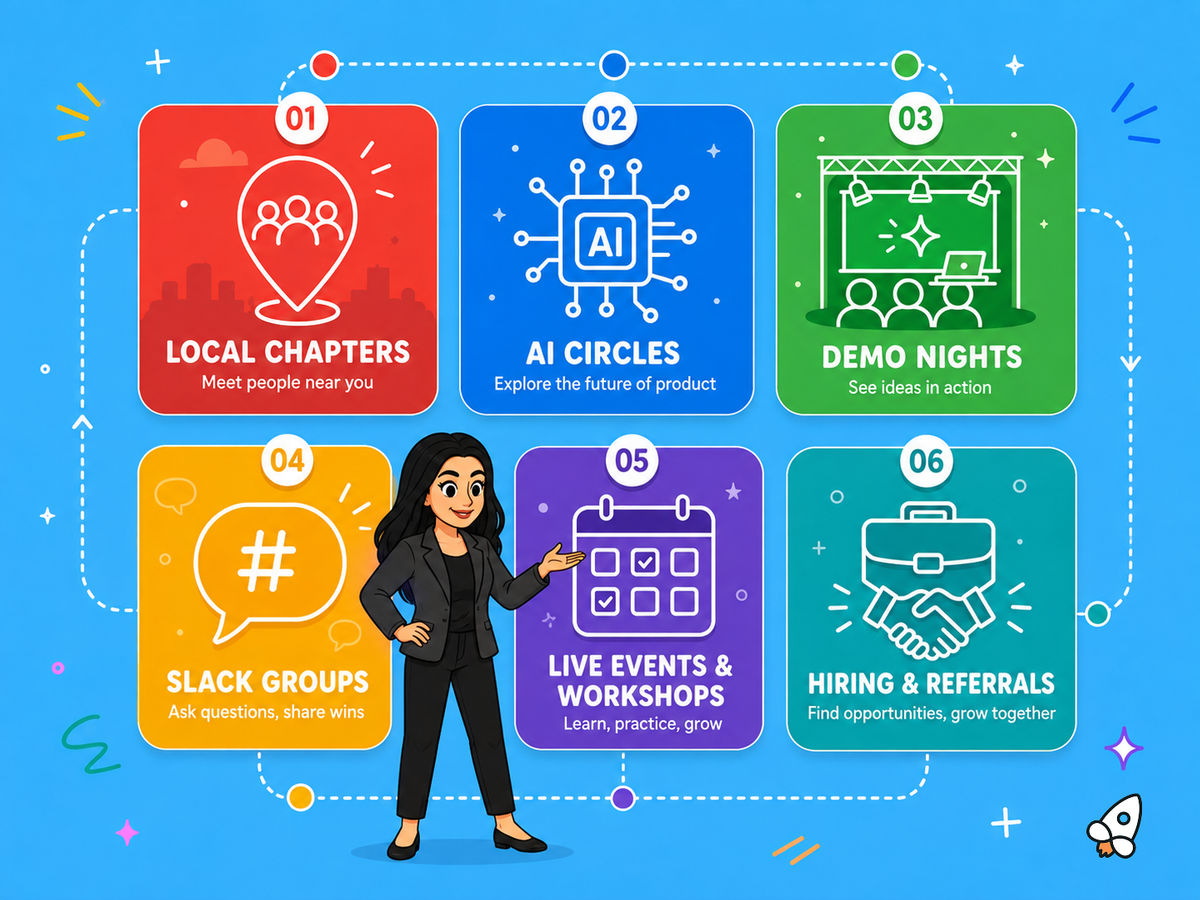
If you want more interviews, better contacts, and stronger product skills, you need to pick the right meetup format - not just attend random events. Referred candidates are 3–5x more likely to get interviews, and by 2026, 20% of PM job posts mention AI, up from 2% in 2023.
Here’s the short version:
- Product Management Society events: best for hiring access, mentors, and skill sessions
- Local PM meetups: best for steady local connections and repeat face time
- AI product circles: best for PM skills in the age of AI and higher-paying AI roles
- Founder and startup events: best for meeting decision-makers at early-stage companies
- Demo nights: best for seeing shipped work and showing how you think
- Slack and Discord groups: best for staying in touch after live events
A few points that stand out:
- AI can help find better-fit events, research speakers, and draft follow-ups
- But trust still happens in live conversations
- AI-focused PM roles can pay 30%–40% more
- Candidates with a prototype or teardown portfolio see 50% more recruiter callbacks
- Following up in 24–48 hours gives a better shot at turning a short chat into a next step
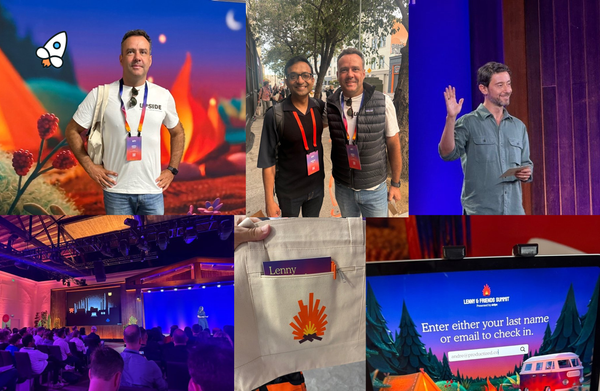
How to Grow Your Product Career by Melissa Perri at Lean Product Meetup
Quick Comparison
Meetup Type | Best For | Who I’ll Meet | Main Career Upside |
|---|---|---|---|
Job search and career growth | PMs, recruiters, founders | Hiring leads, mentors, repeat visibility | |
Local PM Meetups | Local network building | Local PMs, product owners, career-switchers | Referrals and peer support |
AI Product Circles | AI PMs, technical builders, hiring teams | AI role access and sharper domain knowledge | |
Founder and Startup Events | Startup roles | Founders, operators, senior PMs | Fast-moving hiring talks |
Demo Nights | Product judgment and portfolio talk | Builders, investors, PMs | Better stories, better follow-up |
Slack and Discord Communities | Staying connected | Event members, hiring managers, peers | Referrals, feedback, job leads |
If I had to sum it up in one line: the best meetup is the one that matches your current level, target role, and follow-up habit.
Why Product Meetups Matter More in the AI Era
AI is changing what makes a product manager worth hiring. As AI tools make routine work cheaper and faster, the human edge shifts to judgment, influence, and trust. You build those skills through peer learning and actual relationships, not just software.
In the AI era, the point of a meetup isn't just showing up. It's about building judgment, trust, and access.
"As execution gets cheaper, the critical skill becomes choosing what to execute." - Jenny Karuna, CPO, Katch
That shift makes in-person meetups MORE useful, not less. In 2026, 20% of PM job postings now mention AI, up from just 2% in 2023. That's a big jump. Meetups can help close that gap through peer learning. They also give you direct access to recruiters and hiring managers who show up with hiring in mind.
AI can help with the prep work. It can sort through event options, pull speaker details, and even draft follow-up notes. But the meetup itself is where trust gets built. And trust is what often turns a chat into a referral.
That's why the six meetup types below matter. Each one gives you a different way to learn, get seen, and open the door to referrals.
1. Product Management Society Events
Product Management Society runs 50+ in-person meetups a year and brings PMs, recruiters, and hiring managers into the same room, backed by a community of more than 2,400 members, from junior PMs to directors and founders. That mix matters. For PMs, it can mean faster access to mentors, referrals, and the people who make hiring calls.
"Many members report landing roles through PM Society connections." - Gabriela Naumnik, Founder, Product Management Society
These events lean into practical skills, not just small talk. Workshops on AI and discovery give people specific, useful topics to discuss. The group also offers a variety of online tools that help attendees apply workshop ideas to real product problems.
The value doesn’t stop when the meetup ends. After attending, members get access to post-meetup channels where the conversation keeps moving. People trade feedback, share support, and help each other stay on track. That’s where things often click: one chat can turn into repeated visibility over time. And that repeated visibility is what helps a single event grow into a longer-term network.
The Lisbon chapter has a 4.7/5 rating on Meetup, based on 197 ratings. Junior PMs can find mentors there, while senior PMs get peer-level strategy talks and more face time with hiring decision-makers.
2. Local Product Management Meetups and Chapter Communities
Local PM meetups put you in the same room with recruiters, hiring managers, and other PMs who can help turn a first hello into a warm intro. That’s why local chapters work so well for PMs who want steady visibility instead of one-off chats.
These groups also give you peer mentorship, accountability, and hands-on workshops around AI product strategy and discovery. In plain English: you’re not just meeting people. You’re building the AI product skills hiring teams expect now. And when the group keeps talking between events, those lessons tend to stick.
Between meetups, private Slack or WhatsApp groups often become the place where people swap job leads, get quick feedback, and compare compensation notes. That part matters a lot. The meetup opens the door, but what happens after usually makes the difference.
Follow up within 24–48 hours. Mention one specific detail from the conversation and share one relevant resource. It’s a small move, but it helps turn a short intro into an actual relationship.
3. AI Product Circles and Specialist Roundtables
If local PM meetups give you range, AI product circles give you depth. General meetups are great for meeting people across the field. But AI product circles tend to dig into the work itself. Instead of light after-work chatter, you get structured sessions on topics like model evaluation, AI-assisted prioritization, and OKR alignment.
That matters for another reason too: the people in the room. These events often draw hiring managers and recruiters, and those conversations can lead to warm introductions. AI-focused roles also pay 30% to 40% more than standard PM positions, so showing up in the right room can have a clear upside.
A June 2026 AI readiness roundtable, for example, walked attendees through why AI initiatives fail before launch and how to assess execution risk. That's the kind of session that gives you something useful to talk about with hiring managers right away. You're not stuck making vague small talk. You can discuss a shared framework, compare notes, and show how you think.
"AI reduces routine PM work; after 2026 PMs must focus on judgment, risk, and systems thinking while using AI for execution." - Product Management Society Meetup Member
What helps these roundtables stay useful is what happens after the event. Many groups share invite-only WhatsApp groups or private Slack channels on the spot. Those spaces often keep the conversation going with hiring talks, feedback on decision docs, and honest career discussions long after everyone leaves the room. For PMs aiming at AI-heavy roles, that kind of access is hard to ignore.
4. Founder and Startup Product Events
AI product groups tend to go deep on craft. Founder and startup events put you in front of the people who actually make the call. Because startup hiring moves faster, one strong conversation can turn into interviews sooner.
The format matters. Sessions like "Learning Product Management by Breaking Startups" or founder "war stories" panels give you a close look at how early-stage teams make decisions. You get to hear how founders weigh scope, cut features, and decide what matters most right now.
This is also where the "Builder PM" profile tends to show up: an AI-native PM who prototypes fast and works with a lot of independence.
After the event, follow up within 24 hours with a short product teardown or decision memo. It’s a simple way to show how you think and how you make calls.
From there, those connections often carry over into demo nights and accelerator demo days.
5. Demo Nights and Accelerator Demo Days
If founder events reveal how teams make decisions, demo nights reveal what they actually ship. That matters for hiring. Recruiters and hiring managers get to look at live products instead of just scanning resumes. In 2026, candidates who show a portfolio of prototypes or teardowns get a 50% increase in recruiter callback rates compared with those who rely on a standard resume alone.
What sets demo nights apart is the format. You’re seeing products presented live, in the moment, which makes it much easier to spot how a team thinks. Look for trade-offs, features they cut, and what changed after launch. That kind of judgment is often the line between a strong candidate and an average one, and demo nights give you a rare chance to see it up close.
These events also show you how AI products are built and judged. Watch for teams that can speak clearly about accuracy, fallbacks, and cost instead of just saying they “use an LLM.” Domain-specific AI products often show sharper customer understanding than generic wrappers. That gives you a better read on how AI-native teams think, not just what they put onstage.
After the event, move fast. Send a short note within 24 hours and mention one specific detail from a demo you saw. That small step can turn a quick chat into an actual contact, especially since many of the best conversations start after the presentations end.
6. Slack and Discord Communities Tied to Live Product Events
Demo nights and founder events get the conversation started. Slack and Discord keep it alive.
That’s the big draw here: continuity. You can come back days or even weeks later and pick up where things left off, without that awkward feeling of starting from zero. Follow-up stops being a one-off message and starts to feel more like steady networking.
Because everyone already shares the same live-event context, reaching out feels more natural than sending a cold connection request. Recruiters and hiring managers are often active in these spaces too, and plenty of members use them to look for referrals and hiring leads.
The hiring signal is usually tighter inside these groups. Dedicated hiring channels can surface roles before they’re posted in public. And if you share something like a product teardown or a decision doc in a peer review channel, you put your work in front of people who were in the same room and can give direct, useful feedback.
Product Management Society uses invite-only WhatsApp and Slack to keep event discussions active, share AI-focused resources, and connect members with peers and hiring leads.
One simple move: if an event host drops an invite-only WhatsApp, Slack or Discord link during a live session, join right away. These spaces are often invite-only, and they can give you direct access to speakers, hiring leads, and small peer groups. AI is also making it easier to find these communities and sort them by relevance, which is changing how PMs find the right rooms.
How AI Is Changing Meetup Discovery and Networking
Once you’re in the right rooms, AI can help you figure out which events deserve your time.
The biggest change shows up in event matching and attendee targeting. PMs now use AI to sort events by role, industry, location, and career stage instead of digging through generic listings. That level of targeting matters even more now that AI fluency is becoming a baseline expectation in PM hiring.
Before an event, PMs can use an LLM to pressure-test their story. After the event, voice-to-text tools can turn messy notes into clean follow-ups.
That matters because a short session summary can turn into public proof of work and a better follow-up. Sharing a decision memo or product teardown from a local PM meetup, AI roundtable, or demo night puts your thinking in front of people who were already there - and gives them a reason to reply.
Across all six meetup types, AI helps with event matching, prep, note-taking, follow-up, and proof of work.
AI can handle the filtering and the follow-up. The meetup still has to build the trust.
These patterns look different depending on the meetup type, which is why the next section compares them side by side.
Quick Comparison of the 6 Meetup Types
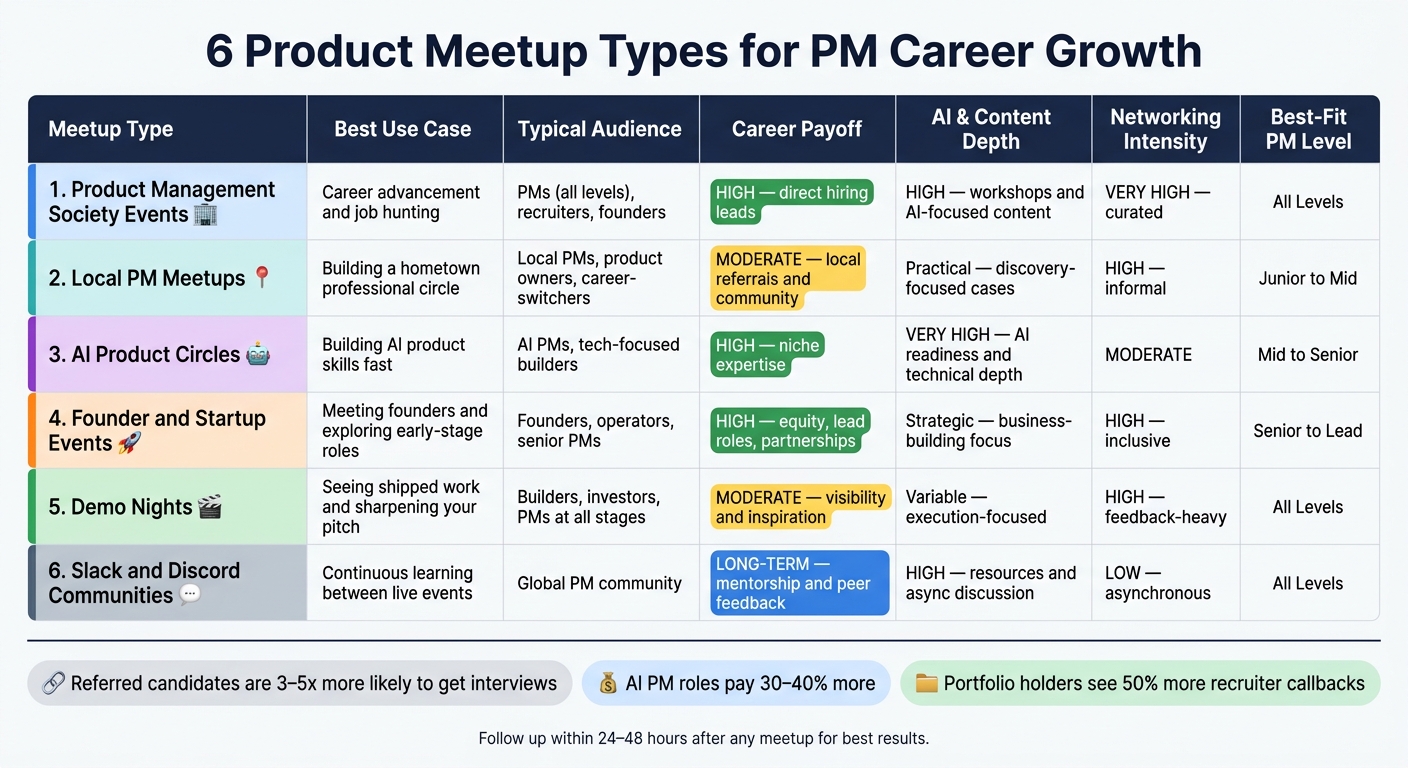
Not every meetup lines up with every career goal. The table below breaks each format down by use case, audience, and payoff, so it’s easier to pick the right room for where you are now and where you want to go.
Meetup Type | Best Use Case | Typical Audience | Career Payoff | AI & Content Depth | Networking Intensity | Best-Fit PM Level |
|---|---|---|---|---|---|---|
1. Product Management Society Events | Career advancement and job hunting | PMs (all levels), recruiters, founders | High - direct hiring leads | High - workshops and AI-focused content | Very High - curated | All Levels |
2. Local PM Meetups | Building a hometown professional circle | Local PMs, product owners, career-switchers | Moderate - local referrals and community | Practical - discovery-focused cases | High - informal | Junior to Mid |
3. AI Product Circles | Building AI product skills fast | AI PMs, tech-focused builders | High - niche expertise | Very High - AI readiness and technical depth | Moderate | Mid to Senior |
4. Founder and Startup Events | Meeting founders and exploring early-stage roles | Founders, operators, senior PMs | High - equity, lead roles, partnerships | Strategic - business-building focus | High - inclusive | Senior to Lead |
5. Demo Nights | Seeing shipped work and sharpening your pitch | Builders, investors, PMs at all stages | Moderate - visibility and inspiration | Variable - execution-focused | High - feedback-heavy | All Levels |
6. Slack and Discord Communities | Continuous learning between live events | Global PM community | Long-term - mentorship and peer feedback | High - resources and async discussion | Low - asynchronous | All Levels |
If you’re early in your PM career, put more attention on local meetups and demo nights. They’re often the easiest way to meet people, hear how teams work, and get comfortable talking about product in public.
Mid-level PMs should spend more time with AI Product Circles and Product Management Society Events. That’s usually where the sharper skill-building and stronger hiring signals show up.
Senior PMs will often get the most from founder and startup events, where conversations lean toward ownership, team building, equity, and bigger role scope.
AI already helps speed up this kind of matching. Next, it’s worth looking at how meetup discovery may change as recommendations get more personal.
What Meetup Discovery May Look Like Next
Once you’ve picked the right meetup type, the next edge is getting into the best-fit room faster.
Right now, finding the right meetup still takes manual work. But AI tools are starting to get better at predicting which events match your goals, based on who’s attending and whether the room lines up with what you want.
One of the most useful shifts ahead is pre-event attendee matching. Instead of walking in and hoping you meet the right people, future tools may point out specific attendees worth meeting before the event starts. That could include hiring managers, mentors, and other high-value contacts tied to your career path. In plain English, warm intros get a lot easier when you know who to look for before you even arrive.
These systems will likely improve on timing, too. Rather than forcing PMs to stitch the puzzle together by hand, they’ll start flagging the best event windows on their own.
But the bigger shift is about what these tools won’t replace. As Jenny Karuna, CPO at Katch, put it:
"As execution gets cheaper, the critical skill becomes choosing what to execute."
AI can help surface the right room and tighten your pitch before you walk in. What it can’t do is read the room, build trust in the moment, or make someone want to back you. That’s where judgment still matters most, especially for PMs who use AI to cut friction without handing over the decision-making.
Conclusion
There’s no single best meetup for every PM. Each format lines up with a different career goal. Local meetups tend to work well for early-career PMs. Society events and roundtables make more sense for mid-to-senior PMs. Founder and demo events often fit PMs aiming for startup roles. The right room depends on where you are now and where you want to go.
AI makes it easier to find better-fit events and show up with more context. It can help you get into the right room. But trust still comes from the live conversation. Use AI to prep faster so you can spend more time on the part that matters most: the conversation itself. Turn your experience into short situation-action-result stories, and draft follow-ups that mention specific moments from the conversation. But the relationship itself - the trust, the follow-through, the genuine back-and-forth - still takes you.
Networking works when you add value, follow through, and keep the conversation moving. One introduction usually doesn’t change much. The payoff comes from repeated, useful contact, not one-off introductions. Pick the right room, show up prepared, and keep showing up.
FAQs
Which meetup type best fits my PM career stage?
If you’re early in your PM career - APM or junior and still building core skills - local, curated in-person product management meetups are often the best place to start. You get a mix of peer networking and hands-on sessions around AI and product discovery, which makes the learning feel more concrete.
They can also help you meet experienced mentors and hiring managers in your area. That matters a lot if you’re looking for a job or trying to move into PM.
How can I use AI to find better product meetups?
AI can help you find better-fit product meetups faster. It can surface the right communities, track industry shifts, and line up event topics with your career goals.
That means you can spend less time digging through listings by hand and more time finding events where you can build useful skills, make meaningful connections, and keep up with the fast-changing AI space. You can also check the Product Management Society event hub for upcoming opportunities.
What should I do after a meetup to turn contacts into referrals?
Send a personal follow-up note that says thank you and mentions one specific thing you talked about. That small detail matters. It shows you were paying attention and helps you stand out from the sea of generic messages.
If you’re going after a company, connect with the hiring manager, a peer PM, and the recruiter you met. Then ask for a short 15-minute conversation about their team or product.
After that, share one specific takeaway and your resume. Between events, stay visible by checking in from time to time and adding useful comments in Slack or on public posts.
If you’re finding this blog valuable, consider sharing it with friends, or subscribing if you aren’t already. Also, consider coming to one of our Meetups and following us on LinkedIn ✨ And check out our official website.
Connect with the founder on LinkedIn. 🚀
About the Product Management Society
The Product Management Society is an international community for product managers, founders, designers, and career-switchers, with 2,400+ members across active chapters in Lisbon, Berlin, Frankfurt, and Mexico City. The community runs more than 50 in-person meetups per year, a Slack network, an invite-only WhatsApp group, a blog, and a growing suite of free tools for product leaders. More information is available at www.productmanagementsociety.com.
About Gabriela Naumnik
Gabriela Naumnik is an AI product leader and the founder of the Product Management Society. A Staff Product Manager working at the intersection of AI and enterprise product, she focuses on AI-powered platforms serving Fortune 500 companies. She is a regular speaker at product conferences, publishes on product management at the Product Management Society's blog, and has built the PM Society into one of the most influential product communities in Europe and Latin America. She holds a B.S. from NYU/NYU Shanghai and an M.S. from Columbia University. More information is available at gabriela-naumnik.com.