Best Practices for AI-Driven Resource Allocation
AI turns roadmap trade-offs into data-driven choices, automating prioritization, RICE scoring, and OKR alignment so teams focus on strategy.

AI-driven resource allocation is transforming how businesses assign resources, shifting from outdated manual methods to dynamic, data-informed systems. By analyzing real-time data and patterns, AI optimizes the distribution of human and technical resources, improving efficiency and decision-making across product management teams.
Here’s what you need to know:
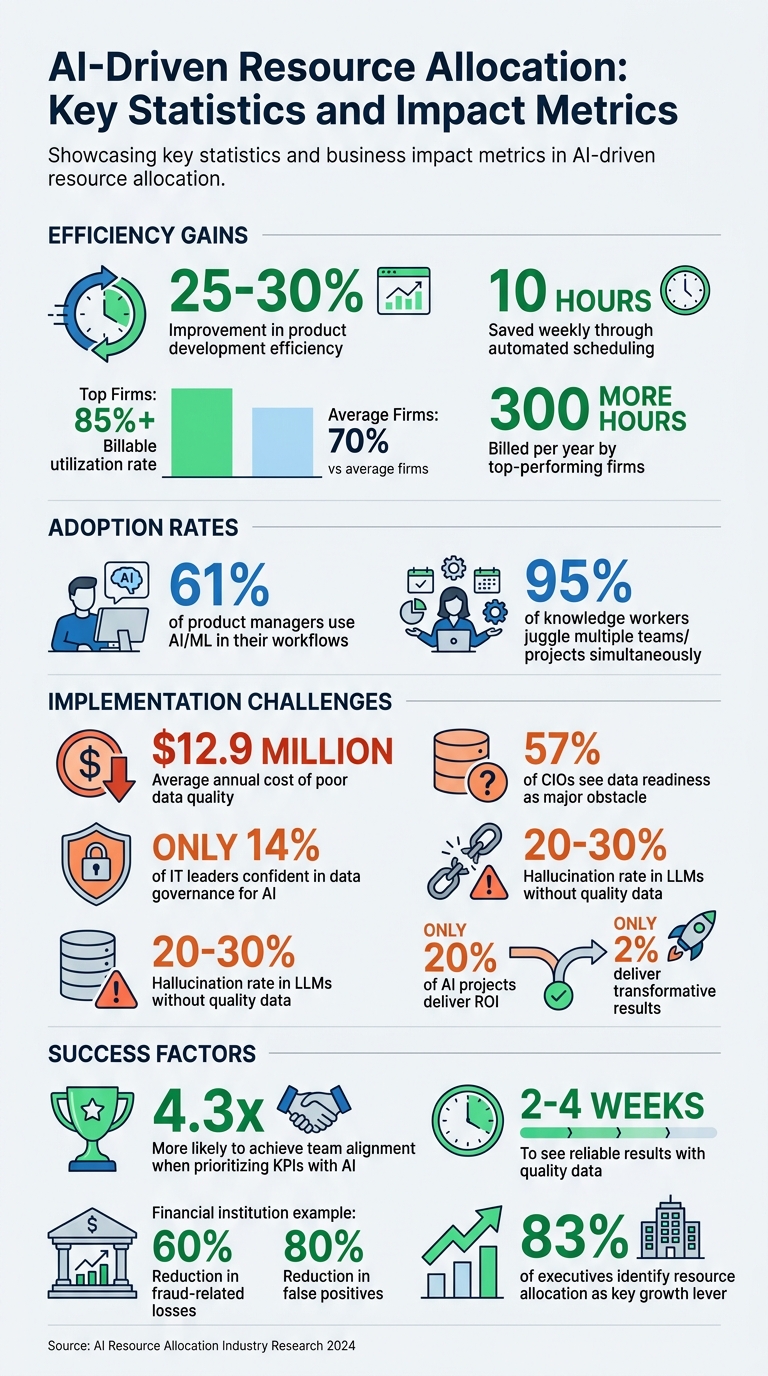
- Efficiency Boost: Companies report 25-30% improvements in product development and up to 10 hours saved weekly by automating scheduling tasks.
- Better Decisions: AI helps teams prioritize tasks using data-backed insights, reducing disagreements and improving alignment.
- Key Practices: Successful implementation depends on setting clear goals, maintaining high-quality data, leveraging predictive analytics, and encouraging collaboration.
This article explains how to implement AI-driven resource allocation effectively, covering goal-setting, data management, predictive analytics, and team collaboration. The right approach can help businesses stay ahead of market changes, allocate resources wisely, and achieve measurable results.
AI-Powered Capacity Planning: Full Resource Utilization in Tough Times
Setting Clear Goals and Metrics
Clear goals are the backbone of effective AI resource allocation. While AI can quickly generate data-driven insights to assist decision-making, it’s up to teams to define goals that truly matter. Without well-defined objectives, even the most advanced AI system risks becoming a tool in search of a purpose. Success hinges on establishing clear criteria that separate actionable AI strategies from aimless reporting.
Start by setting SMART goals to give your AI initiatives a clear direction:
- Specific: Clearly define the desired outcome. For instance, aim for "reducing time-to-hire for engineering roles by 40%" instead of targeting vague improvements in recruitment.
- Measurable: Identify the data source and assign ownership to ensure accountability.
- Achievable: Base targets on real baseline data and available resources, avoiding overly optimistic projections.
- Relevant: Tie goals directly to company OKRs to ensure they contribute to overall business priorities. Bryan Schuldt, Co-Founder of Tability, warns against "superficial planning" where well-crafted goals fail to drive real value.
- Time-bound: Set a clear deadline, like the end of Q2, and schedule regular check-ins to monitor progress.
"AI can write a SMART goal. Your team still needs to make it true." - Bryan Schuldt, Co-Founder, Tability
When tracking progress, focus on leading indicators - metrics you can influence in the short term - rather than solely relying on lagging outcomes measured quarterly. For example, monitor "onboarding steps completed" weekly instead of waiting for the annual "retention rate" metric. AI can help by generating three goal versions - conservative, realistic, and ambitious - so you can evaluate trade-offs in light of budget and technical constraints.
Once goals are in place, align them with precise KPIs that measure both technical performance and business outcomes. A balanced approach is key: combine technical metrics like GPU utilization with business-focused indicators like cost savings or customer satisfaction. Research shows that organizations prioritizing KPIs with AI are 4.3 times more likely to achieve alignment across teams.
Examples of KPI Categories and Metrics
KPI Category | Specific Metric Examples | Purpose |
|---|---|---|
Efficiency | Reduction in manual processing time; Increase in automated transactions | Measures operational improvements |
System Quality | GPU/TPU utilization; Token throughput; Model latency | Tracks infrastructure health and cost efficiency |
Business Impact | Revenue per visit (RPV); Cost savings; Customer churn rate | Quantifies financial performance |
Adoption | Frequency of use; Query length; Thumbs up/down feedback | Assesses user engagement and tool value |
Fairness | Reduction in biased outcomes; Model transparency/explainability | Ensures ethical compliance and trustworthiness |
For example, a financial institution using AI for fraud detection achieved impressive results by defining clear KPIs. They reduced fraud-related losses by 60% and cut false positives by 80%. This demonstrates how well-chosen metrics can drive impactful outcomes, balancing technical precision with tangible business benefits.
Ensuring Data Quality and Integrity
Once your goals are defined, maintaining high-quality data becomes critical to making AI-driven resource allocation effective.
AI systems rely on clean, consistent data to function properly. Poor data quality costs businesses an average of $12.9 million annually - a staggering figure that highlights the risks of unreliable data. Without accurate inputs, AI analytics can produce flawed insights, leading to wasted resources, missed deadlines, and a loss of trust from stakeholders.
The challenge is widespread. Only 14% of IT leaders feel confident that their data and content are adequately governed for AI, while 57% of CIOs see data readiness as a major obstacle to unlocking AI's potential. Additionally, Large Language Models (LLMs) are prone to generating inaccurate outputs - known as hallucinations - in 20–30% of cases when not grounded in solid data.
"A business's most defensible competitive 'moat' lies within its proprietary data assets." - Sanjeev Mohan, Principal, SanjMo
Implementing Data Management Policies
Strong data governance begins with data discovery and profiling. This involves identifying your data assets, their formats, and relationships, while analyzing factors like uniqueness and sensitivity. Such analysis can reveal hidden trends or data inconsistencies that might otherwise go unnoticed.
Create data contracts that specify key attributes and service level agreements (SLAs) for each data source. For instance, your HR system should always provide accurate team availability, while your project management tool must deliver up-to-date task statuses. Assign data stewards - dedicated individuals responsible for maintaining data quality and overseeing cleansing processes - to ensure ongoing reliability.
Incorporate real-time data observability to monitor pipelines for anomalies, errors, or performance drops before they affect AI decisions. Tracking data lineage - the journey of data from its origin to its final destination - enables teams to understand why an AI system made a specific decision and quickly address any issues.
With these governance measures in place, attention can shift to organizing and refining historical data, a crucial step for accurate AI predictions.
Cleaning and Organizing Historical Data
Historical data plays a key role in helping AI identify patterns related to team skills, project needs, and past outcomes. Start by using data profiling algorithms to evaluate factors like uniqueness, value ranges, and cardinality. These algorithms also help spot missing values, duplicates, or inconsistencies that could distort AI predictions. For example, ensuring that team availability data is current and that project tasks are fully documented is essential for reliable resource allocation.
Standardize and integrate data from multiple sources, using automated quality rules to identify and correct discrepancies. This ensures that historical data accurately reflects present conditions. For example, align resource costs across HR and Finance systems, reconcile project timelines across tools, and adopt uniform naming conventions for skills and roles.
To streamline data management, apply data minimization by eliminating redundant copies, which not only improves efficiency but also reduces exposure to potential security risks, as required by regulations like the GDPR. For unstructured data, such as team feedback or project reviews, use data chunking to break the information into smaller, context-preserving units that AI can process more effectively.
Most AI resource allocation tools start delivering reliable results within 2–4 weeks of being connected to high-quality, well-organized data. This underscores the importance of investing time and effort into cleaning and structuring your data properly.
Using Predictive Analytics and Automation
When you combine high-quality data with clear performance metrics, predictive analytics and automation can transform how resources are allocated. With clean data as the foundation, AI steps in to predict resource needs and manage scheduling tasks that would otherwise demand hours of manual effort.
Predictive analytics shifts teams from reacting to problems to planning ahead. By analyzing historical patterns - like user feedback, sales trends, and project results - AI can forecast how features will perform. This allows teams to allocate engineering time and budgets more effectively. In fact, companies have seen a 25–30% boost in efficiency, with 61% of product managers now using AI to prioritize backlogs.
"With generative AI and GPTs, it's just been much more powerful, much smarter, and much faster." - Cem Kansu, VP of Product, Duolingo
Using Predictive Analytics for Forecasting
AI can find patterns across scattered data sources - like user feedback, surveys, and analytics - that might go unnoticed by humans. This capability allows teams to prioritize roadmap items based on their expected business impact, rather than relying on subjective opinions. For instance, predictive models can identify which features are likely to boost retention or revenue, ensuring top developers are assigned to the most impactful projects.
Unlike static roadmaps that might remain unchanged for months, AI-driven systems adjust priorities weekly as new data becomes available. This ensures resources are aligned with the latest market demands instead of outdated plans. Predictive modeling also helps forecast future demand by analyzing past sales and customer behavior. This ensures that budgets and workforce efforts are allocated where they’re needed most. Once forecasts are in place, AI can streamline workflows by automating scheduling tasks.
Automating Resource Scheduling
Scheduling manually becomes a nightmare when 95% of knowledge workers are juggling multiple teams and projects simultaneously. AI simplifies this chaos with "Auto Schedule" algorithms, which turn task lists into actionable project schedules. These schedules include realistic estimates, resource assignments, and deadlines - all informed by past performance data.
AI also enables skill-based matching, pairing team members with tasks based on their expertise, availability, and previous work. Real-time availability heat maps help managers avoid overloading employees. Top-performing firms, thanks to efficient resource planning, hit billable utilization rates of 85% or higher, while average firms hover around 70%. This difference means consultants at top firms bill about 300 more hours per year than their average counterparts.
Additionally, Robotic Process Automation (RPA) takes over repetitive tasks like status updates and calendar management, freeing project managers to focus on strategic decisions. To succeed with automation, it’s wise to start small - test with range estimates and low-risk pilot projects to demonstrate value before scaling up.
Promoting Collaboration and Continuous Improvement
Even the most advanced AI systems need human guidance. The best results in resource allocation come when cross-functional teams work together to set boundaries, interpret AI outputs, and refine systems over time. Without this kind of oversight, AI can unintentionally amplify biases or stray from strategic goals as market conditions change.
Building Cross-Team Collaboration
AI simplifies cross-team negotiations by replacing guesswork and subjective opinions with consistent, data-driven insights. Metrics like customer needs, business impact, and effort take center stage, moving discussions away from internal politics. For example, a clear projection showing that Feature X could boost retention by 6% helps teams align and justify their roadmap decisions.
AI-powered tools also provide a broader view, showing how a feature in one product line might influence timelines in another. This allows leaders to make smarter, enterprise-wide decisions about resource allocation. Take Vercel, for instance - they improved decision-making and coordination across product teams by adopting a centralized development hub and fostering a community focused on shared best practices. To achieve similar results, consider creating a community of practice where stakeholders from different areas can exchange AI strategies and ensure ethical and coordinated governance. Additionally, use AI for dependency mapping to identify potential blockers between teams early on.
This kind of collaborative approach naturally supports the ongoing need to maintain AI accuracy, especially as market needs shift.
Regularly Updating AI Models
Collaboration is crucial, but keeping AI models updated is just as important to sustain their effectiveness. Clean data and precise forecasting are critical, but so is the continuous adjustment of the models themselves.
AI systems must be regularly fine-tuned to stay relevant, especially since only 20% of AI initiatives achieve ROI, and just 2% deliver transformative results. Embedding feedback loops into AI systems ensures they remain aligned with changing market trends. For instance, introducing structured randomization can address uncertainties and reduce the risk of systematic exclusion.
"There is a balance to be had between overall utility and respecting the rights of the individuals who are receiving a scarce resource, but oftentimes the tradeoff is relatively small." - Ashia Wilson, Professor, MIT Department of Electrical Engineering and Computer Science
Regularly reviewing resource usage metrics can uncover patterns and highlight areas for improvement. When external factors or market conditions shift, reassess the AI's allocation strategies. Think of AI as a decision-making partner - it handles the heavy lifting of data analysis, while humans provide the vision and nuanced judgment. If the system makes a poor recommendation, flag it immediately for retraining.
Conclusion
AI-powered resource allocation enhances decision-making by combining human expertise with data-driven insights. Companies that have implemented these strategies report a 25-30% improvement in product development efficiency, translating into measurable gains in performance and productivity.
These results highlight the importance of precise execution. Achieving success requires balancing the predictive capabilities of AI with human oversight. While 61% of product managers already integrate AI or machine learning into their workflows, only 20% of AI projects deliver a return on investment. To bridge this gap, organizations must focus on the core principles discussed earlier: setting clear goals, ensuring high-quality data, consistently updating models, and fostering strong collaboration across teams.
"What we need to be doing is planning for outcomes. Treat your plans as a series of hypotheses you're going to test - through rapid prototyping." - Rob Seaman, CPO, Slack
AI models demand ongoing care. Allocate 20-30% of resources to retraining and monitoring for drift to maintain their effectiveness over time. Establish clear exit criteria from the outset to avoid falling into the sunk cost trap, and diversify data sources to minimize bias. These steps are critical for building a foundation of sustainable success.
Organizations that succeed treat AI as a strategic partner, not a quick fix. With 83% of executives identifying resource allocation as the key lever for driving growth, adopting these practices isn’t just about improving efficiency - it’s about securing a competitive edge in today’s data-driven world.
FAQs
What data is needed before using AI for resource allocation?
To make the most of AI for resource allocation, start by collecting key data points. This includes information on work patterns, task completion times, team capacity, scheduled time off, recurring meetings, and historical workloads. With this data, AI can assist in predictive capacity modeling and pinpoint areas where resources might be stretched too thin.
How do we pick the right KPIs for AI-based allocation?
When selecting KPIs for AI-based resource allocation, it's crucial to focus on specific, measurable goals that align with your organization’s priorities. For instance, you might aim to boost productivity, cut operational costs, or streamline workflows. These KPIs should directly reflect what success looks like for your business.
Once you've defined them, keep a close eye on these metrics. Regular monitoring ensures the AI system is truly optimizing resources and delivering the results you’re targeting. This ongoing evaluation helps you stay on track and make adjustments as needed.
How can we prevent AI allocation from becoming biased or outdated?
To ensure AI systems are fair and current, start with high-quality, representative data. This means using datasets that reflect the diversity of the real world, reducing the risk of bias creeping into the system. Pair this with fairness-aware algorithms designed to identify and minimize disparities in decision-making.
It's also essential to regularly audit models for bias. By reviewing how the AI operates over time, you can catch and address any unintended biases that may emerge. Additionally, having diverse oversight committees - groups made up of individuals with varied backgrounds and perspectives - helps ensure fairness and relevance are consistently evaluated.
These steps collectively promote responsible decision-making and keep AI systems aligned with current standards and societal expectations.
If you’re finding this blog valuable, consider sharing it with friends, or subscribing if you aren’t already. Also, consider coming to one of our Meetups and following us on LinkedIn ✨ And check out our official website.
About the Product Management Society
The Product Management Society is an international community for product managers, founders, designers, and career-switchers, with 2,400+ members across active chapters in Lisbon, Berlin, Frankfurt, and Mexico City. The community runs more than 50 in-person meetups per year, a Slack network, an invite-only WhatsApp group, a blog, and a growing suite of free tools for product leaders. More information is available at www.productmanagementsociety.com.
About Gabriela Naumnik
Gabriela Naumnik is an AI product leader and the founder of the Product Management Society. She is a regular speaker at product conferences, publishes on product management at the Product Management Society's blog, and has built the PM Society into one of the most influential product communities in Europe and Latin America. She holds a B.S. from NYU/NYU Shanghai and an M.S. from Columbia University. More information is available at gabriela-naumnik.com.